How to turn an AI tool into a real business
TL;DR
Lovable makes it possible to build real businesses without coding, by moving from demo vibes to a serious platform that handles data, apps, and agents. Start by doing things manually, then break problems into testable pieces, iterate, and scale with a product that blends services and goods for real-world use. The key is disciplined iteration.
Transcript
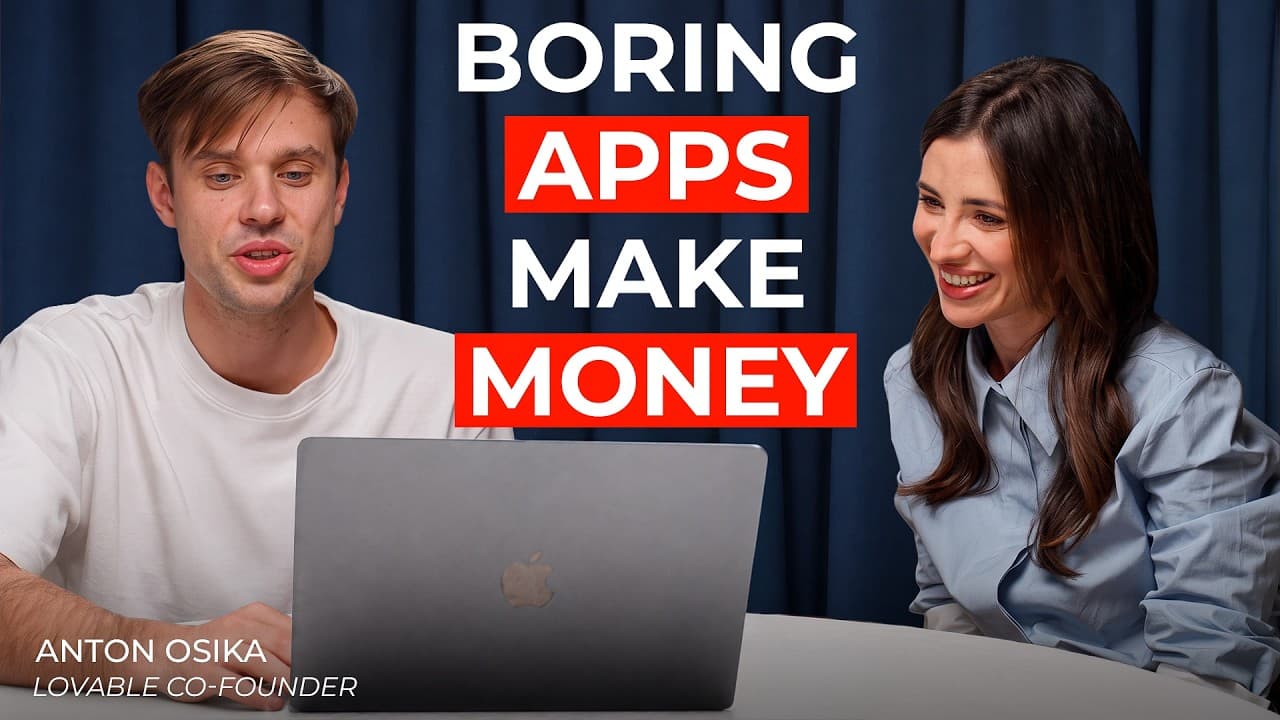
We're abandoning the word [music] vibe coding. >> Yeah, Vibe works for demo, but we're way past that. You don't build your company on Vibes. >> This is Anton Oika. He launched Lovable, where anyone can build an app without code. Less than 2 years [music] later, the company is worth 13 billion. Together, apps built on Lovable now get [music] nearly ... Read More
Key Insights
- App and agent integration is central to Lovable’s value, allowing data to drive automated workflows while users observe and steer the process in real time.
- The path to a scalable AI business starts with manual steps to understand the problem, then decomposing it into testable components to avoid overengineering from the outset.
- Founders with hands-on experience and a deep understanding of their problem space are more likely to build successful ventures on Lovable, as they can translate domain knowledge into practical AI solutions.
- The most successful ideas blend real-world services with products, creating solutions that are not purely internet based and that can be monetized through customer value.
- Aiming for rapid iteration while maintaining quality is emphasized, as maximal perfection can stall progress; test small parts and iterate toward a stronger final product.
- Lovable supports “agent integrations” to let apps act as intelligent assistants, combining data and AI prompts for more powerful automation.
- The conversation suggests that the next three years will favor entrepreneurs who can automate everyday tasks with AI, turning manual routines into scalable processes.
- Creativity and prompt engineering are highlighted as core skills, with ongoing learning about how to train one’s own creativity to generate more effective AI workflows.
Install to Summarize YouTube Videos and Get Transcripts
Explore YouTube Video Summarizer or Get YouTube Transcript Extractor
Questions & Answers
Q: What is Lovable and why is it changing how people build software?
Lovable is presented as a platform that lets people build apps without traditional coding, enabling them to run real businesses on the same system. The interview argues that vibes and demos are insufficient for a growing company, and that a serious platform is needed to manage data, apps, and agents. This shift lowers barriers to entry and accelerates experimentation, while still requiring disciplined iteration to reach revenue and scale.
Q: How should a founder approach solving a big problem according to the interview?
The suggested approach is to start by doing things manually to understand the process, then break the problem down into smaller, testable steps. If something is broken, identify the smallest part that can be tested, iterate toward improvement, and avoid overengineering from the outset. This method helps validate value before building automated systems.
Q: Who is best positioned to start a business right now, based on the discussion?
The interview notes that many successful Lovable users are experienced professionals with more than 11 years in their field, who are closest to the problems they want to solve. However, younger entrepreneurs also appear, bringing fresh perspectives. Across demographics and geographies, serious projects emerge when a real problem is recognized and a viable path to revenue is identified.
Q: What top opportunities does Anton Osika see for building today?
The guidance is to solve real world problems that combine services and products rather than focusing solely online. Personalization and practical integration into daily tasks, like groceries or home management, are highlighted as fertile ground. The key is to find problems people care about and present exciting, usable solutions rather than reinventing technology for its own sake.
Q: What is the recommended status of an entrepreneur starting out with AI?
The recommendation is to start with a clear problem, test a basic solution, and then expand gradually. It emphasizes learning by doing and iterating with prompts and agent integrations. The process involves early, tangible outcomes and a plan to scale as the product proves value and gains customer traction.
Q: What role does creating an agent play in personal productivity according to the episode?
Building an agent is framed as a way to automate routine knowledge worker tasks, giving a direct path to more efficient workflows. The activity helps individuals understand how agents operate, which in turn informs better design of tools and processes. This aligns with the broader theme of moving from manual work to AI-assisted automation.
Q: How important is user feedback and testing in Lovable’s approach?
User feedback is described as crucial, with a process that includes testing multiple users and refining prompts, data flows, and interfaces. The show promotes talking to potential users early and often, iterating on the product based on real experiences rather than theoretical assumptions. The approach minimizes risk while accelerating product-market fit.
Q: What is the long term value of combining apps and agents on Lovable?
The long term value lies in the ability to create cohesive systems where data drives intelligent actions through agents and apps. This combination enables scalable automation across tasks and workflows, leading to more efficient operations and clearer paths to monetization. The framework supports building a business around practical, repeatable AI-enabled processes.
Summary & Key Takeaways
-
Lovable enables business building without coding and emphasizes moving beyond demos to operate real customer-facing apps and services. The founder discusses breaking large problems into manageable steps, testing iteratively, and choosing between app and agent integrations to manage data and workflows efficiently.
-
The conversation stresses that real entrepreneurs come from people already close to problems, with experience across industries, and that AI tools are most valuable when they solve tangible world needs rather than purely online tasks.
-
A practical framework emerges: build a personal agent, connect it to data via Lovable, and design a workflow that combines a product and service to achieve practical outcomes, all while considering SEO and branding adjustments later.
Read in Other Languages (beta)
Share This Summary 📚
Summarize YouTube Videos and Get Video Transcripts with 1-Click
Try YouTube Summary with ChatGPT & Claude or YouTube Transcript Generator
Explore More Summaries from Silicon Valley Girl 📚


Summarize YouTube Videos and Get Video Transcripts with 1-Click
Try YouTube Summary with ChatGPT & Claude or YouTube Transcript Generator