How Does Poor Sleep Cause Insulin Resistance?
TL;DR
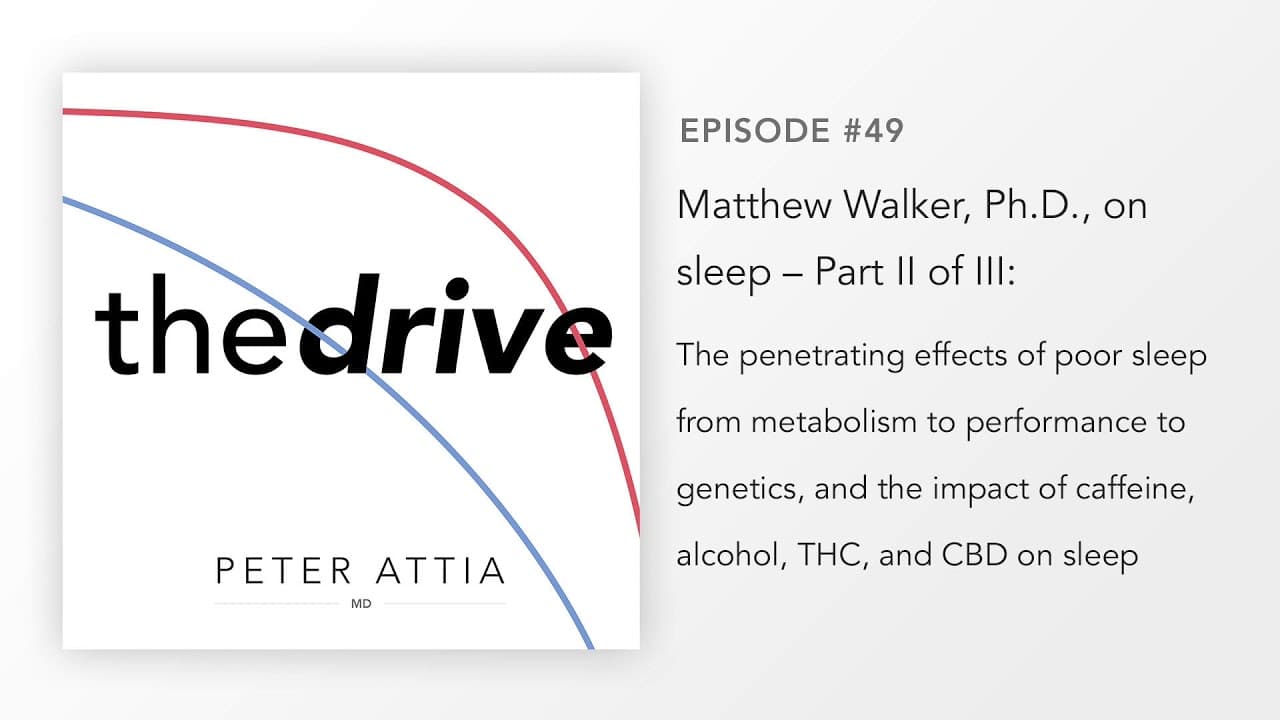
Restricting healthy people to just four hours of sleep for two weeks cut their ability to move glucose into muscle by roughly half, pushing them toward a pre-diabetic state despite no diet or exercise changes. Sleep loss disrupts glucose homeostasis by impairing how pancreatic beta cells release insulin and how the body's cells absorb blood sugar.
Transcript
hey everyone welcome to the Peter Atia drive I'm your host Peter Atia the drive is a result of my hunger for optimizing performance health longevity critical thinking along with a few other obsessions along the way I've spent the last several years working with some of the most successful top performing individuals in the world and this podcast is ... Read More
Key Insights
- Sleep deprivation dramatically reduces the body's ability to dispose of glucose into muscle, a change Matthew Walker calls one of the most important physiologic functions, effectively mimicking metabolic disease in previously healthy people.
- The euglycemic clamp is described as the gold standard for measuring insulin resistance, injecting glucose and insulin while holding blood glucose steady by titrating insulin to reveal how well the body handles sugar.
- A University of Chicago study restricted subjects to four hours of sleep per night for two weeks and found a roughly fifty percent reduction in their capacity to put glucose into their muscles.
- The insulin-resistance finding has been replicated at four, five, and six hours of sleep across a single week, showing even modest short-term sleep restriction damages glucose control.
- Healthy individuals with no signs of diabetes can be driven into what looks like a pre-diabetic state after only about a week of insufficient sleep, potentially warranting a metformin prescription based on their readings alone.
- Peter Attia attributes his own weight gain, insulin resistance, and low testosterone during medical residency largely to chronic sleep deprivation rather than diet, since he exercised intensely throughout that period.
- Exercise alone cannot offset the metabolic damage of severe sleep loss, as Attia's heavy training during residency failed to protect his glucose tolerance or hormonal profile.
- Glucose homeostasis depends on pancreatic beta cells sensing a blood-sugar spike and releasing insulin, which then signals the body's cells to absorb glucose and prevent a dangerous rise; sleep loss disrupts this chain.
Install to Summarize YouTube Videos and Get Transcripts
Explore YouTube Video Summarizer or Get YouTube Transcript Extractor
Questions & Answers
Q: How does lack of sleep cause insulin resistance?
Insufficient sleep disrupts glucose homeostasis, which depends on pancreatic beta cells sensing a spike in blood sugar and releasing insulin, and on the body's cells then absorbing that glucose. Sleep loss interferes with this process, so glucose is no longer cleared from the bloodstream into muscle efficiently. In a controlled study, sleep-deprived subjects lost roughly half their ability to dispose of glucose into muscle, effectively mimicking a diseased metabolic state in previously healthy people.
Q: What did the University of Chicago sleep study find?
The study restricted subjects to four hours of sleep per night for two weeks, then used a euglycemic clamp, the gold standard for measuring insulin resistance, to test glucose disposal. Subjects suffered roughly a fifty percent reduction in their ability to put glucose into their muscles. Because glucose disposal into muscle ranks among the most important physiologic functions, this represented a profound metabolic impairment produced purely by sleep restriction, without any change in diet or activity.
Q: What is a euglycemic clamp and why does it matter?
A euglycemic clamp is described as a rigorous, gold-standard test for measuring insulin resistance. Researchers inject glucose and insulin into the subject and keep the blood glucose level steady by titrating the insulin dose. This elegantly measures one of the most important features of metabolism, namely how well the body disposes of glucose, primarily into the muscle. Because it holds glucose constant while adjusting insulin, it precisely reveals how much insulin is needed to clear sugar, exposing insulin resistance.
Q: Can just one week of short sleep affect blood sugar?
Yes. Walker notes the insulin-resistance effect has been replicated at four, five, and six hours of sleep across a single week. Taking healthy individuals who show no signs of diabetes and limiting them to about five hours of sleep for one week can produce readings that resemble a pre-diabetic state. Attia says that if a clinician read those end-of-week results without knowing the experiment, they might conclude the person was pre-diabetic and consider prescribing metformin.
Q: Why did Peter Attia think sleep caused his metabolic problems?
Attia describes being metabolically deranged at the end of his residency, with weight gain, insulin resistance, and low testosterone. He initially blamed cafeteria food, but realized sleep deprivation was the real driver. Crucially, he exercised intensely throughout residency, so a lack of exercise was not the cause. Despite training that should have strongly benefited his metabolism, he believes a glucose tolerance test then would have been badly impaired, pointing to chronic sleep loss as the primary factor.
Q: Can exercise protect you from the metabolic effects of poor sleep?
According to Attia's experience, exercise alone cannot fully offset severe sleep deprivation. Throughout his demanding residency he managed to exercise like crazy, yet still developed weight gain, insulin resistance, and low testosterone. He argues that despite the powerful positive effect training should have on the metabolic system, his glucose handling would still have tested very poorly. This suggests that sleep loss can override the metabolic benefits normally gained from consistent, intense physical activity.
Q: How does the body normally regulate blood sugar?
Glucose regulation, or glucose homeostasis, involves at least two major steps. First, beta cells in the pancreas must sense a spike in blood sugar and release insulin. Second, that released insulin signals the cells of the body to reach out and absorb the blood glucose. This absorption prevents an otherwise dangerous spike in blood sugar. Both steps, insulin release and cellular uptake, must happen properly, and sleep deprivation disrupts this coordinated system.
Q: How much glucose is actually in the bloodstream compared to the body?
Attia explains that the amount of glucose circulating in the bloodstream is trivial compared with what is stored in the muscles and liver. A normal blood sugar level corresponds to only about a teaspoon's worth of glucose in the blood, and even frank diabetes corresponds to just a couple of teaspoons. Because so little glucose is in circulation while muscle and liver hold far more, losing a large share of the ability to store glucose in muscle is metabolically devastating.
Q: What topics does the final part of the Matthew Walker sleep series cover?
This is part three of three of the Matthew Walker sleep series on the Peter Attia Drive. It examines the wide-ranging effects of insufficient sleep on metabolism, insulin resistance, appetite, food choices, athletic and exercise performance, decision-making, workplace productivity, leadership, and genetics. It also covers the impact of caffeine and alcohol on sleep quality, the efficacy of THC and CBD as sleep aids, the two-way link between sleep and mental health, memory, and Walker's projects, closing with Formula One drivers.
Summary & Key Takeaways
-
In the final part of the Matthew Walker sleep series on the Peter Attia Drive, the two examine how insufficient sleep devastates metabolism. A carefully controlled University of Chicago study restricted subjects to four hours of sleep for two weeks, then measured glucose disposal with a euglycemic clamp.
-
The study found subjects lost roughly half their ability to move glucose into muscle, one of the body's most vital metabolic tasks. The effect has been replicated at four, five, and six hours across a single week, and it can push otherwise healthy people toward a pre-diabetic state.
-
Attia links his residency-era weight gain, insulin resistance, and low testosterone to sleep loss rather than food or inactivity. Walker explains the mechanism: pancreatic beta cells must sense rising blood sugar and release insulin, which signals cells to absorb glucose and prevent dangerous spikes.
Read in Other Languages (beta)
Share This Summary 📚
Summarize YouTube Videos and Get Video Transcripts with 1-Click
Try YouTube Summary with ChatGPT & Claude or YouTube Transcript Generator
Explore More Summaries from Peter Attia MD 📚




Summarize YouTube Videos and Get Video Transcripts with 1-Click
Try YouTube Summary with ChatGPT & Claude or YouTube Transcript Generator