What Are the Seven Components of Pushdown Automata?
TL;DR
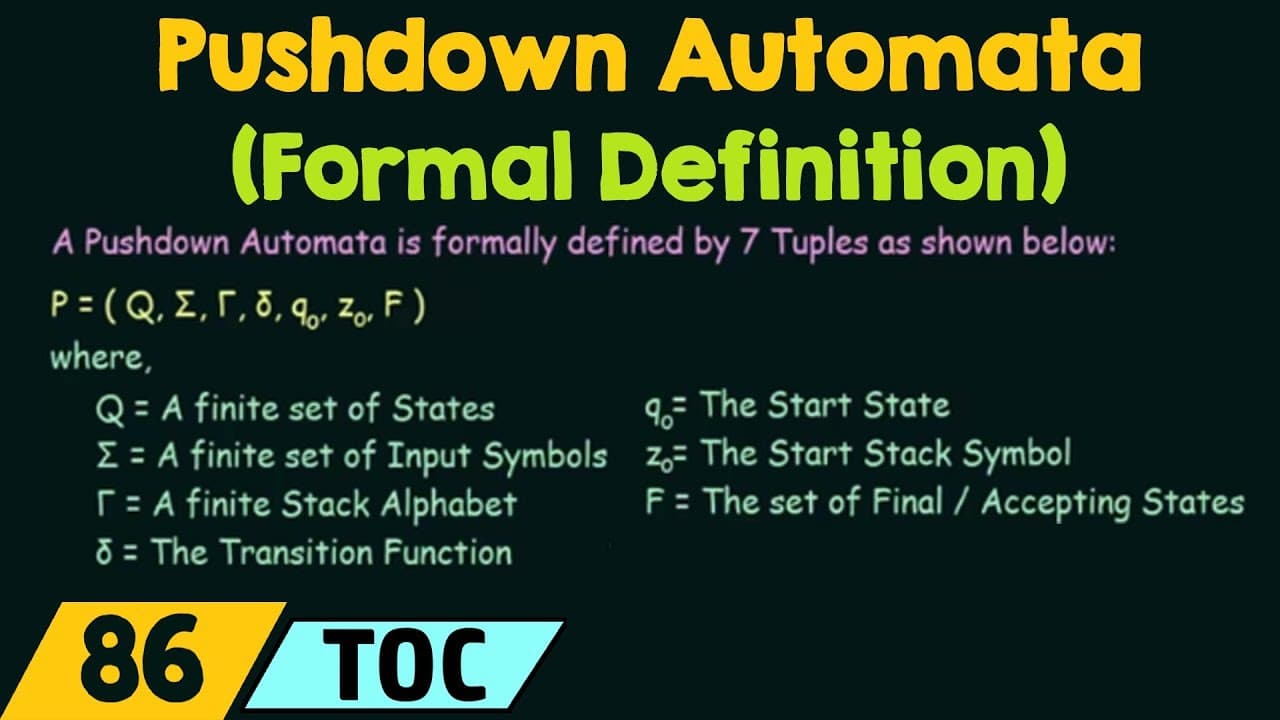
Pushdown automata are defined by seven components, including states, input symbols, a stack alphabet, a transition function, a start state, a start stack symbol, and final states. The transition function processes three elements—current state, input symbol, and stack symbol—and generates a new state alongside modifications to the stack, showcasing operations like popping, maintaining the stack, and pushing new symbols.
Transcript
in the last lecture we have started studying about pushed on automata and we have also seen a brief introduction to push down automata and in this lecture we will be seeing about the formal definition of pushed on automata and we shall see how push down automata is formally defined and what they mean alright so a pushed on automata is formally defi... Read More
Key Insights
- 📚 A pushdown automata is formally defined by seven tuples (Q, Σ, Γ, δ, q0, z0, F) that represent sets and symbols used in the automata.
- 🔠 Q is a finite set of states, Σ is a finite set of input symbols, and Γ is a finite stack alphabet, which differentiates a pushdown automata from a finite automata.
- 🔄 The transition function δ takes three arguments: Q, a, and X. Q is a state, a can be an input symbol or an empty symbol, and X is a stack symbol.
- 🔁 The output of the transition function δ is a pair (P, γ) where P is a new state and γ is a string of stack symbols that replaces X at the top of the stack.
- ☑️ If γ equals ε, the stack is popped and becomes empty. If γ equals X, the stack remains unchanged. If γ equals YZ, X is replaced by Z and Y is pushed onto the stack.
- ⛔️ A pushdown automata has the presence of a stack, making it more powerful than a finite automata.
- ✅ The start state is defined as q0, and the start stack symbol is represented by z0. F represents the set of final or accepting states.
- 📝 Understanding the formal definition of pushdown automata is important for studying and analyzing its behavior and capabilities.
Install to Summarize YouTube Videos and Get Transcripts
Explore YouTube Video Summarizer or Get YouTube Transcript Extractor
Questions & Answers
Q: What are the key elements in the formal definition of pushdown automata?
The formal definition of pushdown automata includes seven tuples, which define the states, input symbols, stack alphabet, transition function, start state, start stack symbol, and final states. These elements work together to describe the behavior of pushdown automata.
Q: How does the transition function work in a pushdown automaton?
The transition function in a pushdown automaton takes three arguments: the current state, an input symbol, and a stack symbol. It then produces a new state and a modified stack. The stack can be popped (emptied), unchanged, or have new symbols pushed onto it, depending on the given inputs.
Q: What does it mean when the stack is popped in a pushdown automaton?
When the stack is popped in a pushdown automaton, it means that the topmost symbol in the stack is removed, resulting in an empty stack. This operation occurs when the output of the transition function includes an empty string (ε) as the modified stack symbol.
Q: How is the stack unchanged in a pushdown automaton?
The stack remains unchanged in a pushdown automaton when the output of the transition function includes the same stack symbol as the input symbol. This indicates that no changes were made to the stack during the transition.
Q: What happens when a symbol is replaced and pushed in a pushdown automaton?
When a symbol is replaced and pushed in a pushdown automaton, it means that the topmost symbol in the stack is replaced with a new symbol, and an additional symbol is pushed onto the stack. This occurs when the output of the transition function includes a string that represents the replaced symbol and the symbol pushed onto the stack.
Summary & Key Takeaways
-
Pushdown automata are formally defined by seven tuples, including states, input symbols, stack alphabet, transition function, start state, start stack symbol, and final states.
-
The transition function takes three arguments: current state, input symbol, and stack symbol, and produces a new state and a modified stack.
-
The output of the transition function includes a new state and a modified stack, with possible operations of popping, unchanged stack, and pushing new symbols.
Read in Other Languages (beta)
Share This Summary 📚
Summarize YouTube Videos and Get Video Transcripts with 1-Click
Try YouTube Summary with ChatGPT & Claude or YouTube Transcript Generator
Explore More Summaries from Neso Academy 📚
Summarize YouTube Videos and Get Video Transcripts with 1-Click
Try YouTube Summary with ChatGPT & Claude or YouTube Transcript Generator