What Is DeepSeek Terminus? Hybrid Model Explained
TL;DR
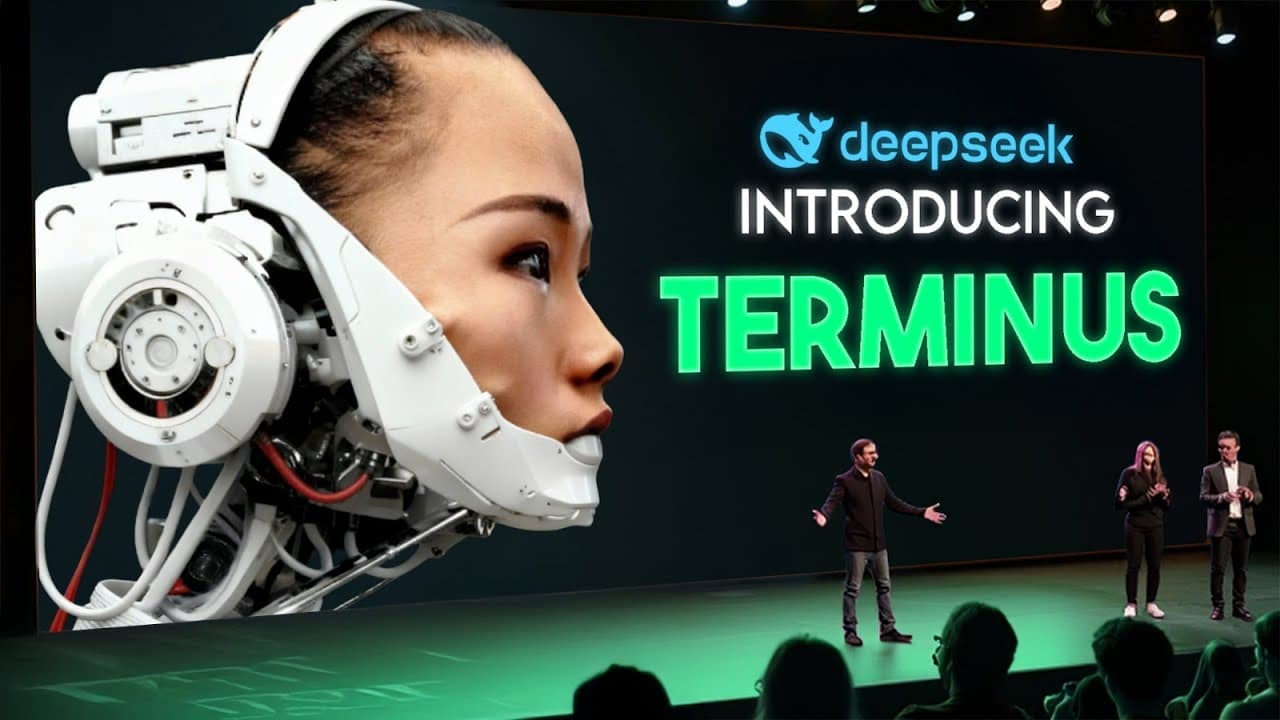
DeepSeek Terminus is an open-source upgrade to V3.1 that sharpens tool-using agents and fixes English-Chinese language mixing. It lifts BrowseComp from 30 to 38.5 and Terminal Bench from 31.3 to 36.7, keeps a 128,000-token context and dual chat/reasoner modes, and stays cheap under the MIT license.
Transcript
Deepseek is back with a new release called Terminus, an upgrade to the V3.1 model from August, and it packs a lot more than just a version bump. If you've been keeping an eye on the AI space, you know DeepS has been pushing this hybrid reasoning approach where their models don't just generate text, they actually function like agents, tapping into e... Read More
Key Insights
- DeepSeek Terminus is an upgrade to the V3.1 model from August that doubles down on hybrid reasoning, where models function like agents that tap external tools rather than just generating text.
- Language consistency is the headline fix: previous versions sometimes mixed English and Chinese or inserted random characters, and Terminus resolves most of that for more stable developer output.
- Tool-use benchmarks jumped the most, with BrowseComp rising from 30 to 38.5 and Terminal Bench from 31.3 to 36.7, showing the model uses tools more effectively than V3.1.
- Terminus keeps a dual-mode setup: DeepSeek Chat (non-thinking) handles conversations, function calling, and JSON with 8,000 max output tokens, while DeepSeek Reasoner handles multi-step problems up to 64,000 tokens.
- Both modes process up to 128,000 tokens of context, roughly three to four hundred pages, though that trails Grok 4 Fast's advertised 2 million and Google Gemini 2.5 Pro's 1 million.
- Training added 840 billion more tokens than the last version plus a new tokenizer and updated prompt templates, lifting Simple QA from 93.4 to 96.8 and Humanity's Last Exam from 15.9 to 21.7.
- The upgrade involves trade-offs: Chinese BrowseComp scores slipped, Codeforces fell from 2091 to 2046, and some coding benchmarks dipped as DeepSeek tuned hard for tool use and stability.
- Pricing stays aggressive at 7 cents per million input tokens for cache hits, 56 cents for cache misses, and $168 per million output tokens, far below GPT-5 around $10 or Claude Opus 4.1 at $75.
Install to Summarize YouTube Videos and Get Transcripts
Explore YouTube Video Summarizer or Get YouTube Transcript Extractor
Questions & Answers
Q: What is DeepSeek Terminus?
DeepSeek Terminus is a new release that upgrades the V3.1 model from August, packing more than a version bump. It doubles down on DeepSeek's hybrid reasoning approach, where models don't just generate text but function like agents that tap into external tools to complete real tasks. It improves language consistency, upgrades its built-in code and search agents, and remains open source under the MIT license so developers can self-host and use it commercially.
Q: How much better is Terminus than V3.1 on benchmarks?
Terminus shows meaningful gains in tool use. On BrowseComp, which tests multi-step live web searches, it rose from 30 to 38.5. On Terminal Bench it went from 31.3 to 36.7. Simple QA climbed from 93.4 to 96.8, SWE Verified from 66 to 68.4, SWE-bench multilingual from 54.5 to 57.8, GPQA Diamond from 80.1 to 80.7, and Humanity's Last Exam from 15.9 to 21.7.
Q: What language handling problem does Terminus fix?
One of the first things people noticed is that Terminus is much more consistent handling English and Chinese. Previous versions sometimes mixed the two languages or even inserted random characters, which annoyed developers who wanted stable output. This release fixes most of that. However, there is a trade-off: on the Chinese-language version of BrowseComp, scores slipped a bit, suggesting DeepSeek optimized more heavily for English web performance this time around.
Q: What are the two modes in DeepSeek Terminus?
Terminus keeps its dual-mode setup. DeepSeek Chat is the non-thinking mode for straightforward conversations, function calling, JSON outputs, and lighter tasks, with a maximum output of 8,000 tokens defaulting to 4,000. DeepSeek Reasoner is the thinking mode for tougher multi-step problems, going up to 64,000 tokens defaulting to 32,000. If a reasoner request requires tool use, it gets automatically routed back through the chat model.
Q: How large is the context window in Terminus?
Both modes can process up to 128,000 tokens of context in one go, which is about three to four hundred pages of text in a single input and output. That is fairly generous, though it does not reach the 2 million token context that Grok 4 Fast advertises or the 1 million tokens offered by Google Gemini 2.5 Pro. Terminus also supports function calling, fill-in-the-middle completions, and JSON outputs for building structured applications.
Q: How much does DeepSeek Terminus cost to use?
API pricing stays at 7 cents per million input tokens for cache hits, 56 cents per million for cache misses, and $168 per million output tokens. Compared to GPT-5 at around $10 or Claude Opus 4.1 at $75 per million output tokens, the pricing is highly disruptive. One video review mentioned a slightly different breakdown of 27 cents per million input tokens and $1 per million output tokens, but the official numbers stick to the $168 figure.
Q: What are the trade-offs in Terminus compared to V3.1?
It is not a straight win across the board. On Codeforces, which measures competitive programming skills, the score slipped from 2091 down to 2046, and a few other coding-heavy benchmarks like AIDER Polyglot also took a small hit. The Chinese BrowseComp score dropped, and gains on pure reasoning tasks with no tools were much smaller. DeepSeek acknowledged they lean toward consistency and stronger agent performance over raw coding speed.
Q: Is DeepSeek Terminus open source and can it be used commercially?
Yes. The model is fully open source under the MIT license, which is rare for models that compete this closely with big proprietary systems. VentureBeat pointed out that Terminus, with 685 billion parameters, matches or exceeds the performance of closed systems while being completely free to use commercially. Updated demo code on Hugging Face makes local deployment easier, and many developers are already self-hosting Terminus to cut reliance on DeepSeek's own servers.
Summary & Key Takeaways
-
DeepSeek Terminus upgrades the V3.1 model with a stronger hybrid reasoning approach where the model acts like an agent using external tools. Key improvements include far more consistent English and Chinese output, ending the earlier problem of mixed languages and random characters, plus more reliable built-in code and search agents.
-
Benchmarks show the biggest gains in tool use: BrowseComp climbed from 30 to 38.5 and Terminal Bench from 31.3 to 36.7. Simple QA rose to 96.8 and Humanity's Last Exam to 21.7, but Chinese BrowseComp, Codeforces, and some coding benchmarks slipped as a trade-off for stability.
-
Terminus keeps dual chat and reasoner modes with 128,000-token context, supports function calling and JSON, and stays extremely cheap at $168 per million output tokens. It is MIT-licensed open source with 685 billion parameters, so developers can self-host and use it commercially for free.
Read in Other Languages (beta)
Share This Summary 📚
Summarize YouTube Videos and Get Video Transcripts with 1-Click
Try YouTube Summary with ChatGPT & Claude or YouTube Transcript Generator
Explore More Summaries from AI Revolution 📚




Summarize YouTube Videos and Get Video Transcripts with 1-Click
Try YouTube Summary with ChatGPT & Claude or YouTube Transcript Generator