How Is AI Transforming Biomedical Research in Aging and Cancer?
TL;DR
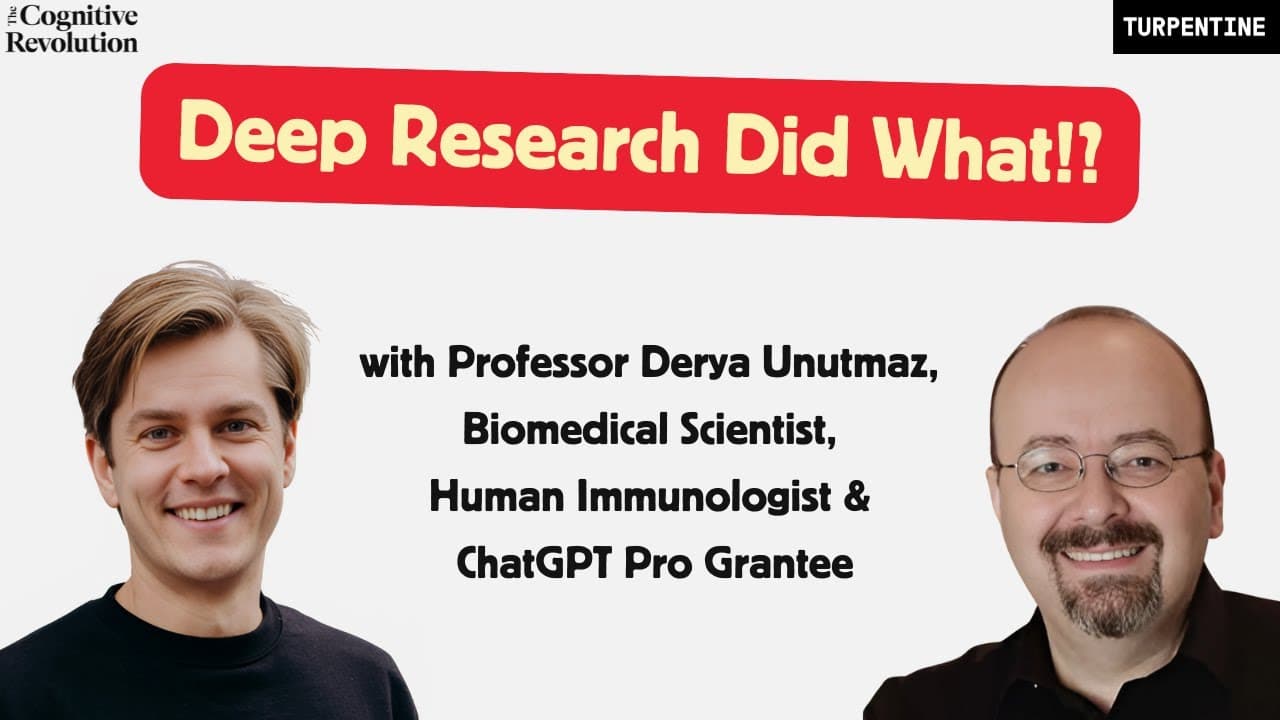
AI is revolutionizing biomedical research by enhancing hypothesis generation and data analysis, making it unethical not to use these tools in medical contexts. Professor Derya Unutmaz argues that AI acts as a collaborator on par with human experts, democratizing science and enabling significant contributions from young researchers. He envisions a future where diseases are cured and aging is reversed, driven by AI's insights.
Transcript
to say that AI cannot come up with anything novel or Innovative is total nonsense in fact I will argue that very soon AI is going to be much more Innovative and creative than we are if I see AI is a collaborator it's almost On My Level it's not even like a student level anymore like another professor who is very knowledgeable in the field these are... Read More
Key Insights
- AI is seen as a collaborator on par with human experts, aiding in hypothesis generation, literature review, and data analysis.
- Professor Unutmaz emphasizes the democratizing power of AI, enabling even young researchers to make significant scientific contributions.
- AI models are becoming indispensable in medical contexts, improving outcomes and reducing errors in clinical and research settings.
- The integration of AI in scientific processes is straightforward, focusing on a conversational approach rather than advanced prompt engineering.
- AI has provided Eureka moments in research, offering insights that recapitulate decades of scientific work in concise analyses.
- The future of AI in science includes reversing aging and treating all diseases within the next decade, with AI driving these breakthroughs.
- Resistance to AI is diminishing as more people witness tangible results, leading to a shift towards curiosity and excitement.
- Professor Unutmaz envisions a golden age with AI, where resource scarcity is eliminated, diseases are cured, and aging is reversed.
Install to Summarize YouTube Videos and Get Transcripts
Explore YouTube Video Summarizer or Get YouTube Transcript Extractor
Questions & Answers
Q: How does Professor Unutmaz view AI's role in his research?
Professor Unutmaz views AI as an intellectual partner that is capable of contributing to frontier professional work. He emphasizes that AI assists in various stages of scientific research, including hypothesis generation, literature review, experimental design, and data analysis. He considers AI to be on par with human experts, providing valuable insights and even surpassing human creativity in some instances.
Q: What impact is AI having on the democratization of science?
AI is significantly democratizing science by enabling individuals, regardless of their level of formal education or experience, to contribute to scientific discovery. Unutmaz highlights that AI provides young researchers with the tools to make meaningful contributions, allowing them to bypass traditional barriers such as lengthy educational paths and limited access to resources. This democratization is fostering a more inclusive and innovative scientific community.
Q: What are Professor Unutmaz's thoughts on the ethical implications of using AI in medicine?
Professor Unutmaz argues that it has become unethical not to use AI in medical contexts. He cites the repeated demonstrations of AI's ability to reduce errors and improve outcomes in clinical settings as well as its potential to accelerate research breakthroughs. He believes that every day matters to the millions of people waiting for medical advancements, and thus, AI should be integrated into medical practices to maximize benefits.
Q: How does Professor Unutmaz suggest scientists approach AI models?
Unutmaz suggests that scientists should adopt an opportunity-oriented mindset when working with AI models. Rather than relying on advanced prompt engineering, he recommends a natural conversational approach, characterized by relentless curiosity and trial and error. He encourages scientists to view AI as a collaborator, engaging with it openly to explore new ideas and solutions, and iterating on prompts to achieve the best outcomes.
Q: What are some of the Eureka moments Professor Unutmaz experienced with AI?
Unutmaz shares several Eureka moments where AI provided insights that recapitulated decades of his scientific work in concise analyses. In one example, AI analyzed gene expression patterns in T-cells across different age groups, offering insights into cellular aging that his team had not fully appreciated. These moments demonstrate AI's potential to offer innovative and creative solutions that can drive scientific discovery forward.
Q: What is Professor Unutmaz's vision for the future with AI?
Professor Unutmaz envisions a future where AI leads to a golden age, characterized by the elimination of resource scarcity, the curing of diseases, and the reversal of aging. He believes that AI will play a crucial role in achieving these advancements, transforming the way we understand and interact with the world. He also emphasizes the importance of developing regulatory AI models to ensure safety and ethical use.
Q: How is resistance to AI changing according to Professor Unutmaz?
Resistance to AI is gradually giving way to curiosity and excitement as more people witness tangible results. Unutmaz notes that while there was initial skepticism, particularly in the medical field, the undeniable benefits of AI are leading to increased adoption. He observes that individuals who were once dismissive of AI's capabilities are now recognizing its potential and integrating it into their work.
Q: What role does Professor Unutmaz see AI playing in scientific discovery?
Unutmaz sees AI as a transformative force in scientific discovery, capable of driving breakthroughs in understanding and treating complex biological systems. He believes that AI will enable researchers to uncover new insights, predict experimental outcomes, and develop innovative solutions to longstanding challenges. By integrating AI into the scientific process, researchers can accelerate progress and achieve goals that were previously thought to be unattainable.
Summary & Key Takeaways
-
Professor Derya Unutmaz discusses how AI is transforming biomedical research, particularly in aging and cancer immunotherapy. He highlights AI's role in hypothesis generation and data analysis, viewing AI as a collaborator on par with human experts.
-
AI is democratizing science, enabling young researchers to make significant contributions. Unutmaz argues that it is now unethical not to use AI in medical contexts, given its ability to improve outcomes and reduce errors.
-
Looking to the future, Unutmaz envisions a golden age with AI, where diseases are cured, aging is reversed, and resource scarcity is a thing of the past. He emphasizes the need for regulatory AI models to ensure safety.
Read in Other Languages (beta)
Share This Summary 📚
Summarize YouTube Videos and Get Video Transcripts with 1-Click
Try YouTube Summary with ChatGPT & Claude or YouTube Transcript Generator
Explore More Summaries from Cognitive Revolution "How AI Changes Everything" 📚



Summarize YouTube Videos and Get Video Transcripts with 1-Click
Try YouTube Summary with ChatGPT & Claude or YouTube Transcript Generator