How Are Big Tech Companies Solving AI's Energy Crisis?
TL;DR
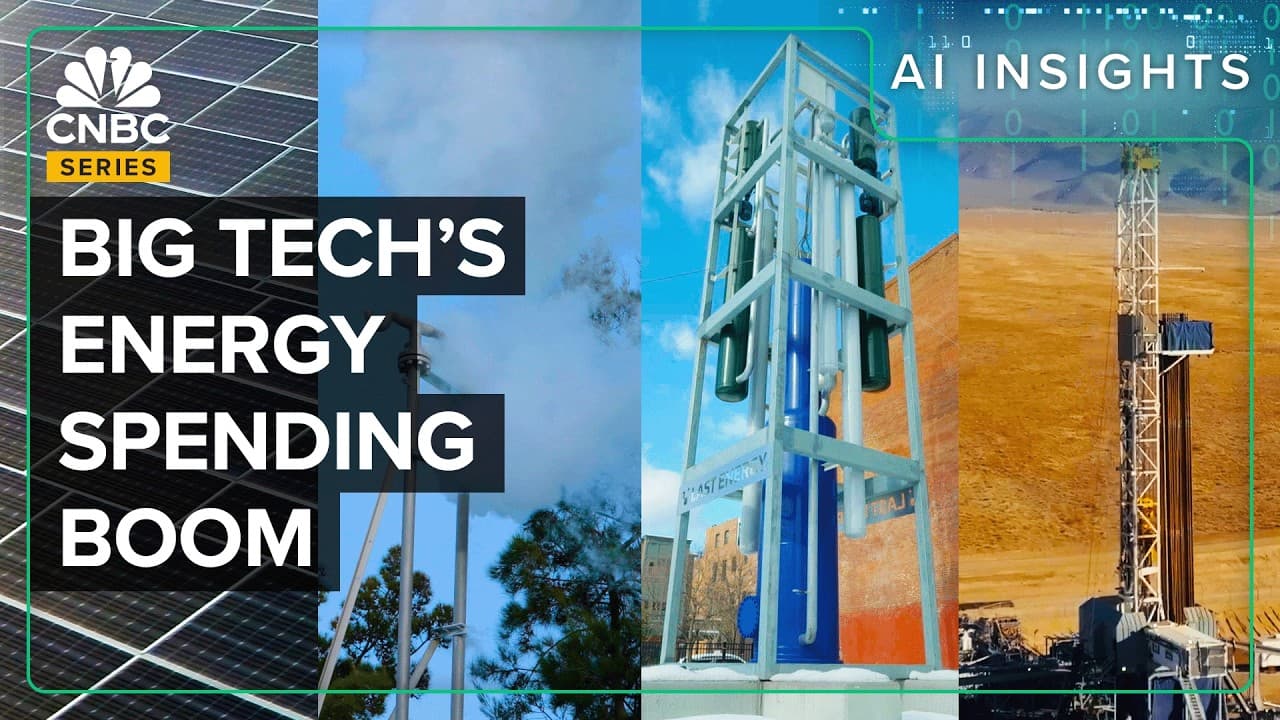
Data centers could reach 12% of total U.S. power consumption by 2028, up from less than 4% in 2022, driving Big Tech to fund unusual energy sources. OpenAI's Sam Altman, Microsoft, Google and Amazon are pouring hundreds of millions into hydrogen, small nuclear reactors, fusion and geothermal to power AI workloads that renewables alone can't reliably supply.
Transcript
In this converted parking lot in Silicon Valley... Yuval Bachar is demonstrating a pressure release –of hydrogen –at his start-up, ECL. The hydrogen is very, very cold and comes out of the vents and actually freezing the water molecules in the air. Hydrogen is one of the bold, alternative power sources seen big investment –as AI workloads sent ener... Read More
Key Insights
- Data center power demand is projected to reach 12% of total U.S. power consumption by 2028, up from less than 4% in 2022 before ChatGPT launched, with demand rising 15 to 20% every year through 2030.
- ECL built the first data center running off-grid on hydrogen, a converted parking lot in Mountain View housing 1,600 Nvidia GPUs, using a hydrogen-oxygen fuel cell reaction whose water byproduct is fed back into on-site cooling.
- Hydrogen comes in three color-coded types: 'grey' (95% of consumption, made from fossil fuels), 'blue' (same process with carbon capture), and 'green' (produced from renewable energy at significantly higher cost by splitting water molecules).
- ECL's blue hydrogen power costs $0.06 per kilowatt hour, about a third of the average U.S. power price, and the company is building an $8 billion, 1 gigawatt Texas data center near 600 miles of hydrogen pipelines, targeted for 2029.
- Small modular reactors (SMRs) bring nuclear power to data centers without proximity to large plants; Last Energy's design creates 80MW of heat and 20MW of electricity, encased in a 12-inch steel containment structure to isolate radioactive waste.
- Microsoft is restarting a mothballed nuclear plant on Three Mile Island in Pennsylvania, shut down since 2019 and the site of the worst commercial nuclear accident in U.S. history in 1979, to help meet AI power demand.
- AI power needs favor 'always on' sources providing electricity 24 hours a day, which is why wind and solar don't fit the bill, and why some coal and nuclear plant closures, like in Kansas City near Meta's data center, are being put on hold.
- Cloud providers' carbon-free pledges are slipping: Google's greenhouse gas emissions rose nearly 50% from 2019 to 2023 and Microsoft's rose more than 29%, both driven in part by AI-optimized data center energy consumption.
Install to Summarize YouTube Videos and Get Transcripts
Explore YouTube Video Summarizer or Get YouTube Transcript Extractor
Questions & Answers
Q: Why is AI causing an energy crisis for data centers?
After ChatGPT's release in November 2022 made large language models a must-have across industries, cloud providers raced to build data centers that need more and more power to train and run AI models. Data center power demand is rising 15 to 20% every year through 2030 in the U.S., and could reach 12% of total U.S. power consumption by 2028, up from less than 4% in 2022. An average 100MW data center consumes as much energy as 100,000 U.S. households.
Q: What is ECL and how does its hydrogen data center work?
ECL, founded by Yuval Bachar in Mountain View, California, built the first data center running off-grid entirely on hydrogen. A chemical reaction between hydrogen and oxygen inside a fuel cell creates extreme heat and water vapor that is converted to power and stored in batteries like a Tesla Megapack, powering a small on-site data center with 1,600 Nvidia GPUs. Water is a byproduct that is fed back into the cooling system. Its tank is filled every couple of weeks with 16,000 gallons of hydrogen trucked in from Southern California or Nevada.
Q: What are the three types of hydrogen used for power?
Hydrogen comes in three main types known by color codes based on how they are made. 'Grey' hydrogen accounts for about 95% of the world's current consumption and is made using fossil fuels, releasing significant CO2. 'Blue' hydrogen uses the same process but adds carbon capture to reduce impact, and is primarily what ECL receives. 'Green' hydrogen is produced from renewable energy like wind or solar to split water molecules, through a significantly more expensive process, making up only a tiny fraction of available hydrogen.
Q: How much does hydrogen power cost compared to average U.S. electricity?
According to ECL founder Yuval Bachar, using blue hydrogen the company has gotten the price down to $0.06 per kilowatt hour, which is about a third the average price of power in the U.S. ECL says it has four customers committed at its Texas site so far and is in talks with 16 more. The Texas project is a 1 gigawatt data center, a thousand times bigger than its California pilot, costing $8 billion and planned for completion in 2029, eventually running entirely on green hydrogen.
Q: What are small modular reactors and why are tech companies investing in them?
Small modular reactors, or SMRs, are compact nuclear reactors designed to be brought to data centers without needing to build near a big nuclear plant. Amazon, Google and Microsoft are all investing in SMRs because traditional nuclear stagnated decades ago due to rising construction costs and lengthy timelines. Last Energy's prototype creates 80MW of heat and 20MW of electricity. Half of Last Energy's 80 commercial agreements for 20-megawatt units are going to AI data centers, with its first SMRs scheduled to come online in 2027 in Wales.
Q: Why is Microsoft restarting the Three Mile Island nuclear plant?
Microsoft is restarting a mothballed nuclear plant on Three Mile Island in Pennsylvania to meet surging AI power demand. The plant had been shut down since 2019 and was the scene of the worst commercial nuclear accident in U.S. history in 1979. Nuclear power appeals to AI data centers because it is an always-on source providing electricity continuously 24 hours a day, unlike the most readily available renewables such as wind and solar, which don't typically fit that need.
Q: How did DeepSeek affect expectations about AI energy demand?
In January, China unveiled DeepSeek with efficiency breakthroughs that cast doubt on AI power needs, leading some to ask whether the AI-fueled surge in power demand would continue. However, experts in the video argue that everyone will copy DeepSeek's efficiency gains, with everybody suddenly getting an order of magnitude or two more efficient, which they believe will just create more demand sooner rather than reducing overall energy consumption.
Q: How is the Trump administration changing AI energy investment?
The Trump administration has clearly said it wants to invest in oil and gas, summarized by the phrase 'drill, baby, drill,' and Trump called Biden climate policies a 'green new scam.' This creates uncertainty over whether energy start-ups will continue receiving Biden-era federal grants and tax breaks, making it risky to fund first-of-a-kind projects. A few days before DeepSeek's release, Trump announced Stargate, a joint venture to fund domestic AI infrastructure with up to $500 billion over four years, backed by SoftBank, OpenAI and Oracle.
Summary & Key Takeaways
-
AI workloads have sent data center energy demand soaring, projected to hit 12% of U.S. power by 2028 from under 4% in 2022. Microsoft, Meta, Google and Amazon spent a combined $125 billion on data centers in 2024, and an average 100MW data center consumes as much energy as 100,000 U.S. households.
-
Because AI needs continuous, always-on power that wind and solar can't reliably provide, Big Tech is funding alternatives: ECL runs an off-grid hydrogen data center at $0.06/kWh, while Amazon, Google and Microsoft invest in small modular reactors and Microsoft restarts the Three Mile Island nuclear plant.
-
Policy and competition add uncertainty. China's DeepSeek efficiency breakthroughs cast doubt on power needs while China outspends the U.S. on nuclear fusion. The Trump administration favors oil and gas over Biden-era renewable support, and Trump announced Stargate, a joint venture of up to $500 billion for AI infrastructure.
Read in Other Languages (beta)
Share This Summary 📚
Summarize YouTube Videos and Get Video Transcripts with 1-Click
Try YouTube Summary with ChatGPT & Claude or YouTube Transcript Generator
Explore More Summaries from CNBC 📚






Summarize YouTube Videos and Get Video Transcripts with 1-Click
Try YouTube Summary with ChatGPT & Claude or YouTube Transcript Generator