AI Brain Drain TLDDR: Should You Outsource Tough Calls to ChatGPT?
TL;DR
The TLDDR is that copying decisions, thinking, or writing from ChatGPT uses little of your own brain. Instead of outsourcing tough calls, give an LLM detailed inputs and ask it to analyze options, trade-offs, and scenarios, then own the decision and its consequences yourself. Read on for a practical prompting approach and details of the 90-day AI trading experiment.
Transcript
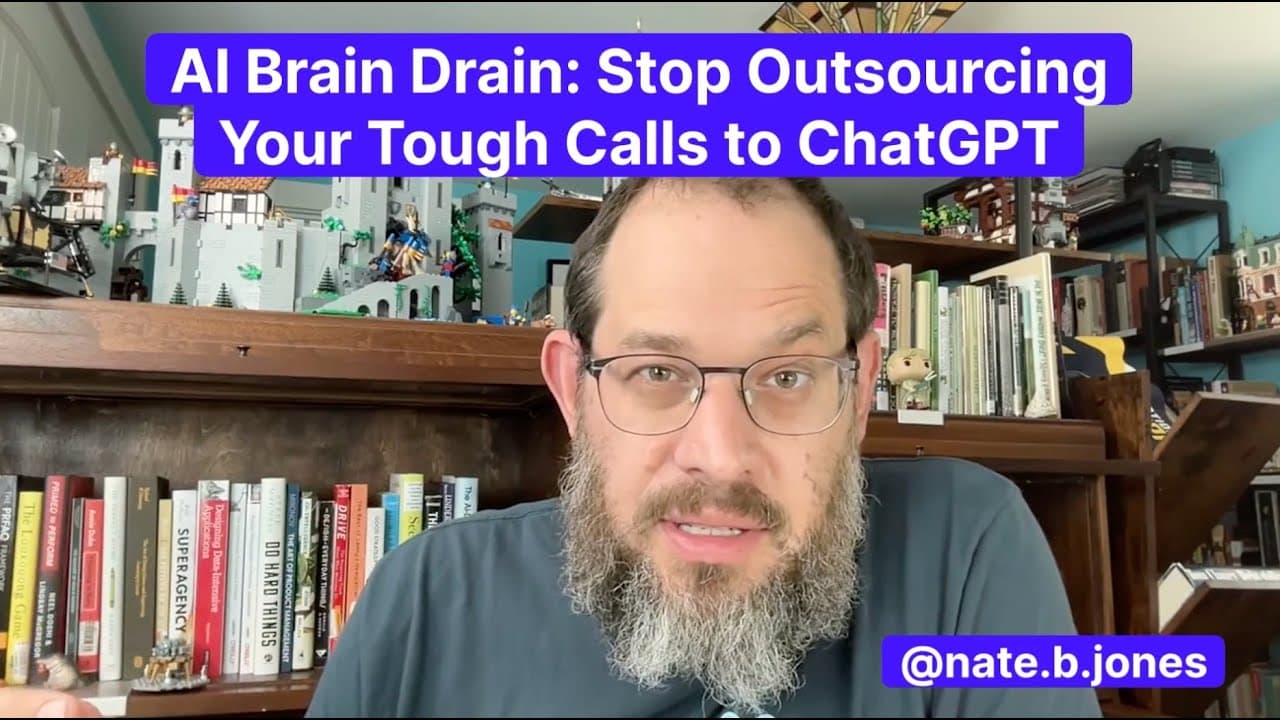
Do you remember the study that came out of MIT that talked about AI taking away people's brain power? It was it made a lot of waves. Basically, the TLDDR is that when it you copy and paste decisions out of Chad GPT or thinking or writing out of Chad GPT, it turns out not much of your brain gets used. Big surprise. There is a larger lesson learned h... Read More
Key Insights
- Passive AI use lowers cognitive effort because copying answers or decisions from ChatGPT leaves less thinking for the user. The broader risk is not merely receiving a weak response, but gradually treating the model as a substitute for judgment in consequential situations.
- Decision outsourcing is often driven by discomfort with uncertainty. People may want to claim credit when an AI-supported choice succeeds and blame the model when it fails, but that behavior avoids the personal responsibility required for sound financial, career, housing, and education decisions.
- Answer prompts typically produce generic responses because an LLM is trained to be helpful even when a request lacks detailed context. Questions such as whether to refinance, sell a house, or request a particular raise do not create enough room for meaningful analysis.
- Analysis prompts work by supplying relevant inputs and asking the model to examine options, trade-offs, and scenarios. Instead of demanding one definitive decision, the user receives a broader picture that can clarify the available choices without removing uncertainty or personal accountability.
- A strong structured prompt defines the model's role, relevant inputs, reflection instructions, requested output, success criteria, and fallback or rejection conditions. Combining these elements helps the model assess whether it has sufficient information and produce analysis suited to a specific decision event.
- LLMs are strong at processing broad ranges of textual input and developing alternatives. When prompted correctly, they can synthesize financial documents, assumptions, goals, and constraints, then examine more options than a person might cover during a single conversation with an adviser.
- Scenario modeling improves decision quality by allowing users to change one assumption and rerun the analysis. Examples include comparing 25% and 15% house down payments or evaluating jobs at different salaries and examining how each choice could affect a budget.
- The 90-day market experiment tests O3 Pro, Opus 4, and Grok 4 with small amounts of real money on Robinhood and Kalshi. Its purpose is to observe recommendations and model differences under real consequences, not to prove that AI can reliably make stocks rise.
Install to Summarize YouTube Videos and Get Transcripts
Explore YouTube Video Summarizer or Get YouTube Transcript Extractor
Questions & Answers
Q: What is the TLDDR on AI brain drain and ChatGPT?
The TLDDR is that copying decisions, thinking, or writing from ChatGPT means little of your own brain gets used. The larger lesson is to use AI for analysis without transferring responsibility for important decisions to it.
Q: How should you use ChatGPT for tough decisions?
Give ChatGPT the relevant inputs and ask for an analysis of options, details, and trade-offs. Treat it as a synthesizer and conversational partner, then make the final decision and accept its consequences yourself.
Q: Why do answer-seeking prompts produce generic AI advice?
An LLM is trained to be helpful, so it can provide an acceptable generic answer even when a prompt lacks room for deep analysis. Questions such as whether to refinance at 6.2% or how much of a raise to request ask for completion rather than careful examination.
Q: What is the difference between an answer machine and a thinking machine?
An answer machine responds directly to questions seeking a result, such as when to sell a house. A thinking machine processes detailed inputs, analyzes alternatives, and provides a clearer overall picture of the contemplated decision.
Q: How can an LLM help analyze a refinancing decision?
Provide information such as W2s, 1099 income, the current house rate, and what you want to accomplish. The LLM can return options with more detail and clarity, but the user must remain responsible for the decision.
Q: Why should people keep ownership of AI-assisted decisions?
People may want AI to carry the burden so they can take credit when a choice succeeds or blame the model when it fails. Owning both the decision and its consequences preserves responsibility while still using the LLM's analytical power.
Q: What is the purpose of the 90-day AI trading experiment?
The experiment asks three LLMs to form opinions, conduct analyses, and establish bets on specific trades using a small amount of real money on Robinhood and Kalshi. The trades will be tracked and judged after 90 days to obtain a directional view of their short-term planning.
Q: Which models are included in the AI trading experiment?
The selected models are O3 Pro, Opus 4, and Grok 4. Their predictions and trades will be documented and tracked, but the purpose is not simply to choose whichever model makes a stock rise.
Summary & Key Takeaways
-
People often ask LLMs to make difficult financial, career, housing, or education decisions because they want certainty and relief from responsibility. This approach usually produces generic answers and may reduce cognitive effort. The recommended alternative is to keep ownership of the choice while asking AI to deepen the underlying analysis.
-
LLMs are most useful as synthesizers that process extensive textual inputs, compare alternatives, and model multiple possible futures. A structured prompt should specify the role, relevant information, reflection instructions, requested output, success criteria, and rejection conditions. Users can then adjust assumptions and examine several scenarios quickly through follow-up chats.
-
A live 90-day experiment will compare trades generated by O3 Pro, Opus 4, and Grok 4 using small amounts of real money on Robinhood and Kalshi. The purpose is to examine model recommendations, outcomes, and meaningful differences, not to identify an automatic stock-picking machine or present any model as a financial adviser.
Read in Other Languages (beta)
Share This Summary 📚
Summarize YouTube Videos and Get Video Transcripts with 1-Click
Try YouTube Summary with ChatGPT & Claude or YouTube Transcript Generator
Explore More Summaries from AI News & Strategy Daily | Nate B Jones 📚






Summarize YouTube Videos and Get Video Transcripts with 1-Click
Try YouTube Summary with ChatGPT & Claude or YouTube Transcript Generator