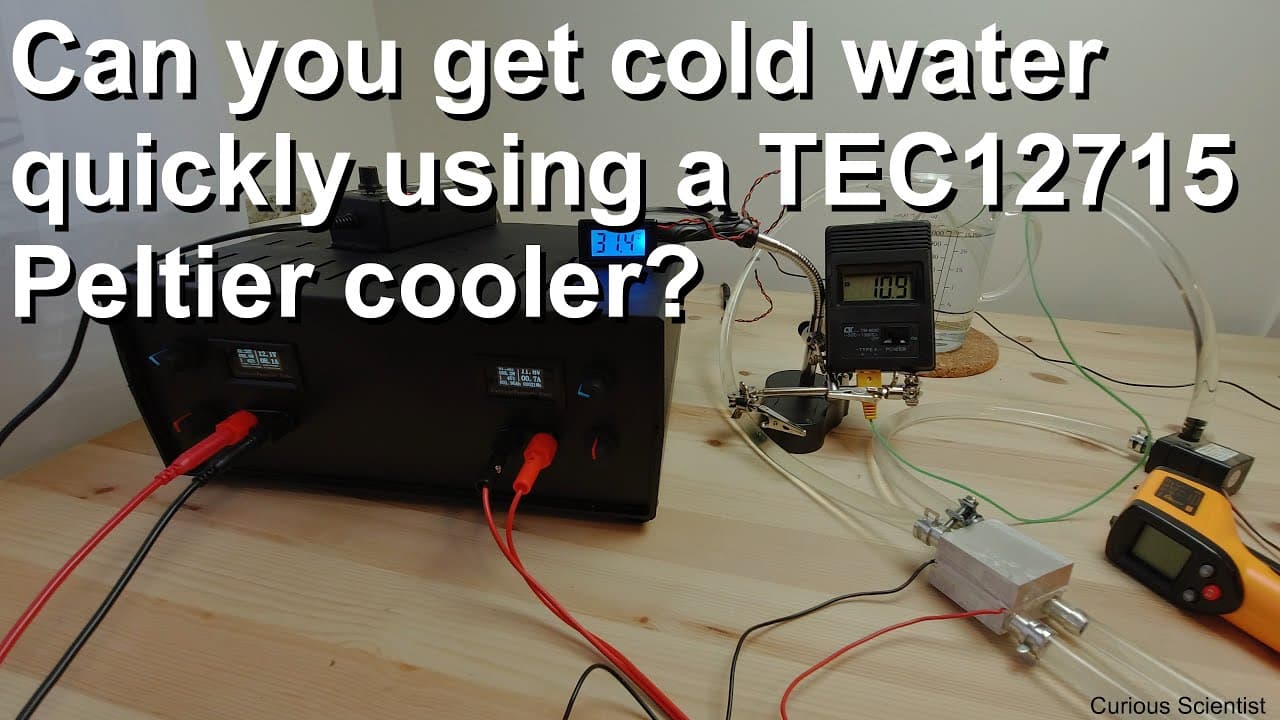
Cooling a jug of water with a single TEC12715
TL;DR
The video explores a new cooling system using a Peltier cooler to efficiently lower water temperature.
Transcript
welcome everyone this is another video about patchy cooling so I made a different cooling system and I would like to try something else than previously so as you can see we have this big black box which is a power supply 15 amperes and 12 volts per channel so it's a dual channel power supply I made it myself you can check some videos about this and... Read More
Key Insights
- ❓ The effectiveness of Peltier coolers can be enhanced by developing systems with better thermal contact to the cooled substance.
- ✊ The experiment demonstrates the significance of a dual-channel power supply in managing the cooler's performance and temperature control.
- 😎 Heat generated by the cooling system itself can impact overall cooling efficiency, necessitating careful current management.
- 🔈 Cooling large volumes of liquid to low temperatures is an energy-intensive process that may not be optimal for practical everyday use compared to traditional refrigeration methods.
- 😎 A cooling system's spatial design can significantly influence its thermal performance, illustrating the importance of strategic engineering in similar projects.
- 😎 As the water temperature decreases, external environmental factors become more detrimental to the cooling process, slowing temperature reduction.
- 😎 Real-world applications of this cooling technique will require addressing both energy efficiency and time constraints to be viable alternatives to standard cooling methods.
Install to Summarize YouTube Videos and Get Transcripts
Explore YouTube Video Summarizer or Get YouTube Transcript Extractor
Questions & Answers
Q: What is the main goal of the cooling experiment presented in the video?
The primary goal of the experiment is to assess how effectively a single Peltier cooler can lower the temperature of one liter of water from 45 degrees Celsius to near freezing, using direct thermal contact and a computer water cooler for optimal cooling.
Q: How does the design of the cooling system enhance efficiency over previous experiments?
This system improves efficiency by creating a close thermal connection between the cold side of the Peltier cooler and the circulating water, which alleviates heat transfer limitations observed in past setups that relied solely on air for cooling.
Q: What specific parameters were adjusted during the experiment to achieve desired cooling results?
The power supply's voltage and current were adjusted throughout the experiment, reaching 12.1 volts and 8.3 amperes to maximize the cooling potential of the Peltier device while monitoring the heat generated by Joule heating to maintain system efficiency.
Q: What are some challenges identified when cooling below room temperature?
Cooling below room temperature presents challenges due to increasing thermal gradients and the environment's heat transfer that can counteract the cooling efforts of the Peltier cooler, making it progressively difficult to achieve lower temperatures over time.
Q: How does ambient temperature affect the efficiency of the cooling process?
Ambient temperature critically affects the cooling process; as the water temperature approaches room temperature, the heat exchange between the water and the environment increases, which can slow down further cooling and require more energy to maintain effective heat removal.
Q: What were the final outcomes of the experiment regarding water temperature?
After one and a half hours, the water temperature was reduced to 11.2 degrees Celsius. Although this outcome signifies some success, it highlights the time-consuming nature and energy consumption necessary to achieve such results, prompting consideration of alternative cooling methods like refrigeration for practicality.
Summary & Key Takeaways
-
The experiment involves a custom dual-channel power supply and a Peltier cooler to cool water, showcasing the effectiveness of cooling performance.
-
The initial temperature of the water is around 45 degrees Celsius, and the setup aims to reduce it to 0 degrees using water cooling methods.
-
Ultimately, the water in the jug cools to approximately 11 degrees Celsius, demonstrating the challenges of cooling large volumes efficiently.
Read in Other Languages (beta)
Share This Summary 📚
Summarize YouTube Videos and Get Video Transcripts with 1-Click
Try YouTube Summary with ChatGPT & Claude or YouTube Transcript Generator
Explore More Summaries from Curious Scientist 📚





![Building a Peltier cooler-based cooling box - First iteration, improvements [Part 2/6] thumbnail](/_next/image?url=https%3A%2F%2Fi.ytimg.com%2Fvi%2F0YlNw0EGnzI%2Fhqdefault.jpg&w=750&q=75)
Summarize YouTube Videos and Get Video Transcripts with 1-Click
Try YouTube Summary with ChatGPT & Claude or YouTube Transcript Generator