How Does Destiny Network Shared World Missions?
TL;DR
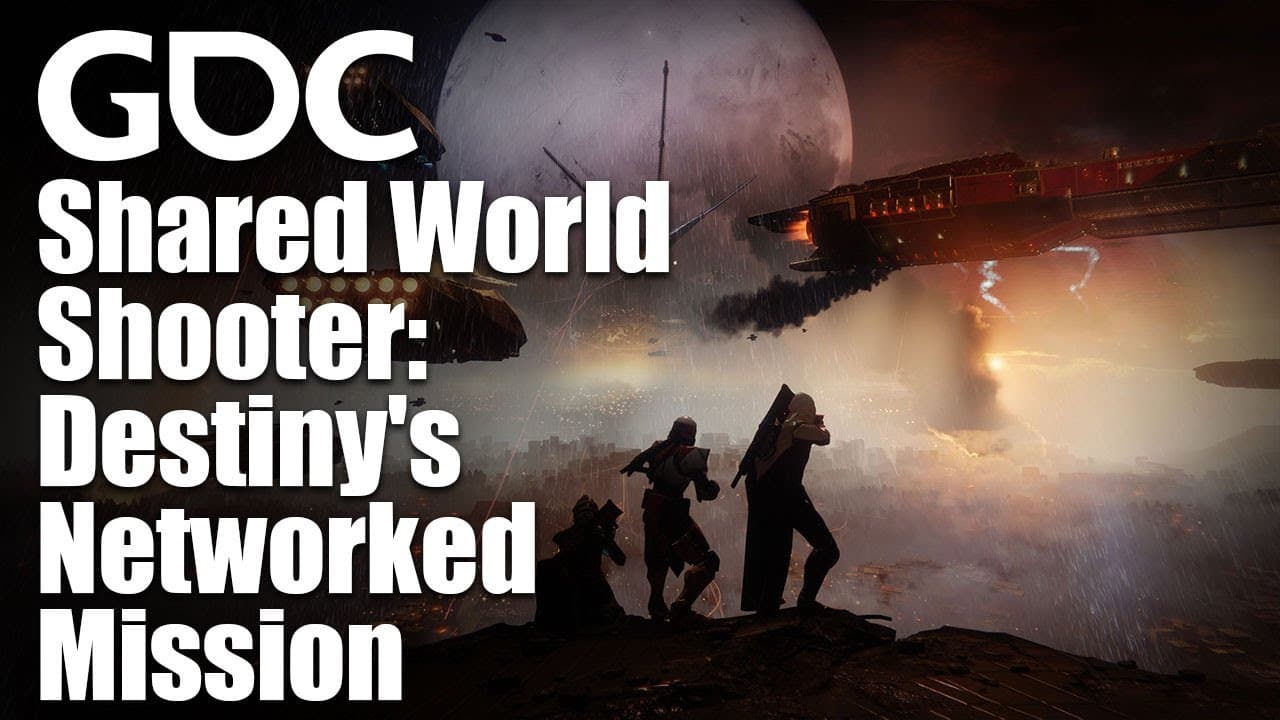
Destiny combines cloud-hosted activity hosts with peer-to-peer networking to deliver responsive shooter combat, cooperative missions, seamless matchmaking, and exploration without tightly tethering players together. Its architecture divides destinations into simulation and matchmaking units called bubbles, allowing players to encounter new strangers while the system streams assets, limits active combat complexity, and preserves the feel of a single-player shooter.
Transcript
alright let's get started it looks like this might be a little bit full so if any of you guys that are on the edge could move it it just makes it easier for anybody comes in late to find a seat I like that this is a room of completionists you guys all stuck around to the very last talks at GDC and I personally appreciate that because I wanted the l... Read More
Key Insights
- Destiny's networking architecture is a hybrid system combining traditional peer-to-peer networking with cloud-hosted activity hosts. The activity hosts run a stripped-down simulation of mission script logic, while peer-to-peer communication preserves the low-latency action gameplay expected from Halo and similar shooters.
- The central responsiveness requirement was that online play should feel like a single-player shooter. Because online matchmaking was mandatory rather than optional, Bungie rejected Halo Reach's cooperative lockstep approach, where firing a weapon could require waiting through the full network round-trip time.
- Halo Reach used two different networking models. Player-versus-player matches used a peer-to-peer host-client arrangement with one console arbitrating state changes, while cooperative campaign play used deterministic lockstep networking that exchanged controller inputs and waited for every machine before advancing the next simulation tick.
- Cooperative play was required across every activity. Bungie also wanted players to join friends while an activity was already underway, so the existing player-versus-player model had to be extended to support campaign scripting and AI alongside responsive action networking.
- The presence of other players was intended to make equipment, appearance, attack power, and level more meaningful. Bungie favored encounters between players pursuing different goals because intersecting paths could provide social visibility without creating direct competition for resources or forcing everyone to advance at the same pace.
- Untethered exploration allows friends to occupy different areas of the same destination. Unlike Halo cooperative play, which imposed a maximum distance from the physics host and teleported players who fell behind, Destiny lets one player gather spinmetal while another continues toward the mission objective.
- Bubbles are production constraints rather than the realization of a creative vision. Bungie adopted them because the project also involved a new intellectual property, its first multiplatform release, a new engine, and several ambitious online design requirements that still had to ship in 2014.
- A bubble is simultaneously a unit of simulation, asset streaming, and matchmaking. A standard bubble supports six players and 25 AI, while memory holds assets for no more than two bubbles, the currently simulated area and the next area being pre-cached.
Install to Summarize YouTube Videos and Get Transcripts
Explore YouTube Video Summarizer or Get YouTube Transcript Extractor
Questions & Answers
Q: How does Destiny's hybrid networking architecture work?
Destiny combines traditional peer-to-peer networking with cloud-hosted machines called activity hosts. The activity hosts run a stripped-down simulation focused on mission script logic, while peer-to-peer networking supports responsive action gameplay. This division lets the game continuously match players with strangers while maintaining the low-latency shooting feel Bungie considered necessary for parity with single-player and competitive shooters.
Q: Why did Bungie avoid lockstep networking for Destiny?
Bungie considered Halo Reach's cooperative lockstep model too latent for Destiny's goal of feeling like a single-player shooter. Lockstep networking exchanges player inputs and waits until every machine's input arrives before advancing the simulation. Even with techniques that reduced perceived delay, players could still pay a full network round-trip between pulling the trigger and seeing the gun fire.
Q: What is an activity host in Destiny?
An activity host is a cloud-hosted machine that runs a stripped-down simulation of Destiny's mission script logic. It is one half of the game's hybrid architecture, working alongside peer-to-peer networking rather than replacing it. Truman says this structure supported a million-player launch load with a few hundred data-center servers because each server could handle more than 10,000 players.
Q: What is a bubble in Destiny's game architecture?
A bubble is a bounded unit used for three related purposes: combat and physics simulation, asset streaming, and matchmaking. A player actively simulates only one bubble at a time and keeps assets for at most two bubbles in memory. The second asset set belongs to the next area being pre-cached before the player crosses the bubble boundary.
Q: How many players and AI can a standard Destiny bubble support?
A standard bubble was designed for six players and 25 AI, although Bungie used different performance limits depending on factors such as vehicles and maximum player count. The six-player population supports a three-player fireteam plus three strangers, while 25 AI provides enough active enemies for the action-game experience Bungie was targeting within one simulated area.
Q: How does Destiny let players meet strangers seamlessly?
Destiny treats bubbles as units of matchmaking, allowing the game to introduce different strangers as a player moves through the world. Bungie wanted to remove traditional matchmaking lobbies and menus so that other players could appear automatically and organically. This supports repeated social encounters during a longer session instead of limiting the player to the same three strangers.
Q: Why did Bungie want players with different goals to meet?
Bungie believed that simply being perceived by other players gives greater value to an avatar's appearance, equipment, attack power, and level. However, it wanted strangers' paths to intersect rather than remain parallel toward identical objectives. Players pursuing different goals are less likely to compete for resources, create resentment, or pressure one another to move faster than desired.
Q: How does Destiny support untethered cooperative exploration?
Destiny allows friends to play in separate areas of the same destination instead of enforcing the maximum-distance tether used in Halo cooperative play. A player can accompany a friend during a mission, stop to harvest spinmetal, or explore while the friend moves ahead. This design supports meeting up and playing together without requiring every participant to follow one activity line continuously.
Summary & Key Takeaways
-
Destiny was Bungie's first four-platform, always-online game and its first attempt at seamless background matchmaking. The team wanted strangers to enter a player's session organically, without matchmaking lobbies or separate single-player and multiplayer menu choices. These goals required a networking topology substantially different from the architecture used by previous Halo games.
-
The architecture combines peer-to-peer action networking with cloud-hosted activity hosts that simulate stripped-down mission script logic. According to Truman, this hybrid model supported launch without queues or downtime, handled a million-player load with a few hundred data-center servers, and allowed each server to support more than 10,000 players.
-
Bubbles constrain simulation, asset streaming, and matchmaking. A player simulates one bubble of combat and physics while keeping at most two bubbles' assets in memory, including the current and pre-cached areas. A standard bubble supports six players and 25 AI, balancing responsive combat, cooperative groups, strangers, exploration, and practical production scope.
Read in Other Languages (beta)
Share This Summary 📚
Summarize YouTube Videos and Get Video Transcripts with 1-Click
Try YouTube Summary with ChatGPT & Claude or YouTube Transcript Generator
Explore More Summaries from GDC Festival of Gaming 📚



Summarize YouTube Videos and Get Video Transcripts with 1-Click
Try YouTube Summary with ChatGPT & Claude or YouTube Transcript Generator