How RL and LoRA reshape efficient LLMs
TL;DR
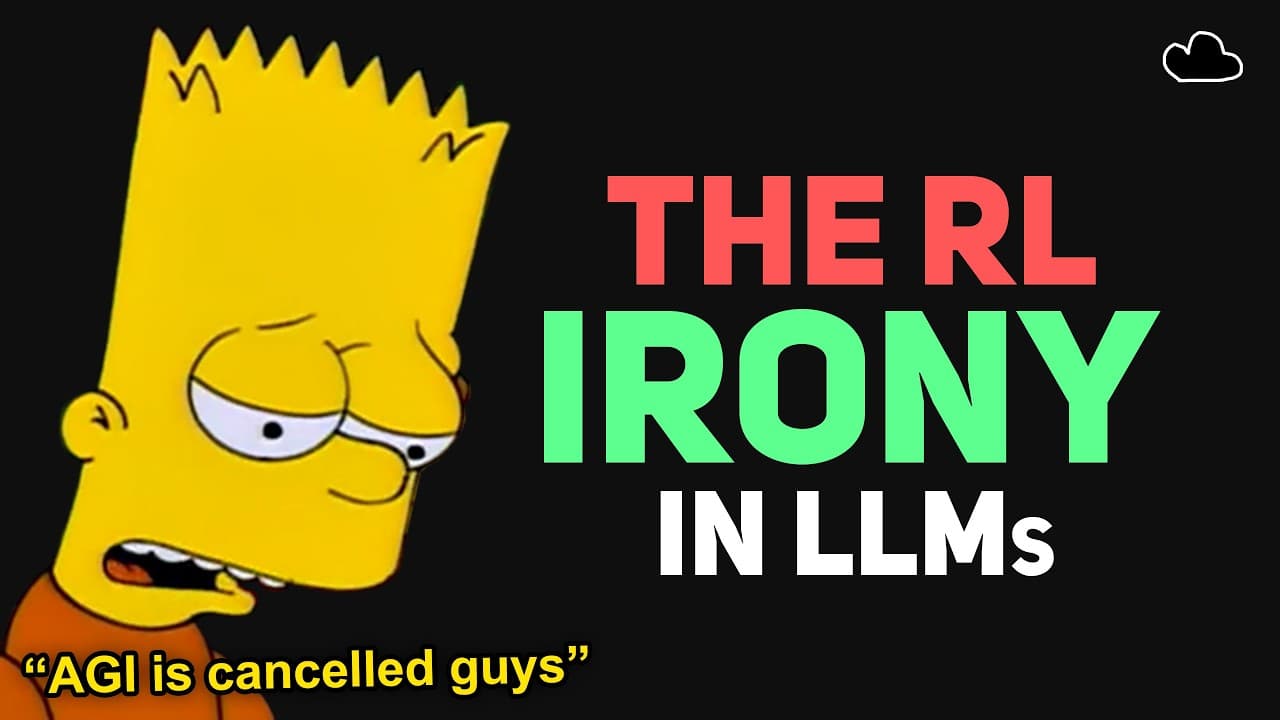
RL adds exploration and self-correction but is noisy and not the sole path to AGI. Pre training with next token prediction provides more information per step, while RL optimizes outcomes and can be combined with LoRA to train only tiny adapters. This combination offers efficiency without sacrificing core capabilities, though not all limits are removed.
Transcript
In the latest Andre Carpathy interview with Doris Patel, he said that AGI is still a decade away and reinforcement learning is definitely not the key for us to get there. And in another interview with Ilias Scutzver, he also said roughly the same thing. But with how much the current LM improvements rely on RL at giving it human level capabilities l... Read More
Key Insights
- RL training introduces noise because it learns from entire episodes with sparse rewards.
- Next token prediction provides denser, step by step information compared to episodic RL signals.
- RL enables exploration of solution spaces and self-correction mechanisms beyond supervised pre-training.
- Sparsity of RL rewards means it conveys limited information per episode, impacting learning efficiency.
- LoRA decomposes updates into two small matrices, enabling training with frozen base models.
- RL often updates only a fraction of the model weights, highlighting targeted optimization.
- LoRA with RL could offer practical efficiency gains by keeping updates light and modular.
- Under certain conditions, Laura can be equivalent to full fine-tuning, but this depends on the training setting and data.
- More videos from this channel:
- More from this channel: bycloud
Install to Summarize YouTube Videos and Get Transcripts
Explore YouTube Video Summarizer or Get YouTube Transcript Extractor
Questions & Answers
Q: How does RL learning differ from next token prediction in terms of information flow
RL learning uses sparse, end of episode rewards to shape behavior, meaning the model receives very little information per episode and must infer effective strategies from the outcome. In contrast, next token prediction provides dense feedback at every token, guiding the model step by step and making early corrections possible during training.
Q: Why might RL not be the best route to AGI according to the video
The video argues that RL can reduce generalizability by sharpening the sampling distribution and focusing on task-specific outcomes, which can limit broad learning. While RL offers exploration and self-correction, it does not guarantee generalizable intelligence and may not scale to AGI as a sole training paradigm.
Q: What is LoRA and how does it relate to RL in training LLMs
LoRA is a method that trains two small matrices to represent updates, while keeping the original model frozen. This creates a low rank, efficient fine tuning approach. When paired with RL, LoRA could enable targeted, lightweight updates guided by sparse rewards, reducing compute while maintaining performance.
Q: What is the main benefit of combining RL with LoRA
The main benefit is achieving efficient, scalable updates by training only tiny adapter matrices while using RL to steer learning through outcomes. This can preserve model capability with far fewer parameter changes, making personalized or task-specific adaptations more practical in large models.
Q: What limitation does the video attribute to Laura without regret
The video notes that Laura without regret is equivalent to full fine tuning only under certain conditions, and may struggle in pre training-like settings where the model has to absorb broad knowledge. Therefore, its effectiveness depends on data distribution and training objectives.
Q: How does RL affect diversity and generalization in LLMs
RL tends to sharpen the model’s sampling distribution to improve task performance, which can reduce diversity and generalization. This means the model becomes better at specific tasks but less capable of broad, generalized reasoning across varied contexts.
Q: What role does entropy detection play in RL signals
Entropy detection is mentioned as a method to produce denser, richer signals within RL, potentially leading to stronger and more informative feedback that can guide learning more effectively than sparse rewards alone.
Q: What practical use case is suggested for RL and LoRA together
The video suggests practical use cases include personalized agents and efficient reasoning improvements, where RL provides the learning signal and LoRA enables light, modular updates suitable for deployment at scale without full fine-tuning of large models.
Summary & Key Takeaways
-
RL is noisy and may not be the key to AGI, but it enables exploration and self-correction that pre-training alone cannot ensure.
-
LoRA allows fine tuning by training two small matrices, reducing the need to update the full model, which pairs well with RL in practice.
-
The combination of RL and LoRA aims for efficient, scalable personalization and reasoning improvements, while acknowledging fundamental limits and conditions for equivalence to full fine-tuning.
Read in Other Languages (beta)
Share This Summary 📚
Summarize YouTube Videos and Get Video Transcripts with 1-Click
Try YouTube Summary with ChatGPT & Claude or YouTube Transcript Generator
Explore More Summaries from bycloud 📚


Summarize YouTube Videos and Get Video Transcripts with 1-Click
Try YouTube Summary with ChatGPT & Claude or YouTube Transcript Generator