What is Shadow AI and how to secure agentic automation
TL;DR
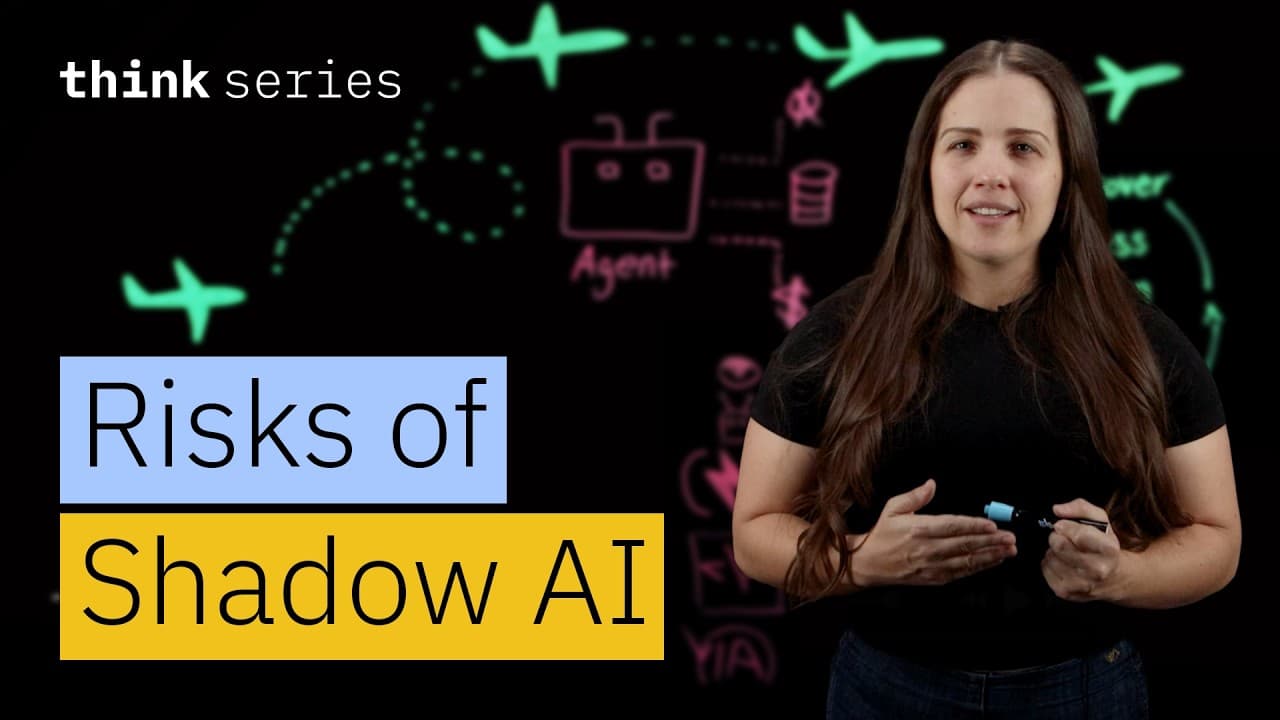
Shadow AI are unofficial helpers that operate without formal oversight, risking unseen actions, data leakage, and governance gaps. The remedy is a unified control plane for agentic AI, enforced least privilege, automated logging, and proactive red teaming to discover and mitigate risks before incidents occur. With continuous monitoring and auditable evidence, safe scale of AI automation is achievable.
Transcript
Imagine an AI that doesn't just chat, it clicks buttons. It books appointments, files tickets, updates records and pings APIs. It's not a chatbot anymore. It's a doer. And that's agentic AI. And here's the kicker. The biggest risk isn't just what it thinks, it's what it does. Especially when shadow AI pops up outside the lines. If security and gove... Read More
Key Insights
- Shadow AI is the unofficial AI your team spins up to get work done with no tickets, no approvals and no paper trail.
- Shadow AI is hard to see because there is no obvious robot helper to track, making safety governance challenging.
- The risk of data leakage increases when helpers copy and paste or use loose keys for passwords.
- Compliance is strained when there is no record of what the helper did or how a decision was reached.
- Too much access is dangerous; give the smallest key needed for the task.
- Messy incidents happen because ownership and scope are unclear, delaying cleanup.
- A single control plane is proposed to discover assess govern secure and audit every AI action.
- Use cases demonstrate guardrails in healthcare and citizen services to keep patient and citizen data safe.
Install to Summarize YouTube Videos and Get Transcripts
Explore YouTube Video Summarizer or Get YouTube Transcript Extractor
Questions & Answers
Q: What is Shadow AI and why does it matter?
Shadow AI refers to unofficial AI helpers that operate without formal tickets, approvals or a paper trail, enabling them to perform tasks autonomously. This matters because such agents can act without central oversight, increasing the risk of data leaks, policy violations, and untraceable actions. Visibility, governance and auditability are essential to limit risk while still enabling automation.
Q: How does Shadow AI introduce visibility problems?
Shadow AI introduces visibility problems because there may be no obvious indicator of its existence. When there is no appointing authority or documented workflow, it becomes difficult for security teams and governance programs to monitor, track, or attribute actions. This lack of visibility makes incidents harder to detect and contain.
Q: What are the data leakage risks associated with agentic automation?
Data leakage risks arise when automated helpers copy and paste information or use loose credentials, allowing private data to escape control. Without strict access controls and restricted data flows, sensitive information can be exposed to unintended tools or outputs, creating privacy and compliance challenges.
Q: Why is compliance difficult with untracked helpers?
Compliance is difficult because there is no explicit record of what the helper did, the data it touched, or the steps it followed. Without an audit trail, auditors cannot verify how decisions were made or whether appropriate controls were applied, undermining accountability and regulatory adherence.
Q: What does least privilege mean in this context?
Least privilege means granting the smallest level of access necessary for a task. In practice, this prevents a helper from accessing unrelated data or broad system permissions, limiting potential damage if something goes wrong and simplifying containment and remediation.
Q: How can incidents be contained more effectively?
Incidents can be contained more effectively by having clear ownership, scope, and rapid remediation processes. When something fails, the ability to identify who owns the tool, what it touched, and how to fix it speeds up recovery and reduces overall impact.
Q: What is proposed to unify risk visibility and control?
The proposed solution is a single control plane that discovers, assesses, governs, secures, and audits every AI action in a continuous loop. This unification ensures that all agentic actions are visible, validated, and auditable, enabling safer fast-scale AI operations.
Q: What are the two use cases used to illustrate safe automation?
The video uses healthcare and citizen services as two use cases. In healthcare, guardrails ensure patient safety and accuracy of notes and orders while enabling efficient clinician support. In citizen services, automation helps with tasks like tax filings and license renewals, while preserving privacy, consent, and auditability.
Summary & Key Takeaways
-
Shadow AI is an unofficial AI that operates with no formal tickets, approvals, or paper trail, enabling autonomous actions beyond governance. This creates visibility gaps, potential data leakage, and compliance challenges that are hard to detect without integrated controls.
-
A single control plane that centralizes discovery, governance, security, and audit enables least privilege access, automated logging, and continuous risk assessment. Red teaming and runtime policy enforcement help catch prompt injection, data leakage, and misconfigurations before they cause harm.
-
The video presents two use cases, healthcare and citizen services, to illustrate how guardrails and careful access control preserve safety and privacy while enabling practical automation of routine tasks.
Read in Other Languages (beta)
Share This Summary 📚
Summarize YouTube Videos and Get Video Transcripts with 1-Click
Try YouTube Summary with ChatGPT & Claude or YouTube Transcript Generator
Explore More Summaries from IBM Technology 📚
Summarize YouTube Videos and Get Video Transcripts with 1-Click
Try YouTube Summary with ChatGPT & Claude or YouTube Transcript Generator