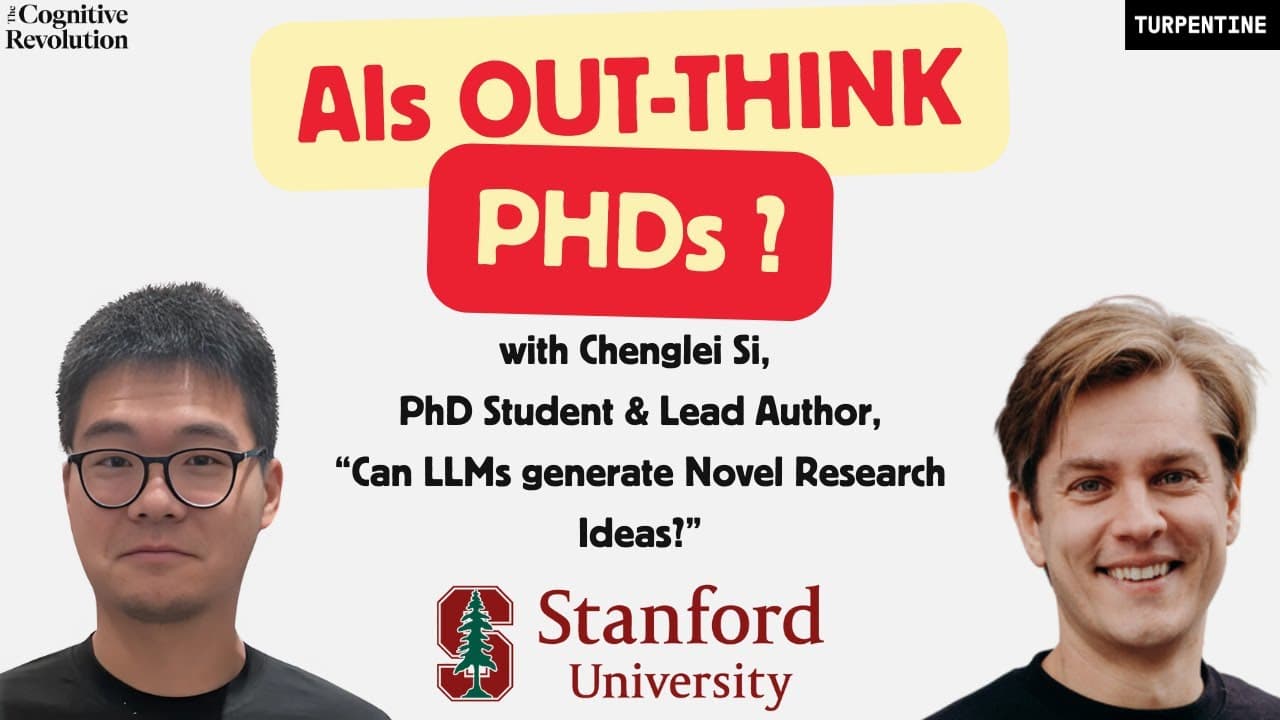
Can AIs Generate Novel Research Ideas? The Cognitive Revolution with Lead Author Chenglei Si
TL;DR
Yes, AI systems can generate promising novel research ideas, though their practical value still needs validation. In Chenglei Si’s study, more than 100 AI PhD researchers submitted ideas that were compared with ideas from Claude, and expert reviewers rated the anonymized AI ideas significantly higher for novelty and excitement. The discussion also examines limited generalizability, feasibility, and whether future systems could meaningfully automate research. Read on for the evidence and caveats.
Transcript
Hello, and welcome to The Cognitive Revolution, where we interview visionary researchers, entrepreneurs, and builders working on the frontier of artificial intelligence. Each week, we'll explore their revolutionary ideas, and together, we'll build a picture of how AI technology will transform work, life, and society in the coming years. I'm Nathan ... Read More
Key Insights
- Large language models can generate novel research ideas, often scoring higher in novelty and excitement compared to human ideas.
- Human evaluators found AI-generated ideas to be more out-of-the-box and less grounded in existing work.
- AI ideas showed a higher maximum score in novelty, indicating potential for groundbreaking contributions.
- The study used a rigorous setup with human and AI-generated ideas anonymized and rewritten to ensure fair evaluation.
- AI ideas were rated slightly lower on feasibility, suggesting challenges in practical implementation.
- The study highlights the potential for AI to contribute significantly to scientific discovery, especially in generating novel concepts.
- Execution and validation of AI-generated ideas are crucial to assess their real-world applicability and effectiveness.
- The research suggests a future where AI could automate parts of the research process, potentially leading to faster scientific advancements.
Install to Summarize YouTube Videos and Get Transcripts
Explore YouTube Video Summarizer or Get YouTube Transcript Extractor
Questions & Answers
Q: Can AIs generate novel research ideas?
Yes, the study found that Claude-generated research ideas scored significantly higher than human ideas on novelty and excitement. However, the work focused specifically on prompting techniques for language models in AI research, so the result cannot confidently be projected onto other scientific domains.
Q: How did AI-generated research ideas compare with human-generated ideas?
Expert reviewers rated the AI-generated ideas significantly higher on both novelty and excitement. Chenglei Si also described the AI ideas as generally more out of the box and less grounded in existing work than the human ideas.
Q: How was the study of AI-generated research ideas conducted?
The researchers asked more than 100 PhD researchers working in AI to submit new research ideas and offered cash prizes for the best entries. They also asked Claude to generate ideas, processed the text to create a more level playing field, and had expert reviewers rate the ideas without knowing their source.
Q: Who is Chenglei Si, and what did he study?
Chenglei Si is presented as a Stanford PhD student researching ways to use large language models to automate research. As the paper’s lead author, he and his collaborators investigated whether large language models can generate novel research ideas.
Q: What did Chenglei Si observe about the strongest ideas in the study?
Si reported that nine of his 10 favorite ideas from the entire project turned out to be AI-generated. He also observed that AI ideas tended to be more unconventional and less grounded in existing work than human ideas.
Q: Why were the research ideas anonymized before evaluation?
The text was processed to create a level playing field between the human- and AI-generated submissions. Expert reviewers then scored the ideas without knowing where they came from, reducing the influence of perceived authorship.
Q: What limitations apply to the finding that AI can generate novel ideas?
The study concerns prompting techniques for language models and research ideas in AI. The host cautions that its result cannot confidently be generalized to harder sciences and says current models do not yet make frontier research dramatically more accessible or scalable.
Q: Could large language models automate scientific research?
The study provides evidence that models can sometimes contribute meaningful, novel research ideas when supported by substantial system-design effort and many millions of tokens. Execution and validation remain necessary before those ideas can demonstrate practical value or produce genuinely consequential research results.
Summary & Key Takeaways
-
AI systems, particularly large language models, have demonstrated the ability to generate research ideas that score highly on novelty and excitement compared to human-generated ideas. This suggests that AI could significantly contribute to scientific research by offering unique perspectives and innovative ideas. However, the feasibility and effectiveness of these ideas require further validation through execution and practical application.
-
The study involved anonymizing and rewriting AI and human-generated ideas to ensure fair evaluation by human judges. AI-generated ideas were found to be more novel and exciting, but slightly less feasible compared to human ideas. This highlights the potential for AI to contribute to scientific discovery, especially in generating novel concepts, while also emphasizing the need for practical validation.
-
The research indicates a future where AI could automate parts of the research process, potentially leading to faster scientific advancements. However, execution and validation of AI-generated ideas are crucial to assess their real-world applicability and effectiveness. The study provides a foundation for further exploration into AI's role in scientific research and development.
Read in Other Languages (beta)
Share This Summary 📚
Summarize YouTube Videos and Get Video Transcripts with 1-Click
Try YouTube Summary with ChatGPT & Claude or YouTube Transcript Generator
Explore More Summaries from Cognitive Revolution "How AI Changes Everything" 📚





Summarize YouTube Videos and Get Video Transcripts with 1-Click
Try YouTube Summary with ChatGPT & Claude or YouTube Transcript Generator