How Do Lithuanian and Latvian Compare?
TL;DR
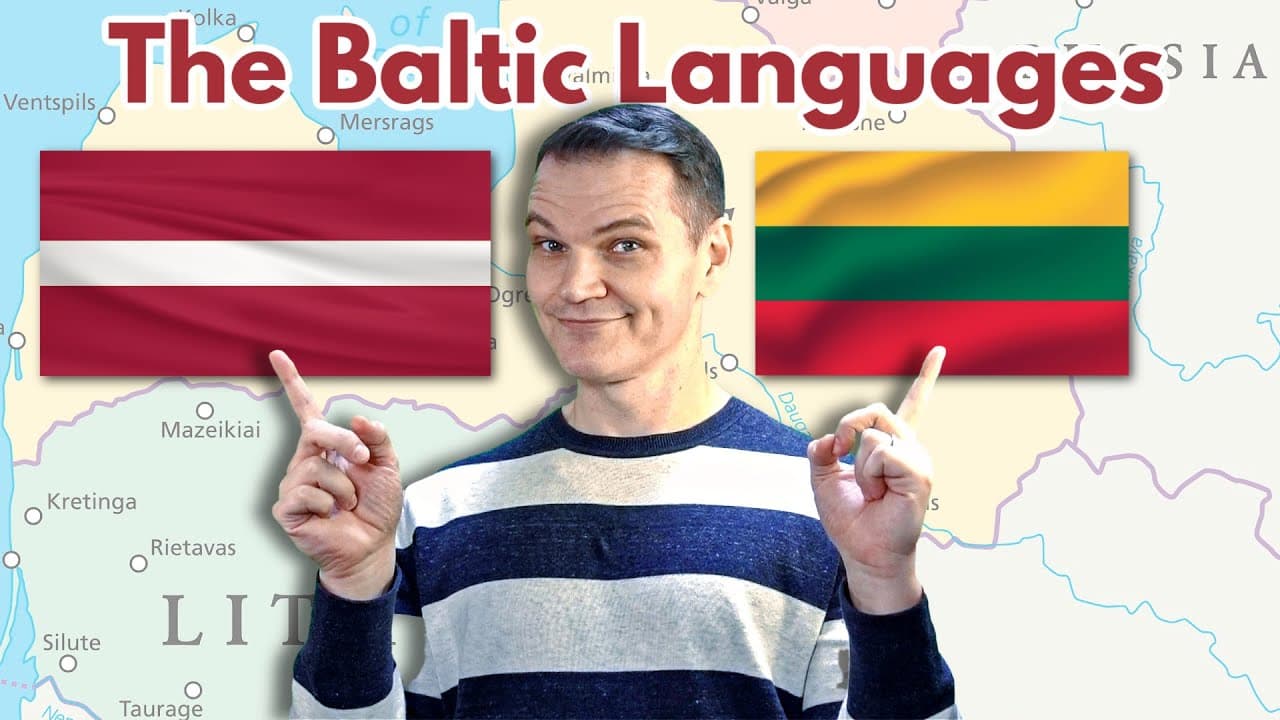
Lithuanian and Latvian are the only two living Baltic languages, but they are generally not mutually intelligible. Both preserve conservative Indo-European features, including seven grammatical cases, extensive inflection, flexible word order, and pitch accent, while differing in vocabulary, stress, sound patterns, and historical influences from neighboring languages and ruling powers.
Transcript
the Indo-European language family includes languages as diverse as English Spanish Greek Russian Persian and Hindi which have been changing and diverging from each other for thousands of years and are now radically different from their common ancestor language Proto Indo-European it's often said that the Indo-European languages that retain the most... Read More
Key Insights
- Lithuanian and Latvian are the only living Baltic languages discussed as undisputed languages, although Latgalian and Samogitian are sometimes treated as separate languages rather than dialects. Estonia is geographically Baltic, but Estonian belongs to the Finnic family and has entirely different linguistic origins.
- Lithuanian is the more conservative of the two living Baltic languages and retains numerous features associated with earlier Indo-European stages. The proposed explanation is that Lithuanian-speaking communities experienced less non-Baltic influence, while Latvian developed through closer contact with Finnic-speaking Livonians.
- Lithuanian and Latvian are related but generally not mutually intelligible. They share cognates and grammatical structures, yet much of their vocabulary differs, and similar words can carry somewhat different meanings. A speaker may sometimes recognize a sentence through cognates without understanding the languages broadly.
- Baltic language history is documented relatively late because these languages were not written during much of their early development. The oldest surviving Baltic writing is a fourteenth-century Old Prussian text, Lithuanian first appeared in writing in the fifteenth century, and Latvian writing dates from the sixteenth century.
- German, Polish, and Russian rule affected Baltic language development in different periods. German influenced orthography and vocabulary, Polish supplied loanwords to Latvian and especially Lithuanian, and Russian authorities pursued Russification through education, publishing restrictions, and pressure to replace local languages.
- Lithuanian print media using the Latin script was banned from 1865 to 1904 under the Russian Empire. Lithuanians continued using the script secretly and smuggled books printed across the border in Lithuania Minor, demonstrating organized resistance to official efforts to impose Cyrillic.
- Lithuanian and Latvian are highly inflected languages with seven grammatical cases: nominative, genitive, dative, accusative, instrumental, locative, and vocative. Nouns follow several declension patterns, so speakers must learn numerous endings that identify grammatical roles without depending exclusively on sentence position.
- Pitch accent distinguishes words in both languages, but the systems differ. Lithuanian has a two-tone distinction described as falling and rising, while Latvian has three tones described as level, falling, and broken. Latvian normally stresses the first syllable, whereas Lithuanian stress varies among words.
Install to Summarize YouTube Videos and Get Transcripts
Explore YouTube Video Summarizer or Get YouTube Transcript Extractor
Questions & Answers
Q: What are the living Baltic languages?
Lithuanian and Latvian are the two living Baltic languages identified in the account. Latgalian, normally treated as a Latvian dialect, is sometimes classified as a distinct language, and the same debate applies to Samogitian within Lithuanian. Old Prussian belonged to the Western Baltic branch but disappeared by the eighteenth century after Germanization and assimilation of its speakers.
Q: Are Lithuanian and Latvian mutually intelligible?
Lithuanian and Latvian are generally not mutually intelligible, despite sharing substantial vocabulary, cognates, and grammatical features. Their words can differ completely, and related words may carry somewhat different meanings. A Lithuanian speaker might understand an individual Latvian sentence when recognizable cognates align, but that limited recognition does not make ordinary communication between the two languages reliably understandable.
Q: Why are Baltic languages considered conservative?
Baltic languages are considered conservative because they retain Indo-European features that most other living members of the family have lost. Lithuanian is described as more conservative than Latvian, but neither is the same as Proto-Indo-European. Their conservatism is associated with the relative isolation of Baltic peoples during early migrations, although direct written evidence about their early development is scarce.
Q: How are Baltic and Slavic languages historically related?
Baltic and Slavic languages are theorized to descend from a shared Proto-Balto-Slavic language spoken as far back as 3,500 years ago. Proto-Baltic later divided into Western Baltic, including Old Prussian and other extinct languages, and Eastern Baltic, represented by Lithuanian and Latvian. Definite adjective forms are one grammatical feature traced to Proto-Balto-Slavic and retained in Slavic languages as well.
Q: How did foreign rule influence Lithuanian and Latvian?
Foreign rule introduced linguistic pressure and outside vocabulary into Lithuanian and Latvian. German influenced early orthography and vocabulary, Polish became an upper-class and urban language in the Polish-Lithuanian Commonwealth, and Russian authorities promoted Russification. During later independence, language reformers removed some German, Polish, and Russian influences, though they did not eliminate them entirely from everyday usage.
Q: How did Lithuanians resist the Latin-script printing ban?
From 1865 to 1904, Russian imperial authorities banned Lithuanian print media written in the Latin script and demanded Cyrillic instead. Lithuanians continued using the Latin alphabet secretly and smuggled books across the border. Those books were printed in Lithuania Minor, which was then part of the German Empire, allowing prohibited Lithuanian publications to keep circulating despite official restrictions.
Q: How do noun cases work in Lithuanian and Latvian?
Lithuanian and Latvian use seven noun cases: nominative, genitive, dative, accusative, instrumental, locative, and vocative. Case endings show how a noun functions within a sentence, helping permit flexible word order. The precise endings differ between the languages. Latvian has six declension patterns, split into three masculine and three feminine groups, while Lithuanian has five declension patterns.
Q: How do Lithuanian and Latvian verbs mark their subjects?
Verbs in both languages combine a stem with inflectional suffixes and are conjugated for person and number. First- and second-person subject pronouns can usually be omitted because verb endings identify the subject. Third-person pronouns are generally retained because the third-person singular and plural verb forms are identical, creating ambiguity between subjects such as he and they.
Summary & Key Takeaways
-
Lithuanian and Latvian descend from the Eastern Baltic branch, while Old Prussian and other extinct languages belonged to Western Baltic. Baltic and Slavic are theorized to share Proto-Balto-Slavic ancestry. Lithuanian is considered more conservative than Latvian, although neither language is identical to Proto-Indo-European and direct historical evidence is limited.
-
The Baltic languages developed under German, Polish, Swedish, Russian, and Soviet political influence. German affected early writing and vocabulary, Polish contributed loanwords, and Russian authorities promoted Russification. Lithuanian and Latvian speakers repeatedly resisted language suppression, strengthened their languages during independence, and maintained them through Soviet occupation until independence returned in 1991.
-
Lithuanian and Latvian share seven noun cases, extensive declension, person and number marking on verbs, optional first- and second-person pronouns, flexible word order, and adjective forms that can express definiteness. Their important differences include vocabulary, accent systems, stress placement, consonant patterns, and the amount of influence received from Finnic languages.
Read in Other Languages (beta)
Share This Summary 📚
Summarize YouTube Videos and Get Video Transcripts with 1-Click
Try YouTube Summary with ChatGPT & Claude or YouTube Transcript Generator
Explore More Summaries from Langfocus 📚



Summarize YouTube Videos and Get Video Transcripts with 1-Click
Try YouTube Summary with ChatGPT & Claude or YouTube Transcript Generator