How to choose between LLMs and AI agents for tasks
TL;DR
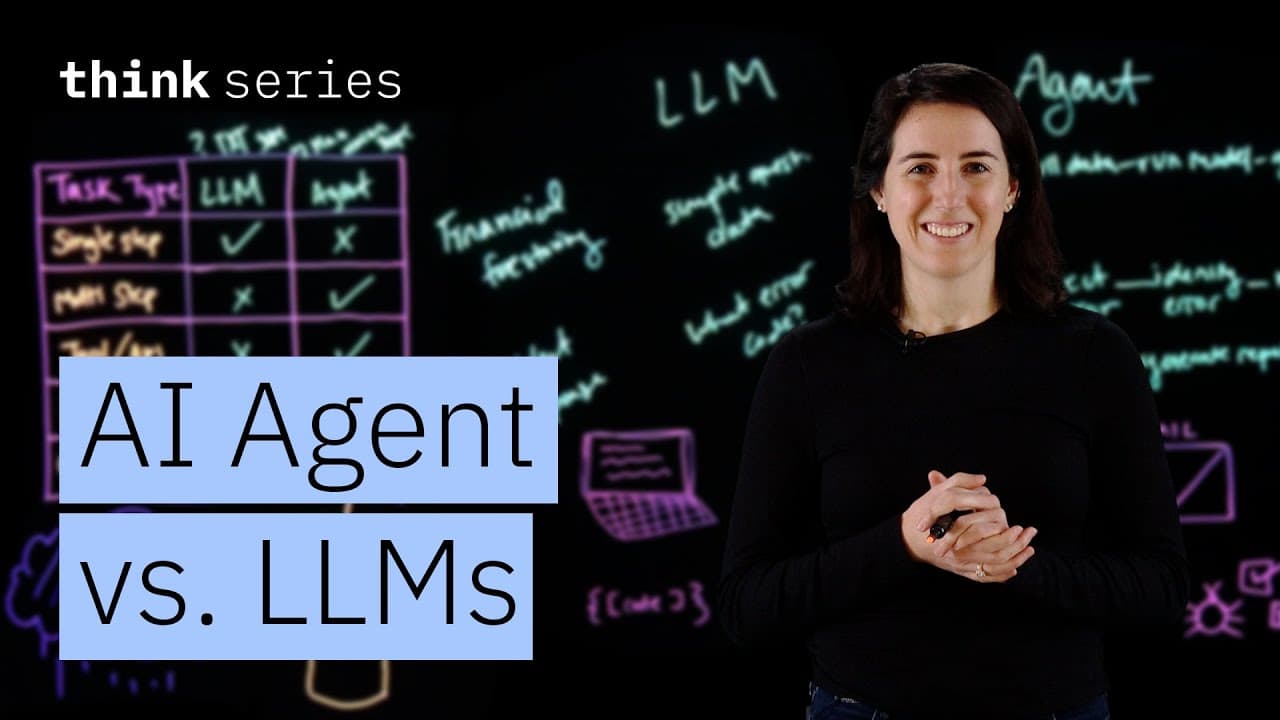
LLMs are best for quick, single-step tasks with fast results, while AI agents shine on complex, multistep workflows that involve planning and using external tools. Use an LLM when speed and simplicity are key, and opt for an agent when tasks require orchestration, tools, and autonomy. The right choice depends on task complexity and tool needs.
Transcript
Imagine you walk into your favorite coffee shop and you say, I'd like something warm, not too sweet and good for a rainy day. One approach is like an agentic system. The barista starts asking, do you want dairy? What size? What temperature? Tea or coffee? It's thorough, but can feel like answering a questionnaire just to get a single drink. Now, im... Read More
Key Insights
- LLMs excel at single step tasks and fast results without planning or tool use
- Agents excel at multistep reasoning and when external tools or autonomy are required
- Speed and overhead are the deciding factors for choosing an LLM over an agent
- Agent use cases include automating workflows, data analysis, and research assistance
- LLMs can handle simple queries like performance trends without needing orchestration
- For multistep tasks such as data pulling followed by modeling and emailing results, an agent is preferable
- Comparison examples show LLM for blog writing and code snippets, agent for workflow and reporting
- Ask if the task truly requires planning or tool interaction to decide between LLM and agent
Install to Summarize YouTube Videos and Get Transcripts
Explore YouTube Video Summarizer or Get YouTube Transcript Extractor
Questions & Answers
Q: How to decide if I should use an LLM or an AI agent for a task
Use an LLM when the task is simple and can be completed in one step with a quick answer or generation, avoiding extra setup. If the task involves multiple steps, decision making, or the need to interact with tools and data sources, an agent is the better choice because it can plan, coordinate, and execute the workflow across tools.
Q: What is an AI agent in the context of AI workflows
An AI agent is a mini AI assistant that can plan, reason, and perform multiple steps. It may search the web, run code, and interact with tools autonomously. Agents typically use LLMs under the hood but add orchestration, tool use, and decision making to complete complex tasks.
Q: When should I use an LLM for content creation
Use an LLM for content creation when the task is straightforward and requires a quick, one-off result such as writing an email, summarizing a document, translating text, or generating ideas. In these cases, speed and simplicity trump the need for planning or external tool integration.
Q: What are common use cases for AI agents
Common use cases for AI agents include automating workflows, data analysis, research assistant tasks, and automated conversational systems. They are especially effective when a task requires multistep workflow, coordination across tools or APIs, and autonomous decision making to determine the next steps.
Q: Can an LLM handle multi-step tasks without an agent
An LLM can handle some multi-step tasks if the steps are simple and can be sequenced in a single prompt. However, for tasks requiring planning, tool calls, data retrieval, or conditional decision making across steps, an agent provides better structure and reliability by managing the orchestration and tool interactions.
Q: What is the benefit of using an agent for incident response or IT tasks
In incident response or IT tasks, agents can detect errors, identify root causes, resolve issues, notify the operations team, and generate reports in a coordinated, multistep process. This orchestration across tools and systems reduces manual effort and increases consistency in handling complex events.
Q: How does speed influence the choice between LLMs and agents
Speed influences the choice because LLMs generally provide faster results with less overhead for simple tasks, while agents add orchestration and tool calls that introduce some latency but enable complex, autonomous workflows. Choose speed-focused LLMs for quick answers and agents for complex tasks.
Q: What scenario favors using an LLM for code generation
Generating code snippets is a scenario that favors an LLM when you need a quick, single task output. The prompt remains straightforward, and the result can be produced rapidly without coordinating multiple tools. For longer development cycles including testing and deployment, an agent might be more appropriate.
Summary & Key Takeaways
-
LLMs handle simple, single-step tasks quickly without external tool calls, making them ideal for fast answers and quick content generation
-
Agents provide multistep reasoning, planning, and tool integration, suitable for complex workflows that require data pulling, model runs, chart generation, and automated reporting
-
The video compares scenarios like writing a blog post, researching competitors, generating code, and debugging to illustrate when to use LLMs versus agents
Read in Other Languages (beta)
Share This Summary 📚
Summarize YouTube Videos and Get Video Transcripts with 1-Click
Try YouTube Summary with ChatGPT & Claude or YouTube Transcript Generator
Explore More Summaries from IBM Technology 📚




Summarize YouTube Videos and Get Video Transcripts with 1-Click
Try YouTube Summary with ChatGPT & Claude or YouTube Transcript Generator