How to Turn Fear Into Resilience and Action
TL;DR
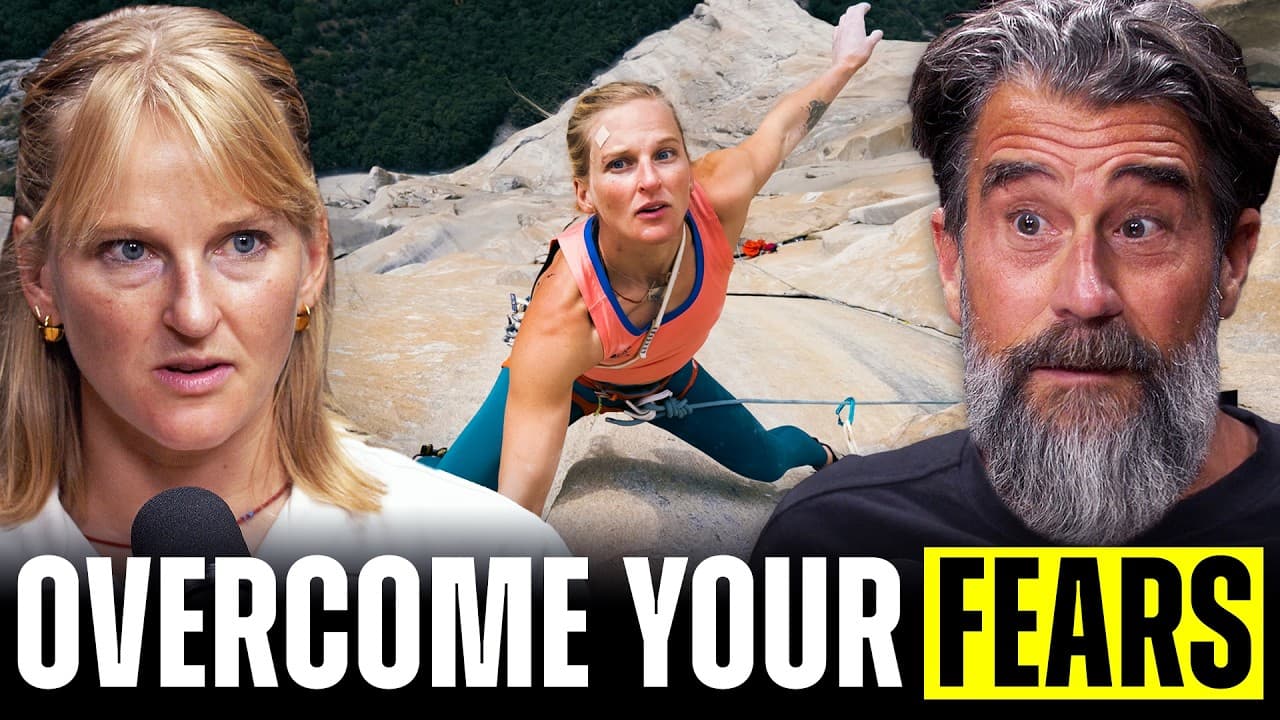
Fear becomes useful when it prompts honest risk assessment instead of automatic retreat or forced confidence. After a 50-foot fall, Emily Harrington identified controllable mistakes, including climbing despite warning signs, moving too fast, and placing too little protection, then returned with stronger preparation and greater agency to become the first woman to free climb El Capitan’s Golden Gate route in under 24 hours.
Transcript
Can we talk about the fall? Like I don't want to give away every everything, but like we have to talk about this. Yeah, that was an unfortunate incident. I'm this lay person who has this privileged opportunity to host all these conversations with all of these climbers. Like Alex has been here a couple times. Your husband, what a beautiful man, Adri... Read More
Key Insights
- Fear is useful information when it reveals hesitation, exhaustion, unsafe conditions, or a damaging mindset. Harrington remembered not wanting to climb at 3:00 in the morning, yet she suppressed those warnings and relied on repeated commands to be confident and keep moving.
- A punishment mindset can impair judgment during a demanding objective. Harrington approached attempt three with a desire to suck it up and finish, even though a 24-hour ascent of El Capitan required sustained physical energy, mental clarity, and decisions responsive to changing conditions.
- The 50-foot fall followed several controllable risk decisions. Harrington climbed in cold, humid conditions before an approaching storm, placed little protective gear while simul-climbing for speed, and continued despite anxious energy and persistent internal warning signs.
- Simul-climbing is a speed tactic in which two climbers ascend together while connected by a rope. Harrington described it as faster than ordinary pitch-by-pitch free climbing, but also as a situation where falling is undesirable for either climber.
- Agency after failure comes from separating controllable mistakes from unpredictable hazards. Harrington concluded that her accident was not caused by random rockfall or an avalanche, because she could change when she climbed, how much gear she placed, and how fast she moved.
- Risk cannot be eliminated merely by mastering the required climbing moves. The conversation emphasizes that climbers and mountain athletes accept some uncertainty because nature can still produce harmful outcomes even when preparation, technique, and decision-making appear sound.
- Resilience is compatible with careful medical assessment. After Harrington hit her head during attempt four, her team conducted first-aid and concussion checks before considering whether she could continue, drawing on their wilderness first responder training and Adrian’s experience as a mountain guide.
- Preparation for another attempt included training and practicing the wall’s difficult sections. Harrington returned the following season after the serious fall, faced another frightening setback, and ultimately became the first woman to free climb the Golden Gate route on El Capitan in under 24 hours.
Install to Summarize YouTube Videos and Get Transcripts
Explore YouTube Video Summarizer or Get YouTube Transcript Extractor
Questions & Answers
Q: How did fear contribute to Emily Harrington’s climbing accident?
Fear contributed indirectly because Harrington treated it as something to suppress rather than information to examine. She woke around 3:00 in the morning feeling afraid, hesitant, and unwilling to climb, but told herself to suck it up. She continued despite cold, humidity, an approaching storm, and anxious energy, then moved quickly and placed little protective gear before falling about 50 feet.
Q: What caused Emily Harrington’s 50-foot fall on El Capitan?
Harrington recalled slipping, possibly because her foot lost contact with the wall, while moving rapidly during a simul-climbing section. She had placed relatively little protective gear because stopping would slow the ascent and the protection needed to cover a long distance. The resulting fall was about 50 feet, and the slab-like wall caused her to tumble, hit a ledge, flip upside down, and strike her head.
Q: What did Emily Harrington learn from her fall?
Harrington learned that the accident involved several choices she could control. She could decide when to climb, how much protective gear to place, and how quickly to move. Because the fall was not attributed to an unpredictable event such as random rockfall or an avalanche, she believed she retained meaningful agency and could reduce similar risks by making different decisions on future attempts.
Q: Why did Emily Harrington return after the accident?
Harrington returned because she did not view the fall as proof that the objective itself was impossible. She recognized specific, controllable mistakes that could be changed, which gave her a path forward rather than only fear. She trained during the following season, worked on difficult sections of the wall, and pursued the goal again, ultimately completing the Golden Gate route in under 24 hours.
Q: What is simul-climbing and why did Harrington use it?
Simul-climbing is a method in which two climbers ascend at the same time while remaining connected by a rope. Harrington described it as occupying a space between ordinary pitch-by-pitch free climbing and free soloing. She and Alex Honnold used it on the lower route because it allowed them to move much faster, although a fall by either climber was not considered ideal.
Q: How did perfectionism affect Harrington’s decision-making?
Harrington’s determination to complete the objective created a ticking-clock feeling after she narrowly failed near the final hard section. Instead of taking a longer recovery period after expending substantial physical and mental energy, she tried again within roughly a week to 10 days. Her desire to finish that year encouraged a punishment mindset in which she dismissed hesitation and pushed forward despite multiple warning signs.
Q: How did Harrington’s team respond after she hit her head on attempt four?
Harrington’s team performed a substantial first-aid and concussion assessment before deciding what should happen next. She had fallen, struck her head, was bleeding, and became highly emotional, but she did not lose consciousness during that incident. Harrington said the team members were wilderness first responders, while her husband Adrian had additional experience handling such situations through his profession as a mountain guide.
Q: How can fear be turned into resilience according to Harrington’s experience?
Fear can support resilience when it leads to honest evaluation and specific changes rather than denial or permanent withdrawal. Harrington’s experience suggests identifying warning signs, reviewing controllable decisions, improving preparation, and accepting that some uncertainty remains. Her return was grounded in the belief that she could choose better timing, protection, pacing, and training, while still maintaining humility about the risks of climbing in nature.
Summary & Key Takeaways
-
Emily Harrington attempted to free climb El Capitan’s Golden Gate route in under 24 hours. After narrowly failing near the final hard section on an earlier attempt, she returned within roughly a week to 10 days, despite feeling afraid, hesitant, physically depleted, and mentally resistant before the climb began.
-
During attempt three, Harrington ignored internal warning signs, moved quickly while simul-climbing, and placed little protective gear. Her foot apparently slipped, causing a fall of about 50 feet on less-than-vertical rock. She tumbled onto a ledge, flipped upside down, hit her head, and briefly lost consciousness before being evacuated.
-
Harrington recognized that many causes of the accident were within her control, including when she climbed, how much protection she placed, and how quickly she moved. She trained for the next season and returned. Her experience highlights resilience, honest self-assessment, vulnerability, preparation, and the humility required when pursuing dangerous objectives in nature.
Read in Other Languages (beta)
Share This Summary 📚
Summarize YouTube Videos and Get Video Transcripts with 1-Click
Try YouTube Summary with ChatGPT & Claude or YouTube Transcript Generator
Explore More Summaries from Rich Roll 📚






Summarize YouTube Videos and Get Video Transcripts with 1-Click
Try YouTube Summary with ChatGPT & Claude or YouTube Transcript Generator