What Are Galaxies and How Do They Form?
TL;DR
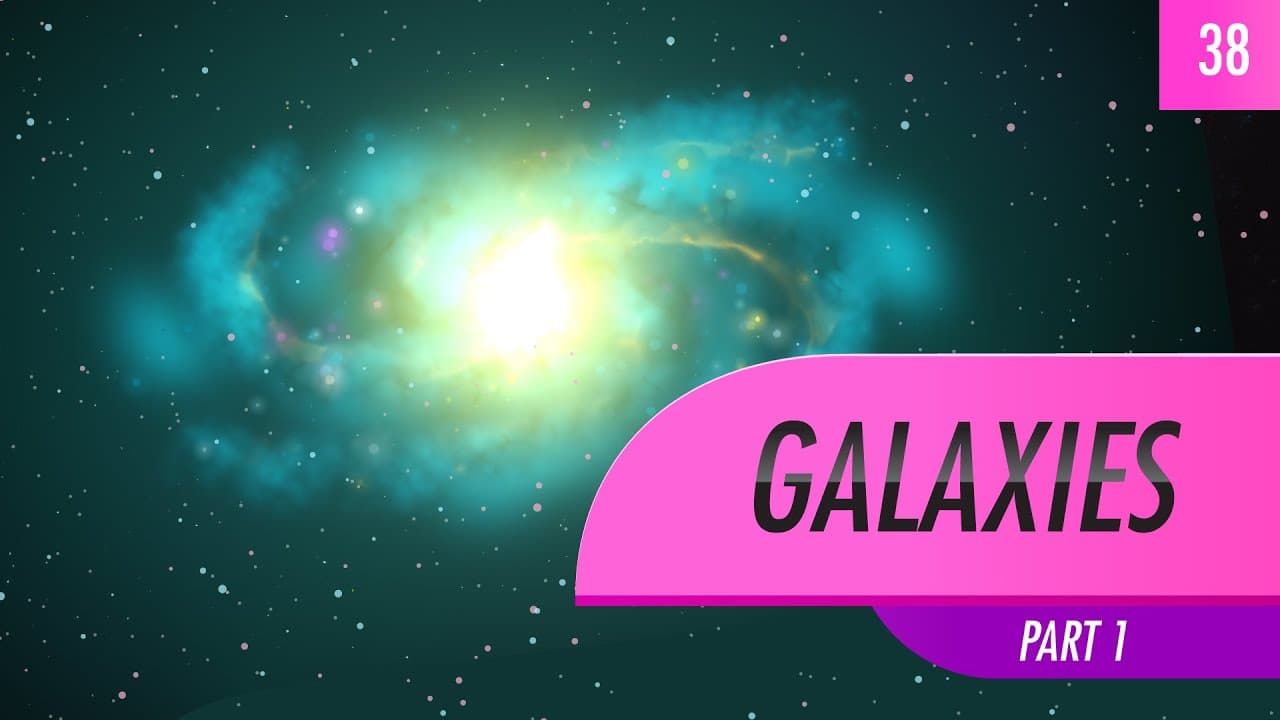
Galaxies are vast collections of stars, gas, and dust, coming in various shapes such as spiral, elliptical, peculiar, and irregular. They can collide and merge, growing larger over time. The discovery of galaxies beyond the Milky Way significantly expanded our understanding of the universe's size and structure.
Transcript
We live in a pretty cool neighborhood: the Milky Way galaxy. We’re out in the suburbs, sure, but it’s still an interesting place, buzzing with activity. Stars, nebulae, stellar clusters of various sorts, the occasional supernova. It’s a happening place. In the earliest part of the 20th century, astronomers were just starting to figure this all out.... Read More
Key Insights
- Galaxies are large systems containing millions to trillions of stars, along with gas and dust.
- The Milky Way is a spiral galaxy, characterized by a flat rotating disk and a central bulge.
- In the early 20th century, there was debate whether spiral nebulae were part of the Milky Way or separate galaxies.
- Edwin Hubble's observation of Cepheid variables in Andromeda proved it was a separate galaxy.
- Galaxies can collide, leading to the formation of elliptical galaxies through merging.
- Spiral galaxies can have various structures, including bars and different types of spiral arms.
- Elliptical galaxies are generally older, with less gas and dust, and are formed from galactic collisions.
- Peculiar and irregular galaxies often result from interactions or collisions with other galaxies.
Install to Summarize YouTube Videos and Get Transcripts
Explore YouTube Video Summarizer or Get YouTube Transcript Extractor
Questions & Answers
Q: What are the main types of galaxies?
The main types of galaxies are spiral, elliptical, peculiar, and irregular. Spiral galaxies, like the Milky Way, have a flat, rotating disk with a central bulge and spiral arms. Elliptical galaxies are more spherical, with older stars and less gas and dust. Peculiar and irregular galaxies often result from galactic interactions or collisions, displaying unique or chaotic shapes.
Q: How did Edwin Hubble prove that Andromeda is a galaxy?
Edwin Hubble used the largest telescope of his time to observe Cepheid variables in the Andromeda Nebula. By measuring their periodic brightness changes, he determined their luminosity and distance, which was far beyond the Milky Way's size. This observation confirmed that Andromeda was a separate galaxy, expanding the known universe's scale.
Q: Why do galaxies collide, and what happens when they do?
Galaxies collide due to their gravitational attraction when they come close enough. During a collision, stars rarely collide due to the vast distances between them, but gas clouds can collide, triggering new star formation. Over millions of years, the galaxies may merge, forming larger elliptical galaxies. These interactions can result in peculiar shapes and structures.
Q: What are spiral galaxies, and how are they structured?
Spiral galaxies have a flat, rotating disk of stars, gas, and dust, with a central bulge of older stars. They often feature spiral arms, which can be tightly wound or loosely extended. Some spirals have bars of stars across their centers. The Milky Way is a spiral galaxy, and these structures contribute to their diverse appearances.
Q: What characterizes elliptical galaxies?
Elliptical galaxies are more spherical or elongated, lacking the distinct structure of spiral galaxies. They contain older stars, with little gas and dust, indicating that star formation occurred long ago. These galaxies vary in size from small dwarfs to massive giants and are often formed from the merger of smaller galaxies.
Q: What are peculiar galaxies, and how do they form?
Peculiar galaxies have unusual shapes and structures, often resulting from galactic collisions or interactions. These events can disrupt the galaxies' original forms, creating unique appearances. For example, ring galaxies may form when a smaller galaxy passes through a larger one, causing gravitational disturbances that reshape the stars and gas.
Q: What defines irregular galaxies?
Irregular galaxies lack a distinct shape or structure, often appearing chaotic. They are typically smaller and may be the result of gravitational interactions or collisions with other galaxies. Some irregular galaxies are simply too small to form a coherent shape, while others are remnants of disrupted larger galaxies.
Q: How do galaxies grow over time?
Galaxies grow by merging with or absorbing smaller galaxies, a process known as galactic cannibalism. This can occur when a larger galaxy's gravitational pull attracts and incorporates smaller neighboring galaxies. Over time, these mergers contribute to the growth of the larger galaxy, adding stars, gas, and dust to its mass, as seen in the Milky Way's ongoing absorption of smaller galaxies.
Summary & Key Takeaways
-
Galaxies are vast collections of stars, gas, and dust, with the Milky Way being a spiral galaxy. They come in different shapes, including elliptical, peculiar, and irregular. The discovery of galaxies beyond the Milky Way expanded our understanding of the universe's scale, revealing that galaxies can collide and merge, leading to new formations.
-
In the early 20th century, astronomers debated whether spiral nebulae were part of the Milky Way or separate galaxies. Edwin Hubble's work with Cepheid variables in the Andromeda Galaxy confirmed it as a separate entity, expanding the known universe's size. Galaxies can collide, forming elliptical galaxies through merging.
-
Spiral galaxies, like the Milky Way, have distinct structures such as bars and spiral arms. Elliptical galaxies are older, with less gas and dust, often resulting from galactic collisions. Peculiar and irregular galaxies usually form from interactions or collisions, showcasing the dynamic nature of the universe.
Read in Other Languages (beta)
Share This Summary 📚
Summarize YouTube Videos and Get Video Transcripts with 1-Click
Try YouTube Summary with ChatGPT & Claude or YouTube Transcript Generator
Explore More Summaries from CrashCourse 📚


Summarize YouTube Videos and Get Video Transcripts with 1-Click
Try YouTube Summary with ChatGPT & Claude or YouTube Transcript Generator