How Do Skeletal Muscles Function and Move?
TL;DR
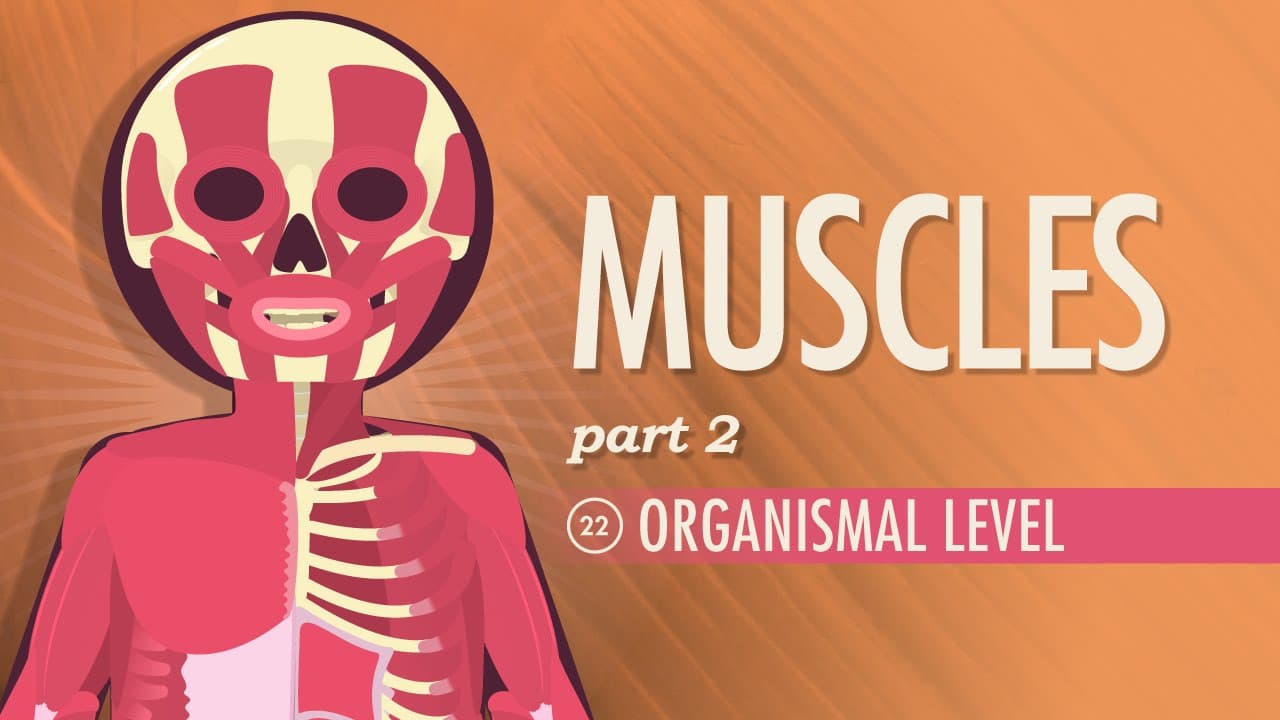
Skeletal muscles perform movements by pulling on bones, never pushing. Motor units, composed of muscle fibers and a motor neuron, determine the strength and precision of muscle contractions. Muscles work in groups such as prime movers, antagonists, and synergists to create, reverse, and stabilize movements.
Transcript
You’ve probably heard somebody refer to a really difficult, onerous task as “the heavy lifting.” Or maybe when someone else tells you that you have to do hard work on your own, they’ll say: “You can’t have somebody else do your pushups for you.” So, yeah, often when we’re talking about hard work that we just don’t want to do, we use metaphors that ... Read More
Key Insights
- Skeletal muscles always pull, never push. Movements are created by muscles pulling insertion points toward origin points.
- Muscles are functionally grouped as prime movers, antagonists, and synergists, each playing distinct roles in movement.
- Motor units consist of muscle fibers and a single motor neuron, dictating muscle contraction strength and precision.
- Muscle twitches have three phases: latent, contraction, and relaxation, affecting how muscles contract and relax.
- Temporal summation occurs when twitches are close together, increasing force, while tetanus is a sustained contraction.
- Recruitment is the process of activating more motor units to increase muscle contraction force.
- The size principle states smaller motor units are activated first, with larger ones recruited as needed for greater force.
- Isotonic movements change muscle length during contraction, while isometric movements generate tension without length change.
Install to Summarize YouTube Videos and Get Transcripts
Explore YouTube Video Summarizer or Get YouTube Transcript Extractor
Questions & Answers
Q: How do skeletal muscles create movement?
Skeletal muscles create movement by pulling on bones. They attach over joints, connecting to two different bones, and when they contract, they pull the insertion point (the bone that moves) toward the origin point (the bone that moves less). This pulling action, rather than pushing, is how muscles facilitate movement.
Q: What are the functional groups of skeletal muscles?
Skeletal muscles are classified into four functional groups: prime movers (agonists), which are mainly responsible for producing a movement; antagonists, which reverse or resist a movement; synergists, which assist prime movers by adding force or stabilizing joints; and fixators, which stabilize the origin of the prime movers.
Q: What is a motor unit and its role in muscle contractions?
A motor unit consists of a group of muscle fibers innervated by a single motor neuron. The motor unit plays a crucial role in muscle contractions by determining the strength and precision of these contractions. Large motor units with many fibers are responsible for powerful movements, while small motor units allow for fine motor control.
Q: What are the phases of a muscle twitch?
A muscle twitch consists of three phases: the latent period, where the stimulus has arrived but no force is produced; the contraction period, where myosin heads bind and the muscle fibers contract; and the relaxation period, where calcium is pumped back into the sarcoplasmic reticulum, stopping the binding cycle and relaxing the muscle.
Q: How does temporal summation affect muscle force?
Temporal summation affects muscle force by increasing the frequency of nerve impulses, leading to successive twitches that overlap. As the relaxation period shortens, more calcium is released, exposing more actin for myosin to bind, resulting in a stronger force in the muscle fiber. This process continues until maximum force is reached in tetanus.
Q: What is the recruitment process in muscle contractions?
Recruitment, or multiple motor unit summation, is the process of increasing muscle contraction force by activating more motor units. It follows the size principle, where smaller motor units with smaller fibers are activated first, followed by larger motor units with larger fibers, allowing for a controlled increase in contraction strength.
Q: What is the size principle in muscle recruitment?
The size principle in muscle recruitment describes the order in which motor units are activated to increase contraction strength. Initially, the smallest motor units with the smallest fibers are activated by the most excitable neurons. As more force is required, larger motor units with larger fibers are recruited, allowing for a progressive increase in muscle contraction force.
Q: What is the difference between isotonic and isometric movements?
Isotonic movements involve a change in muscle length during contraction, allowing for movement of a load, such as lifting a weight. In contrast, isometric movements generate tension without changing the muscle's length, as seen when holding a position against a force. Both types of movements are essential for different physical activities and exercises.
Summary & Key Takeaways
-
Skeletal muscles create movement by pulling, not pushing. They attach over joints and pull insertion points toward origin points. Muscles are grouped into prime movers, antagonists, and synergists, each with a specific role in movement.
-
Motor units, composed of muscle fibers and a motor neuron, determine the strength and precision of muscle contractions. Muscle twitches consist of latent, contraction, and relaxation phases, influencing how muscles contract and relax.
-
Temporal summation increases force by overlapping twitches, while tetanus is a sustained contraction. Recruitment activates more motor units for greater force, following the size principle where smaller units activate first. Isotonic movements change muscle length, whereas isometric ones do not.
Read in Other Languages (beta)
Share This Summary 📚
Summarize YouTube Videos and Get Video Transcripts with 1-Click
Try YouTube Summary with ChatGPT & Claude or YouTube Transcript Generator
Explore More Summaries from CrashCourse 📚
Summarize YouTube Videos and Get Video Transcripts with 1-Click
Try YouTube Summary with ChatGPT & Claude or YouTube Transcript Generator