How to use Python dictionaries: create, length, and constructor
TL;DR
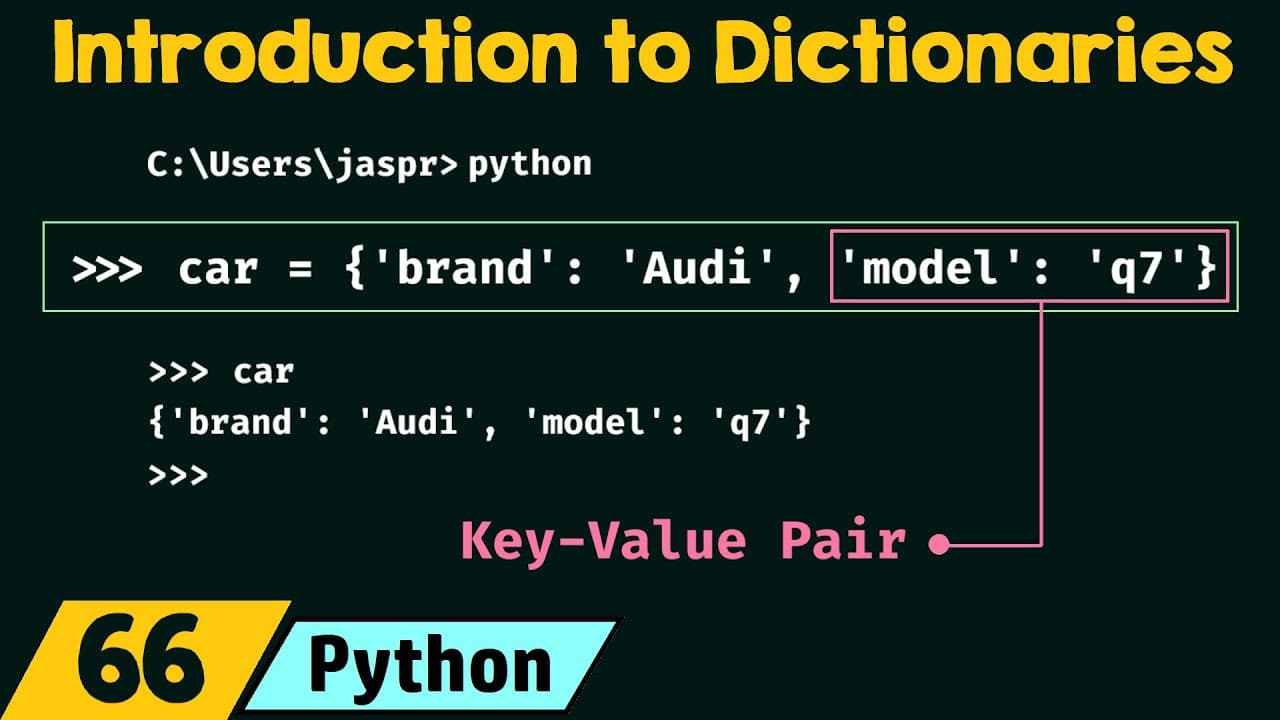
Dictionaries store data as key value pairs and are mutable. Create them with curly braces or the dict() constructor, note that duplicate keys keep the last value, and use len() to count pairs. This video demonstrates creating a sample car dictionary, updating values, and checking its size.
Transcript
foreign onwards we will understand dictionaries in Python in this presentation I will introduce you to the concepts of dictionaries this lecture is all about the introduction to dictionaries so let's get started with this lecture and see all the topics of this presentation the first topic is Introduction to dictionaries the second topic is length o... Read More
Key Insights
- Dictionaries are defined as a collection of key value pairs with unique keys
- Dictionaries store any Python object as a value
- Keys must be unique; later duplicates overwrite earlier ones
- Dictionaries are mutable, allowing in place updates to values
- Updating a value uses the key inside square brackets and assignment
- The len function returns the count of key value pairs in a dictionary
- The dict constructor offers an alternative creation method
- Both creation methods result in the same dictionary structure
Install to Summarize YouTube Videos and Get Transcripts
Explore YouTube Video Summarizer or Get YouTube Transcript Extractor
Questions & Answers
Q: How do you create a dictionary in Python using curly braces
A dictionary can be created by writing key value pairs inside curly braces with a colon separating the key and the value. Separate multiple pairs with a comma. For example, dictName = { 'brand': 'OD', 'model': 'Q7' } creates two pairs. If a key repeats, the later value overwrites the earlier one, keeping the most recent entry for that key.
Q: What happens if you have two identical keys in a dictionary creation
When two identical keys are present in a dictionary creation, only the last key value pair for that key is stored. This means the dictionary ends up containing the most recent value for that key, and the earlier value is discarded silently without an error.
Q: How can you update a dictionary value
To update a dictionary value, reference the key in square brackets and assign a new value, for example dictName['model'] = 'Q8'. This changes only the value associated with that key while leaving other pairs intact. Printing the dictionary after the update shows the new value.
Q: What is the syntax to create a dictionary using the dict constructor
The dict constructor creates a dictionary using keyword arguments or key value pairs separated by equals signs, for example Car = dict(brand='OD', model='Q7'). In this form, the keys are not quoted and are taken from the argument names, producing the same two key value pairs as curly brace notation.
Q: How do you determine the number of key value pairs in a dictionary
The number of key value pairs is determined using the len function, applied to the dictionary like len(Car). This returns the count of pairs, which is not the total number of keys or values separately, but the number of mappings present in the dictionary.
Q: Why are dictionaries considered mutable
Dictionaries are mutable because you can change their contents after creation. You can add new key value pairs, update existing values, or remove pairs. This mutability makes dictionaries a flexible data structure for storing and updating structured data during program execution.
Q: What is a key in a Python dictionary
A key in a Python dictionary acts as a unique identifier for its associated value. Keys must be unique within a dictionary; attempting to reuse a key results in the latter value overwriting the former. Values can be any Python object, including strings, numbers, lists, or even other dictionaries.
Q: Can dictionaries store non string keys
Yes, dictionaries can store keys of various immutable types such as strings, numbers, and tuples. The important rule is that keys must be hashable to ensure they can be used to map to values efficiently. The video demonstrates string keys, but numeric keys are also valid in Python dictionaries.
Summary & Key Takeaways
-
A dictionary in Python is a collection of key value pairs where keys act as unique identifiers and values can be any object.
-
Dictionaries are mutable and support updating values by key, which allows dynamic data changes during runtime.
-
The length of a dictionary is the number of key value pairs and can be obtained using the len function, not by counting keys or values separately.
Read in Other Languages (beta)
Share This Summary 📚
Summarize YouTube Videos and Get Video Transcripts with 1-Click
Try YouTube Summary with ChatGPT & Claude or YouTube Transcript Generator
Explore More Summaries from Neso Academy 📚





Summarize YouTube Videos and Get Video Transcripts with 1-Click
Try YouTube Summary with ChatGPT & Claude or YouTube Transcript Generator