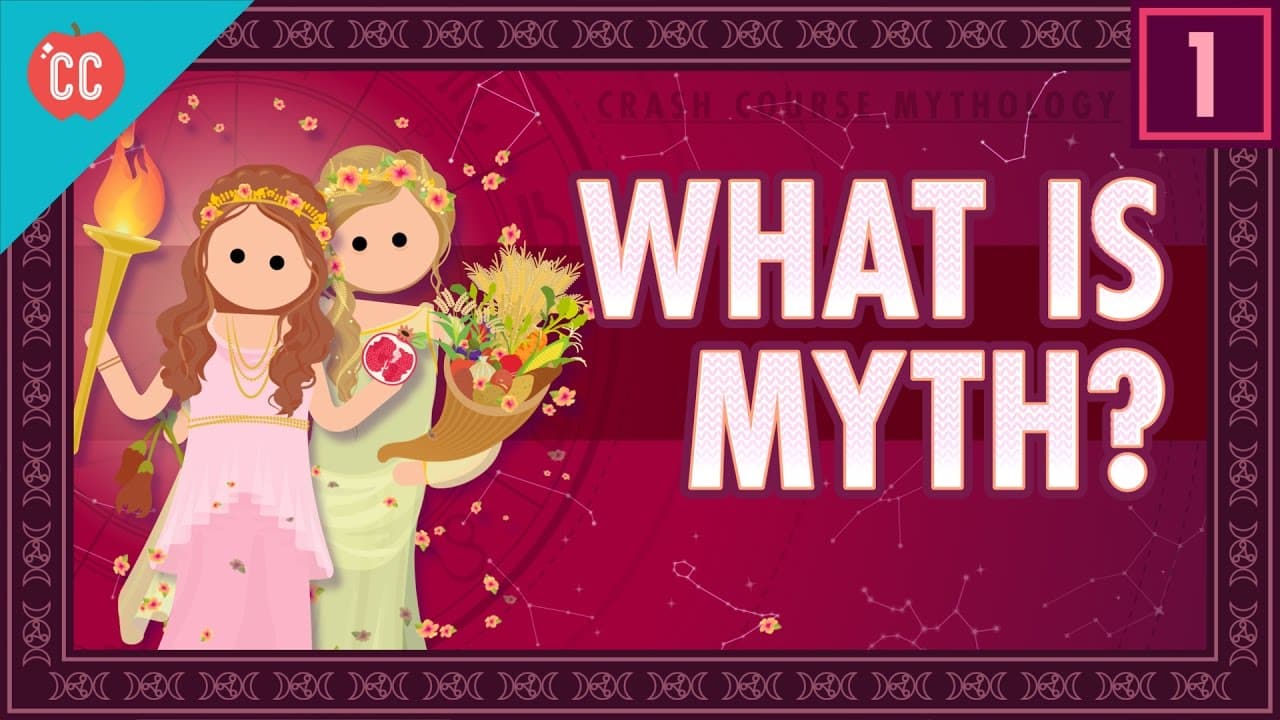
What Is Myth? Crash Course World Mythology #1
TL;DR
A myth is a story with two primary characteristics: significance and staying power. Myths address important questions about how the world works or came to be, and they can survive for centuries or even millennia. Because ancient myths often have multiple versions, unclear authorship, and many possible interpretations, defining them requires care. Read on to see how Crash Course Mythology approaches these complexities.
Transcript
Hello! My name is Mike Rugnetta and this is Crash Course: Mythology. Mythology is a complicated subject. It touches on literature, history, anthropology, sociology, psychology, religion, and even science. Have you ever tried to make a Slurpee, mixing all of the flavors together? Mythology is exactly like that, but it's a Slurpee of knowledge, with ... Read More
Key Insights
- Mythology intertwines with various disciplines such as literature, history, and religion, making it a multifaceted subject to explore.
- Myths often exist in multiple versions, reflecting their ancient origins and diverse interpretations across different cultures.
- The distinction between myth and religion can be blurred, as myths are often viewed as stories rather than truths.
- Myths are characterized by their significance and staying power, addressing important themes like creation and the functioning of the world.
- Myths can include hero stories and non-supernatural elements, expanding beyond traditional religious narratives.
- The story of Persephone illustrates an etiological narrative, explaining natural phenomena like the seasons through mythological events.
- Different theories of mythology, such as those by E.B. Tylor, suggest varying relationships between myth and science.
- The series will cover themes like creation myths, pantheons, and hero stories, offering a comparative and thematic exploration of global myths.
Install to Summarize YouTube Videos and Get Transcripts
Explore YouTube Video Summarizer or Get YouTube Transcript Extractor
Questions & Answers
Q: What is a myth in Crash Course World Mythology #1?
Crash Course defines a myth as a special kind of story with two primary characteristics: significance and staying power. Its subject concerns something important, such as how the world works or how things came to be, and it endures across centuries or sometimes millennia.
Q: Why is mythology a complicated subject?
Mythology intersects with literature, history, anthropology, sociology, psychology, religion, and science. It is also difficult because myths are often ancient, exist in multiple versions, and invite many interpretations.
Q: Why can the same myth have different versions?
Many myths are very old and have been retold in multiple forms. Crash Course may use one particular version or present a composite assembled from several tellings, so a different account does not automatically mean that one version is wrong.
Q: Are interpretations of myths treated as facts?
No. The series presents possible interpretations while emphasizing that their meanings cannot necessarily be confirmed by a weight of evidence, and many myths can be understood in several ways.
Q: What is the relationship between myth and religion?
The line between myth and religion is often blurry. By focusing on myths as stories or literary artifacts rather than judging their truth, the series can examine religious narratives without declaring them true or untrue.
Q: Why is it difficult to identify the authors of myths?
Most myths do not have nameable authors, and their origins are often unknown. Even figures such as Homer or Virgil recast older stories in new language rather than necessarily originating them.
Q: Does the word myth simply mean a false story?
No. Although contemporary English often uses “myth” to label something untrue, the series argues that this definition overlooks stories taken seriously and retold by generations of people.
Q: What do significance and staying power mean in mythology?
Significance means that a myth addresses something important, such as how the world works or came into being. Staying power means that the story has survived for centuries or even millennia, reflecting its deep meaning or functional importance to the people who tell and hear it.
Summary & Key Takeaways
-
Crash Course Mythology, hosted by Mike Rugnetta, delves into the complex world of myths, exploring their intersections with literature, history, and religion. The series aims to present myths as significant stories that have shaped cultures over centuries, emphasizing their staying power and diverse interpretations.
-
The series highlights the challenges in defining myths, often blurring lines with religion and featuring stories with significant explanatory power. Myths like the story of Persephone are explored to illustrate their role in explaining natural phenomena and their cultural importance.
-
Crash Course Mythology will cover various themes, including creation myths, pantheons, and hero stories, offering a comparative and thematic approach. The series aims to introduce viewers to lesser-known myths from diverse cultures, encouraging a deeper understanding of their significance and impact.
Read in Other Languages (beta)
Share This Summary 📚
Summarize YouTube Videos and Get Video Transcripts with 1-Click
Try YouTube Summary with ChatGPT & Claude or YouTube Transcript Generator
Explore More Summaries from CrashCourse 📚

Summarize YouTube Videos and Get Video Transcripts with 1-Click
Try YouTube Summary with ChatGPT & Claude or YouTube Transcript Generator