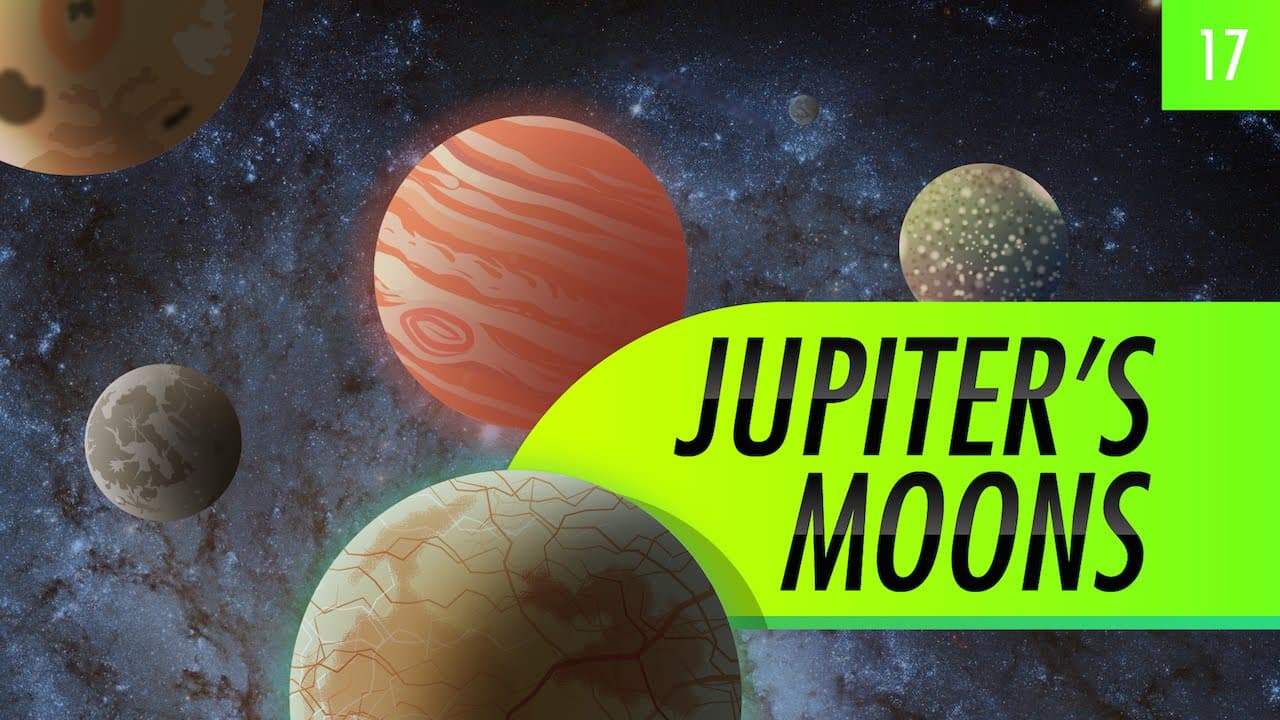
Jupiter's Moons: Crash Course Astronomy #17
TL;DR
Jupiter’s moons are remarkably diverse, ranging from volcanic Io to icy Europa, which may have a life-supporting subsurface ocean. The four Galilean moons helped Galileo show in 1610 that not everything revolves around Earth, while Ganymede’s 5,270-kilometer diameter makes it the solar system’s largest moon. Read on to compare their origins, surfaces, internal activity, and potential habitability.
Transcript
This episode of Crash Course is brought to you by Squarespace. As we saw in the last episode, Jupiter is by far the largest and most massive planet in the solar system. That means it has a very strong gravitational field, which also means it can hold on to a lot of moons. A lot. Right now, as we record this episode, there are 67 that have been conf... Read More
Key Insights
- Jupiter, the largest planet in the solar system, has a strong gravitational field that supports numerous moons, with 67 confirmed.
- The Galilean moons, discovered by Galileo, provided evidence that not everything orbits Earth, revolutionizing astronomy.
- Ganymede, the largest moon in the solar system, is larger than Mercury and may have an iron core and magnetic field.
- Callisto, similar in composition to Ganymede, has a heavily cratered surface and a thin atmosphere, indicating an ancient surface.
- Io is the most volcanic object in the solar system, with its volcanic activity driven by gravitational interactions with other moons.
- Europa is believed to have a subsurface ocean with more water than Earth, raising the possibility of life existing there.
- Jupiter's other moons, including Amalthea, are smaller and irregularly shaped, with retrograde orbits suggesting they may be captured asteroids.
- The concept of the habitable zone is challenged by Europa, which is outside the traditional zone but still has potential for life.
Install to Summarize YouTube Videos and Get Transcripts
Explore YouTube Video Summarizer or Get YouTube Transcript Extractor
Questions & Answers
Q: What are the main characteristics of Jupiter’s moons?
Jupiter had 67 confirmed moons when this Crash Course Astronomy episode was recorded, including the four large Galilean moons. Ganymede is the largest moon in the solar system, Callisto has an ancient cratered surface, Io has over 400 active volcanoes, and Europa likely hides an ocean beneath its icy surface.
Q: What did Galileo discover about Jupiter’s moons in 1610?
Galileo initially observed three small objects near Jupiter that moved, then saw a fourth one a week later. He realized they were orbiting Jupiter, providing evidence that not everything in the solar system revolved around Earth; the four objects are now called the Galilean moons.
Q: What makes Ganymede unusual among moons?
Ganymede is 5,270 kilometers across, making it the largest moon of any planet and even larger than Mercury. It is mostly rock and ice, probably has a liquid iron core, and possesses a magnetic field. Spacecraft measurements and Hubble observations also indicate salty liquid water deep below its surface.
Q: How is Callisto different from the other Galilean moons?
Callisto is about 4,800 kilometers in diameter and has a heavily cratered surface with no indication of volcanic or tectonic activity. Its surface may be as old as the moon itself, and its atmosphere has roughly one one-hundred-billionth of Earth’s surface air pressure. At almost 2 million kilometers from Jupiter, it is too distant to interact gravitationally with the other three large moons.
Q: Why is Io the most volcanic object in the solar system?
Io has over 400 active volcanoes, with several erupting at any given time. Passing moons flex Io through tidal forces, producing friction that heats its interior. Sulfur-rich erupted material gives the surface its yellow, orange, red, and black colors.
Q: How was volcanic activity discovered on Io?
When Voyager 1 passed Io in 1979, its images showed an unusual colorful surface without obvious impact craters. Engineer Linda Morabito noticed what first resembled another moon behind Io, but it was actually the arcing plume of an erupting volcano.
Q: Why is Europa considered a possible place for life?
Europa is believed to contain a subsurface ocean with more water than Earth, despite lying outside the traditional habitable zone. Its reflective, water-ice-rich surface has few craters and is crossed by cracks, dark streaks, and complex ridges, indicating that material from its interior has renewed the surface. These features make Europa an important target in the search for possible life.
Q: How do Jupiter’s moons create auroral footprints on Jupiter?
Ganymede and Io are magnetically connected to Jupiter. Charged particles travel from the moons along magnetic field lines and strike Jupiter near its poles, producing aurorae. Their connections appear as ultraviolet magnetic footprints in Jupiter’s atmosphere.
Summary & Key Takeaways
-
Jupiter's moons, particularly the Galilean moons, offer a fascinating glimpse into the diversity of celestial bodies in our solar system. Ganymede, the largest, is notable for its size and potential iron core. Callisto's ancient surface and Io's volcanic activity further highlight the unique characteristics of these moons.
-
Europa stands out for its potential to support life with its subsurface ocean, despite being outside the traditional habitable zone. This challenges our understanding of habitability and encourages exploration of life possibilities beyond Earth.
-
Jupiter's smaller moons, like Amalthea, add to the planet's intrigue with their irregular shapes and potential origins as captured asteroids. The study of these moons continues to expand our knowledge of the solar system's complexity.
Read in Other Languages (beta)
Share This Summary 📚
Summarize YouTube Videos and Get Video Transcripts with 1-Click
Try YouTube Summary with ChatGPT & Claude or YouTube Transcript Generator
Explore More Summaries from CrashCourse 📚






Summarize YouTube Videos and Get Video Transcripts with 1-Click
Try YouTube Summary with ChatGPT & Claude or YouTube Transcript Generator