How Does the Three Body Problem Challenge Science?
TL;DR
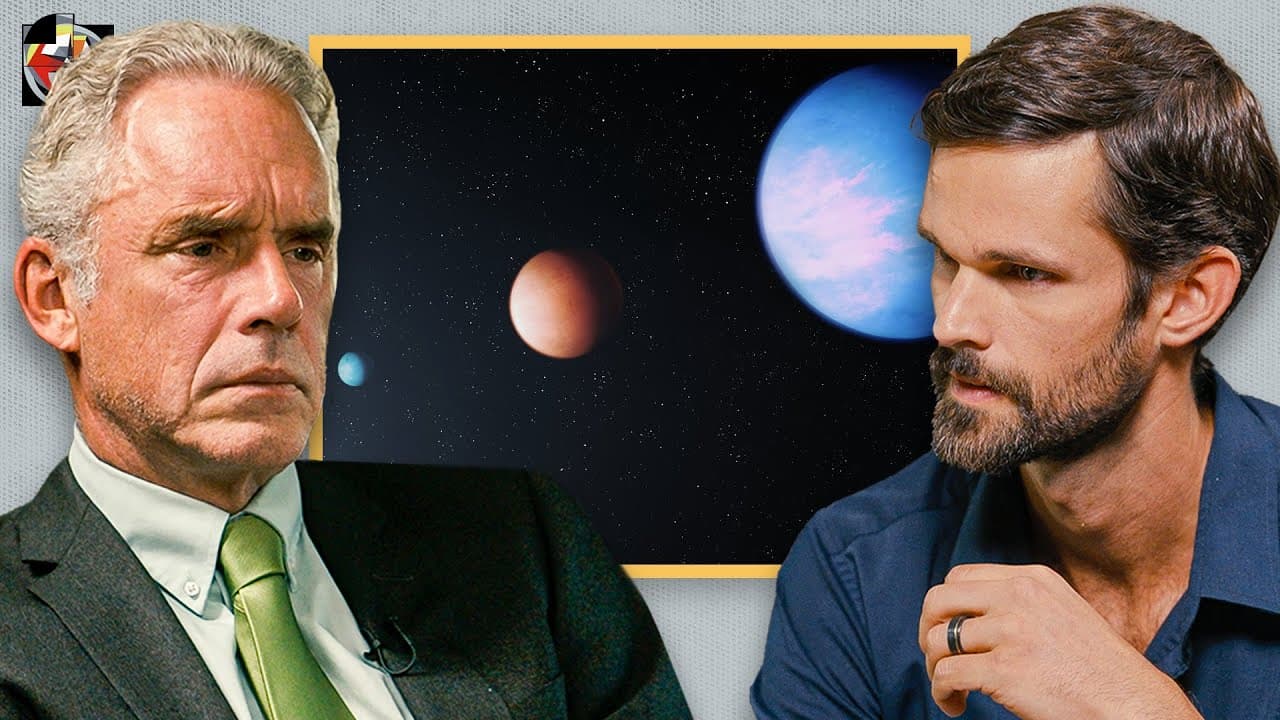
Science depends on faith that reality is unified, intelligible, and answerable to patterns the human mind can grasp. Spencer Klavan and Jordan Peterson argue that the three body problem, the divide between relativity and quantum mechanics, and career-driven statistical analysis expose both the limits of scientific understanding and the ethical commitments required for honest discovery.
Transcript
so I don't know if you're familiar with the three body problem the the not the Chinese science fiction novel made a big splash as a Netflix series recently but it's the novels that really grapple with what you are talking about and what's so remarkable about this series to me is that unlike a lot of American Science Fiction you've get Star Trek Sta... Read More
Key Insights
- The three body problem is presented as a case in which mutually attracting bodies cannot be organized into the kind of exact, consistent system that would make every resulting situation readily comprehensible and navigable by the human mind.
- The Remembrance of Earth's Past novels are interpreted as exploring what science looks like after confidence in a divinely grounded correspondence between the human mind and the structure of the cosmos has been removed.
- Newton's deeper achievement is described as unifying earthly and celestial motion under common laws, thereby breaking the old conceptual barrier between the supposedly disordered sublunary realm and the regular superlunary realm.
- Scientific reasoning depends on the conviction that mathematical patterns are universally valid, cohere within the mind, and also correspond to physical reality closely enough to guide practical achievements such as sending a rocket ship to Mars.
- The conflict between relativity and quantum mechanics resembles the older division between celestial and earthly physics because the theories appear to govern different realms through sets of laws that have not yet been reconciled.
- The search for quantum gravity assumes that the apparent division between physical theories reflects human ignorance rather than a permanent seam in reality or an irreconcilable limitation within the structure of human thought.
- Statistical analysis is vulnerable to career incentives because a large matrix of data can be apprehended through many combinations, allowing researchers to notice patterns that support advancement rather than those that best disclose the truth.
- Scientific integrity requires an ethos that directs investigators toward truth at every small decision point, since concealed careerist choices can betray science, create convincing delusions, and send researchers down mistaken paths for the rest of their careers.
Install to Summarize YouTube Videos and Get Transcripts
Explore YouTube Video Summarizer or Get YouTube Transcript Extractor
Questions & Answers
Q: What does the three body problem reveal about scientific knowledge?
The three body problem is used to illustrate a limit on the hope that every part of reality can be reduced to a consistent abstract system comprehensible to the human mind. When several bodies mutually attract one another, their behavior resists the kind of exact organizing account the discussion calls a logos. Klavan connects that difficulty to the possibility that reality may exceed the mind's capacity to calculate and navigate it.
Q: Why does Klavan connect the Three Body Problem novels to faith?
Klavan interprets the novels as examining science after the removal of confidence that the human mind and the universe bear the same rational imprint. Without that confidence, there is no guarantee that reality will fit the patterns people can understand. The cosmos might eventually confront investigators with structures that do not compute within human cognition, rather than merely presenting puzzles that further research will inevitably solve.
Q: How did Newton challenge the division between earthly and celestial physics?
Earlier thinkers described the region below the moon and the celestial region as domains governed by different principles. Earthly objects appeared irregular, while stars followed observable patterns. Newton's laws provided common rules for phenomena such as an apple descending and a comet crossing the sky. Klavan therefore treats Newton's central accomplishment as the disclosure of an underlying unity, not merely the calculation of gravity.
Q: Why is mathematics treated as more than a mental construction?
The discussion argues that people experience mathematical principles as universally valid and expect them to correspond to physical reality. Mathematics does not merely cohere inside the mind, it can also guide effective action in the world, including the navigation of a rocket ship toward Mars. Klavan says this expectation resembles a transposed monotheistic faith in a unified foundation where reality holds together without contradiction.
Q: How are relativity and quantum mechanics compared with the superlunary and sublunary spheres?
Relativity and quantum mechanics are described as theories that answer to apparently contradictory laws in different realms, much like the former distinction between celestial and earthly physics. Scientists working on string theory, quantum gravity, and other approaches continue to attack that barrier. Their effort assumes that the missing unity reflects incomplete understanding, rather than a permanent fracture in reality that thought can never reconcile.
Q: What assumptions guide scientists searching for a unified theory?
The search assumes that reality is fundamentally coherent and that the human mind can, at least in principle, discover the pattern joining its apparently separate domains. Researchers treat the unresolved conflict between major theories as evidence of ignorance, not proof that nature is intrinsically disjointed. Klavan argues that scientific work continues to rely on these convictions even when individual scientists outwardly deny their philosophical or religious character.
Q: How can career incentives distort statistical research?
A large spreadsheet can be approached through an indefinite range of combinations and potential relationships. If a researcher's primary orientation is career advancement, the patterns that become salient may be those that support publication, credentials, or professional success. Because these choices can remain hidden from colleagues and even from the investigator, the resulting analysis may reinforce a delusion while still appearing to be legitimate scientific work.
Q: Why does scientific discovery require an ethical ethos?
Scientific discovery requires researchers to prefer truth over self-promotion during every small analytical decision. Peterson argues that genuine scientists who make valuable discoveries are deeply shaped by a religious ethos, while careerist motives can pull analysis toward convenient conclusions. Betraying that ethos undermines the foundation of science and can persuade investigators to pursue false patterns for the rest of their careers.
Summary & Key Takeaways
-
Klavan presents the Three Body Problem novels as an inquiry into what science becomes when confidence in a rationally ordered and humanly intelligible cosmos weakens. The original mechanics problem symbolizes the possibility that reality may resist reduction to a consistent abstract system that the human mind can fully comprehend and use.
-
Newtonian mechanics overturned the proposed division between the sublunary and superlunary spheres by describing earthly and celestial motion through common laws. Klavan argues that this achievement rested on confidence in an underlying unity, free of contradiction, whose patterns correspond to the structures perceived by the human mind.
-
Peterson connects the philosophy of scientific unity to research ethics. Because a large dataset permits many possible analyses, career incentives can direct investigators toward convenient patterns. Honest discovery therefore requires an ethos that values truth above advancement, protects researchers from self-deception, and sustains confidence in the scientific enterprise.
Read in Other Languages (beta)
Share This Summary 📚
Summarize YouTube Videos and Get Video Transcripts with 1-Click
Try YouTube Summary with ChatGPT & Claude or YouTube Transcript Generator
Explore More Summaries from Jordan B Peterson 📚


Summarize YouTube Videos and Get Video Transcripts with 1-Click
Try YouTube Summary with ChatGPT & Claude or YouTube Transcript Generator