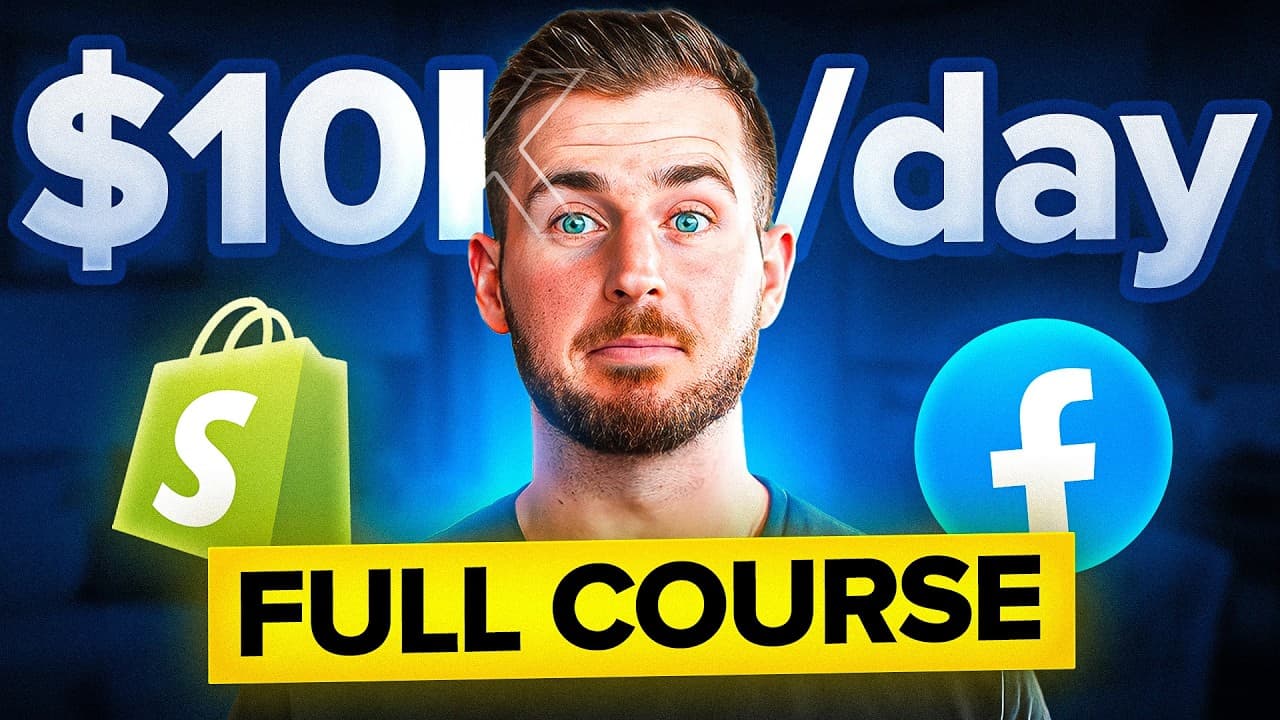
How to Scale Facebook Ads to Profitable $10K Days
TL;DR
Scale Facebook ads by identifying the business’s primary bottleneck before changing campaigns or raising spend. Separate acquisition performance into cost per link click, landing-page conversion rate, and average order value, while using cost per acquisition for final ad decisions. Model conservative and aggressive scenarios to determine whether modest improvements can produce profitable growth.
Transcript
record. All right, cool. We can jump into it now. Sweet. So, today we'll be talking about how to scale Facebook ads, the 10K days in 2025. Um, to be fair, like this is the same stuff that's working on accounts that are doing 30, 40, 50k a day in revenue. I just said 10k a day because um, you know, there's a there's a marketing lesson. If you put to... Read More
Key Insights
- Bottleneck analysis is the starting point for profitable scaling because it identifies the one or two restrictions preventing an account from growing. Removing those restrictions allows more customers and revenue to flow through the business without relying on scattered tactics or unnecessary campaign changes.
- Cost per acquisition is the final metric used to make ad decisions, but separating it into cost per link click and conversion rate provides better diagnostic information. This division shows whether weak performance originates with platform creative and traffic or with the landing page after visitors arrive.
- Cost per link click is a measure of how effectively advertising creative produces traffic on the platform. The goal is not simply to obtain cheaper clicks, because inexpensive traffic can still be low quality and fail to generate purchases for the advertised brand.
- Conversion rate shows how many landing-page visitors complete a purchase. An account can have effective creative and affordable traffic but remain constrained when its landing page fails to convert enough visitors, making conversion optimization a distinct scaling lever.
- Average order value measures how much customers spend per purchase, including whether they buy one item or a larger bundle. Increasing average order value can improve the economics of customer acquisition and gross profit without requiring the business to acquire proportionally more customers.
- Financial modeling is a practical method for evaluating scaling potential before increasing ad spend. The model described uses the previous 30 days of ad spend, cost per link click, average order value, conversion rate, and cost of goods to estimate gross profit.
- A conservative forecast can model a 10% decrease in cost per link click alongside 10% increases in average order value and conversion rate. In the example presented, those combined changes increased projected gross profit from $38,000 to $86,000.
- Client selection can be informed by the amount of improvement required to reach profitability. If modest changes still leave a business with negative gross profit, the account may require substantial work, reducing the probability of becoming profitable during an agency’s first 30 days.
Install to Summarize YouTube Videos and Get Transcripts
Explore YouTube Video Summarizer or Get YouTube Transcript Extractor
Questions & Answers
Q: How do you scale Facebook ads profitably?
Start by identifying the primary bottleneck instead of immediately increasing spend or adopting isolated tactics such as cost caps and bid caps. Examine cost per link click, landing-page conversion rate, and average order value as separate growth levers. Continue making final ad decisions using cost per acquisition, then model how realistic improvements in each lever could affect gross profit.
Q: What is a bottleneck analysis for Facebook ads?
A bottleneck analysis identifies the point where customer flow or revenue growth is being restricted. For Facebook advertising, the restriction may involve the creative’s ability to attract quality traffic, the landing page’s ability to convert visitors, or the amount customers spend. Finding that constraint helps define the one or two actions most likely to unlock further scaling.
Q: Which metrics should you examine before scaling Facebook ads?
Examine cost per acquisition, cost per link click, landing-page conversion rate, average order value, ad spend, cost of goods, and estimated gross profit. Cost per acquisition remains the basis for final ad decisions. The other metrics separate the customer journey into components, making it easier to determine whether the current limitation exists in traffic generation, conversion, or purchase value.
Q: Why separate cost per click from conversion rate?
Separating cost per link click from conversion rate reveals where acquisition performance is breaking down. Cost per link click reflects how well creative generates quality platform traffic, while conversion rate reflects how many landing-page visitors buy. Looking only at cost per acquisition combines both effects, which can obscure whether the advertisement or the landing page requires improvement.
Q: Should Facebook ads be stopped because of a high cost per click?
Cost per click should not be the sole reason for stopping an advertisement in the approach described. Final ad decisions are based on cost per acquisition because clicks must be evaluated by whether they produce customers. Cost per link click is primarily diagnostic, helping determine how effectively creative generates traffic while recognizing that cheap traffic is not necessarily quality traffic.
Q: How can average order value help scale Facebook ads?
Average order value shows how much a customer spends in a transaction, including whether the buyer purchases a single item or a larger bundle. Raising this value can improve gross profit and make acquisition economics more favorable. It is one of the principal scaling levers alongside obtaining cheaper quality traffic and converting a greater share of landing-page visitors.
Q: How do you forecast the financial impact of Facebook ad improvements?
Use the previous 30 days of ad spend, cost per link click, average order value, landing-page conversion rate, and cost of goods to estimate current gross profit. Then create conservative and aggressive scenarios by adjusting those inputs. The conservative example applies a 10% improvement to each main lever, including a decrease in click cost and increases in conversion rate and order value.
Q: How can financial modeling help evaluate an advertising client?
Financial modeling shows how much operational improvement a client needs before the account can become profitable. If modest changes to click cost, conversion rate, and average order value create substantial gross-profit growth, the opportunity may be attractive. If those changes still produce negative gross profit, substantial work may be required, lowering the chance of profitability within the agency’s first 30 days.
Summary & Key Takeaways
-
Profitable Facebook ad scaling begins with a bottleneck analysis. Instead of reacting to competing advice about cost caps, bid caps, and other tactics, identify the one or two restrictions currently limiting growth. A clear, narrow process makes it easier to choose the next actions and evaluate whether those actions improve business performance.
-
Break cost per acquisition into cost per link click and conversion rate to understand separate stages of the customer journey. Cost per link click indicates how effectively creative attracts quality traffic, while conversion rate shows how effectively the landing page turns visitors into buyers. Average order value measures how much each customer spends.
-
Use recent business data to model potential results before making major changes. The proposed calculator uses the last 30 days of ad spend, cost per link click, average order value, conversion rate, and cost of goods. Conservative and aggressive forecasts reveal whether realistic improvements could increase gross profit enough to justify scaling.
Read in Other Languages (beta)
Share This Summary 📚
Summarize YouTube Videos and Get Video Transcripts with 1-Click
Try YouTube Summary with ChatGPT & Claude or YouTube Transcript Generator
Explore More Summaries from Nick Theriot 📚



Summarize YouTube Videos and Get Video Transcripts with 1-Click
Try YouTube Summary with ChatGPT & Claude or YouTube Transcript Generator