How Do You Research and Scale Facebook Ads to $10k+ Days?
TL;DR
Daily market research helps produce Facebook ad ideas that scale by deepening your understanding of the customer. Research for as little as five minutes a day, using ad comments, competitor reviews, YouTube content, and adjacent niches to shape positioning, angles, hooks, and visuals. Because early findings will be surface-level and one winning concept took 45 days to emerge, read on for a practical approach to sustained research.
Transcript
Today we're'll be talking about market research itself, understanding the key concepts of it, how to actually apply market research to ad creation, and then like I said, there's a lot of questions and challenges that people brought to the table to me. So, we're going to be diving into those as well. Now, quick little kind of mindset framing exercis... Read More
Key Insights
- Market research is a daily creative practice that places advertisers in an environment where useful ideas can emerge. Even five minutes of research can maintain that exposure, while longer and repeated sessions increase the likelihood of discovering concepts capable of supporting scalable ads.
- Customer understanding determines the quality of advertising because deeper knowledge enables more specific messages. One day of research may support decent copy, while 30 or 60 days of working with a product can reveal language, desires, and perspectives that were unavailable during the first week.
- Early research is naturally surface-level, so the first ads produced from it should not be judged against advanced standards. Trying immediately to master complex awareness and sophistication concepts can create pressure, block writing, and make an advertiser reluctant to conduct another research session.
- Repetition develops research and advertising ability in the same way repeated boxing practice improves a jab. A beginner can perform the basic action on day one, but 30 days of focused repetitions can improve both execution and the ability to handle more complex concepts.
- Research drives product positioning, advertising angles, hooks, visuals, and unusual creative concepts. It is not merely a preliminary task because its findings determine what customers are shown and how the product is presented throughout the advertisement and landing page.
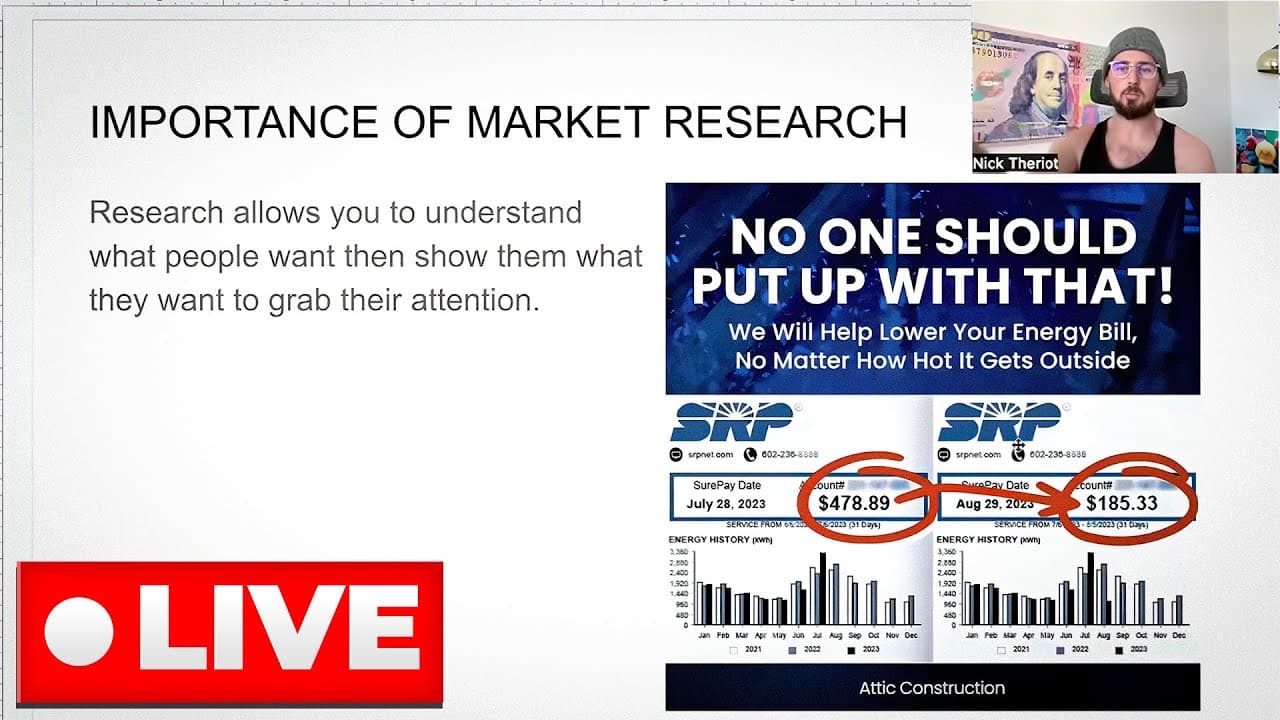
- Customer desires provide a direct guide for creative execution. If research shows that people want lower power bills, the ad should depict that outcome, while the landing page should explain how the offered technique helps produce the reduction customers are seeking.
- Unique angles can create less-contested opportunities when competitors are not using the same message. The speaker describes finding a successful angle after 45 days of research, following a first 30 days in which the team's ideas had not produced strong performance.
- Useful ad concepts can originate from many sources, including a comment on an advertisement, a review on a competitor's website, YouTube research, or an unrelated niche. Remaining open to unexpected connections is therefore as important as following any individual research method.
Install to Summarize YouTube Videos and Get Transcripts
Explore YouTube Video Summarizer or Get YouTube Transcript Extractor
Questions & Answers
Q: How does market research help create Facebook ads that scale?
Market research reveals what customers want and provides ideas for positioning, angles, hooks, visuals, and the overall message. The deeper you understand the audience, the more specific and effective your ads can become. The speaker says their best ads come from research.
Q: How often should advertisers research their market?
Advertisers should conduct market research daily, even when they have no specific question to investigate. A session can last five minutes or five hours. Repeated exposure creates more opportunities to notice ideas that can support scalable ads.
Q: How long does it take for market research to improve ad ideas?
The first week of research will generally produce surface-level ideas. After working with a product for 30 or 60 days, advertisers can develop a much deeper understanding of the customer and write significantly different ads. One winning concept described in the page emerged after 45 days of client research.
Q: What should market research determine for a Facebook ad?
Research should guide the product's positioning, advertising angles, hooks, visuals, and overall message. It should clarify what customers want so the ad can show that desired result. The landing page can then explain how the product's technique helps achieve it.
Q: Where can advertisers find Facebook ad ideas?
Ideas can come from comments beneath ads, reviews on competitor websites, YouTube content, platform feeds, and research into adjacent niches. The speaker emphasizes staying receptive because the best idea may appear unexpectedly rather than through a narrowly defined search.
Q: How should customer desires shape ads and landing pages?
The ad should visibly connect the product to an outcome customers already want, while the landing page explains the relevant technique. For example, if customers want lower power bills, the ad should show that result and the landing page should explain how the technique can help lower the bill.
Q: What should beginners do after their first research session?
Beginners should identify what they actually observed and create ads around those findings. They should accept that the first research and first ads may not be their best work. Continued practice for 30 days can improve both the research process and the resulting ads.
Q: How can advertisers avoid writer's block during market research?
They should stop expecting to uncover hidden customer thoughts or advanced awareness and sophistication insights on day one. That pressure can block both research and writing. Focusing on basic observations and repeating the process allows deeper insights to develop over time.
Summary & Key Takeaways
-
Market research improves through repetition. Early sessions may reveal only surface-level observations, but researching a product for 30 to 60 days can deepen customer understanding and produce substantially different ad ideas. Beginners should remove the pressure to uncover hidden customer thoughts immediately and simply create ads around what they can observe.
-
Research should determine a product's positioning, angles, hooks, visuals, and overall message. Understanding what customers want clarifies what an ad and landing page should show. The speaker illustrates this with customers who want lower power bills: both the advertisement and landing page should visibly connect the product's technique to that desired result.
-
Valuable advertising ideas can emerge from unexpected sources, including ad comments, competitor reviews, YouTube content, and research into adjacent markets. One winning concept appeared after 45 days of client research. The central practice is to research consistently, remain receptive to ideas, and avoid restricting discovery to a single platform or method.
Read in Other Languages (beta)
Share This Summary 📚
Summarize YouTube Videos and Get Video Transcripts with 1-Click
Try YouTube Summary with ChatGPT & Claude or YouTube Transcript Generator
Explore More Summaries from Nick Theriot 📚



Summarize YouTube Videos and Get Video Transcripts with 1-Click
Try YouTube Summary with ChatGPT & Claude or YouTube Transcript Generator