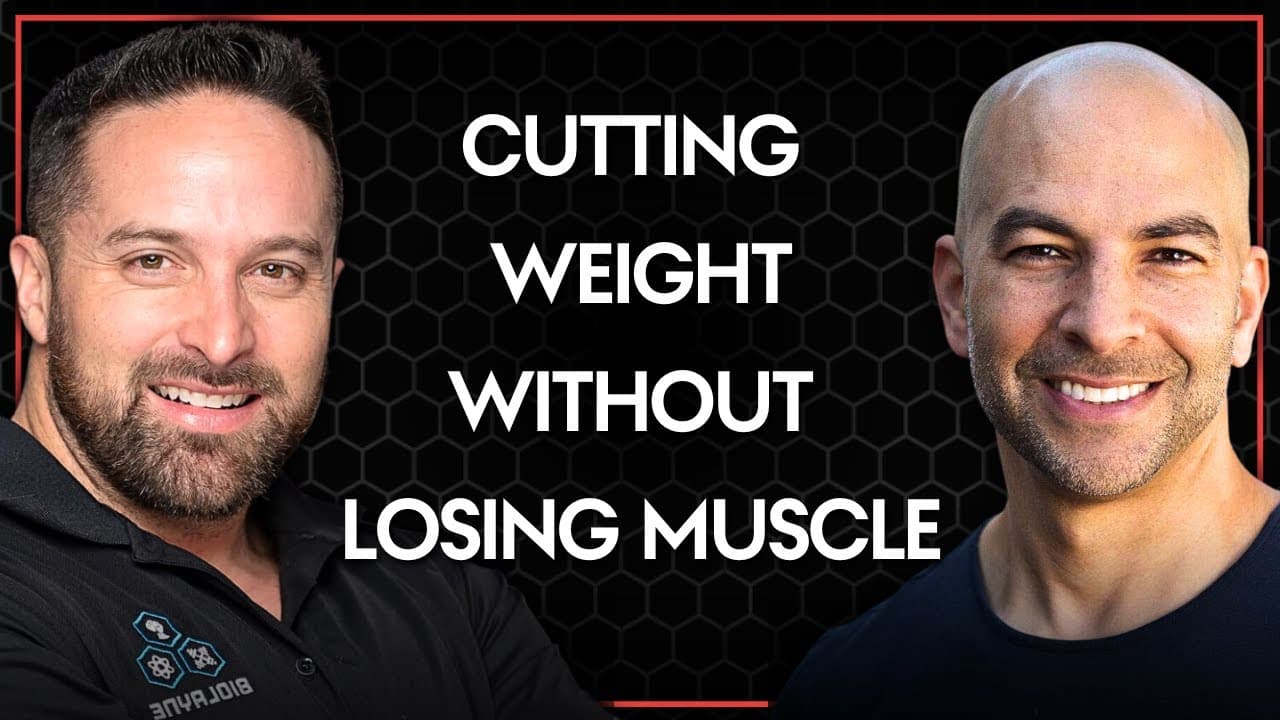
How to Cut Weight Without Losing Muscle Mass
TL;DR
Preserve muscle during weight loss by continuing resistance training, maintaining training quality, and using maintenance-calorie diet breaks, especially as body fat becomes very low. People starting with more body fat generally have a larger energy reserve, while leaner individuals face a rising risk of losing lean tissue as their bodies increasingly defend remaining fat stores.
Transcript
what people don't realize is we look at like we look at these diet studies and we see how much lean body mass gets lost versus fat mass and people don't realize that a lot of this depends on how much body fat you're starting with and then it changes the curve changes so if you're somebody who's overweight or obese you don't really need to worry abo... Read More
Key Insights
- Starting body fat is a major factor in weight-loss composition because people with larger fat reserves can draw more energy from adipose tissue. As body fat becomes extremely low, the body may obtain a progressively larger share of needed energy from lean tissue.
- Muscle-retention difficulty rises sharply near shredded body-fat levels. Layne Norton reports minimal lean mass loss when moving from 15% to 7% by his caliper reference, but estimates that 20% to 30% of weight lost from 7% to 5% may be lean mass.
- Diet breaks are planned periods of eating at maintenance calories without deliberately regaining fat tissue. Norton used two or three weeks of aggressive dieting followed by one, two, or three weeks at maintenance, reporting strong results for preserving strength during a 30-pound reduction.
- Maintenance periods become more useful as body fat falls because removing the final amount of fat requires disproportionately greater effort. Norton compares the process to wringing water from a towel, where water flows easily at first but the last portion requires much more force.
- Body-fat set point theory describes a relatively narrow range of body fat that the body tends to defend. Dropping below the lower end may increase hunger while reducing basal metabolic rate, non-exercise activity thermogenesis, libido, and tolerance for continued caloric restriction.
- Individual muscle retention may depend partly on the body's preferred body-fat range. Norton speculates that someone whose body naturally settles at a higher percentage may lose more lean mass at a body-fat level where another person can preserve it more successfully.
- Resistance training is a major defense against muscle loss during dieting. Some studies omit resistance training, while real-world dieters may reduce training volume or intensity as energy falls, making diminished training stimulus a possible contributor to measured losses of lean body mass.
- Lean body mass is not synonymous with muscle mass because it includes every non-fat tissue and body water. Glycogen depletion carries substantial water loss, and caloric restriction can also shrink gut and liver tissues or contract plasma volume, lowering measured lean mass without equivalent muscle loss.
Install to Summarize YouTube Videos and Get Transcripts
Explore YouTube Video Summarizer or Get YouTube Transcript Extractor
Questions & Answers
Q: How can you cut weight without losing muscle mass?
Continue resistance training, protect training volume and intensity as much as energy allows, and consider maintenance-calorie diet breaks during a prolonged cut. The risk of losing lean tissue increases as body fat becomes very low, so lean individuals may need a slower, more cautious approach with more time at maintenance than people beginning with larger fat reserves.
Q: Why does starting body fat affect muscle loss during dieting?
People beginning with overweight or obesity have a larger reservoir of stored energy available from fat tissue, so the body has less reason to draw heavily from lean tissue. As fat stores become depleted and body fat reaches very low levels, the body increasingly defends its remaining fat, and a larger fraction of additional weight loss may come from lean mass.
Q: What is a diet break during a weight-loss phase?
A diet break is a planned period of eating at maintenance calories, meaning an intake intended to prevent both continued weight loss and the regain of fat tissue. It allows more food than the preceding deficit. Norton describes using one to three maintenance weeks after two or three aggressive dieting weeks and reports that this helped preserve his strength.
Q: When should diet breaks become more frequent?
Diet breaks may become more frequent as a person approaches the lower end of the body-fat range that their body tends to defend. Norton says he would use fewer breaks when coming down from higher body fat, then add them more often near very low levels. He might ultimately spend more time at maintenance than in a deficit.
Q: What is body-fat set point theory?
Body-fat set point theory proposes that the body maintains a relatively tight, homeostatic range of body fat. When body fat falls below the lower end of that range, hunger can rise while basal metabolic rate, non-exercise activity thermogenesis, and libido decline. These responses make further caloric restriction harder and may increase pressure on lean tissue.
Q: Does losing lean body mass always mean losing muscle?
No. Lean body mass includes all non-fat components, including muscle, water, glycogen, skin, bone, organs, gut tissue, and liver tissue. Dieting can reduce glycogen and its associated water, shrink certain tissues, and contract plasma volume. A measured decline in lean mass can therefore overstate the amount of actual skeletal muscle that was lost.
Q: Why is resistance training important during a calorie deficit?
Resistance training provides a strong reason for the body to retain muscle while calories are restricted. Lean mass losses reported in dieting research may partly reflect studies that omit resistance training. In practice, low energy can also cause people to reduce training volume or intensity, weakening the training stimulus and potentially contributing to greater muscle loss.
Q: How reliable are very low body-fat measurements?
Very low body-fat measurements contain inherent error and can differ substantially by method. Norton uses caliper readings as a personal reference rather than claiming they are true absolute values, and he estimates that his DEXA readings would be about three percentage points higher. The discussion emphasizes trends, appearance, and consistent reference methods over treating one number as exact.
Summary & Key Takeaways
-
The proportion of fat and lean body mass lost during dieting depends partly on starting body fat. People with overweight or obesity have larger energy reserves, so early weight loss can come more readily from fat. At extremely low body fat, additional weight loss may include a much larger share of lean tissue.
-
Diet breaks are periods of eating at maintenance calories rather than remaining in a continuous deficit. Layne Norton describes alternating two or three aggressive dieting weeks with one to three maintenance weeks. He reports that this approach worked extremely well for retaining strength while losing 30 pounds after moving up a powerlifting weight class.
-
Reported lean body mass loss does not necessarily equal muscle loss because lean mass includes water, glycogen, organs, skin, bone, and other non-fat tissues. Caloric restriction can reduce glycogen, associated water, gut tissue, liver tissue, and plasma volume. Resistance training and sustained training quality remain important signals for preserving actual muscle.
Read in Other Languages (beta)
Share This Summary 📚
Summarize YouTube Videos and Get Video Transcripts with 1-Click
Try YouTube Summary with ChatGPT & Claude or YouTube Transcript Generator
Explore More Summaries from Peter Attia MD 📚





Summarize YouTube Videos and Get Video Transcripts with 1-Click
Try YouTube Summary with ChatGPT & Claude or YouTube Transcript Generator