Why Did Meta Invest $14 Billion in Scale AI?
TL;DR
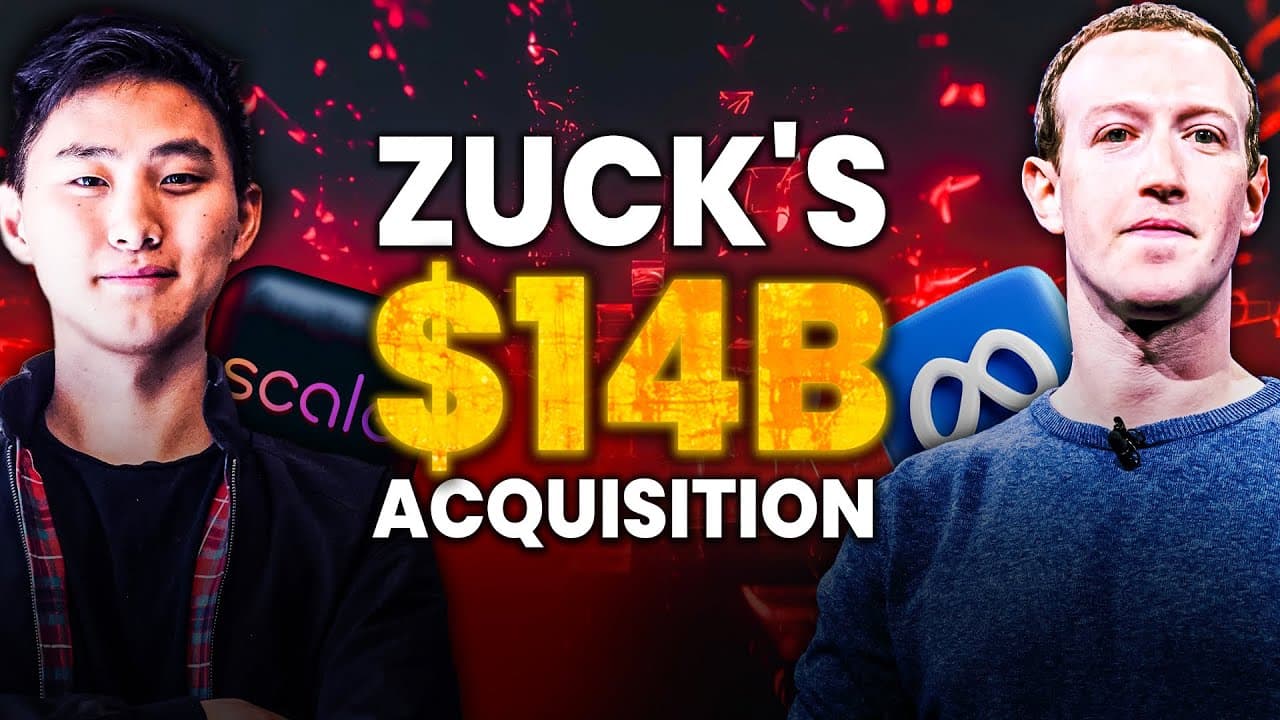
Meta’s $14 billion Scale AI investment is presented as a strategic effort to secure founder Alexander Wang, engineering talent, and data pipelines without fully acquiring the company. By taking a 49% stake, Meta may gain critical AI capabilities while limiting regulatory scrutiny, although the arrangement could still attract FTC attention and depends on whether Scale AI remains valuable as synthetic data expands.
Transcript
Meta just dropped 14 billion dollars on what looks like a simple data labeling company. But this isn't just a simple tech acquisition. This is Zuckerberg's desperate attempt to avoid becoming the next Blackberry of AI. And what I'm about to show you reveals why even Google engineers are calling this move genius or catastrophic. There's no middle gr... Read More
Key Insights
- Meta’s $14 billion Scale AI investment is portrayed as a talent and infrastructure strategy, not simply a purchase of a data-labeling business. The most valuable targets are identified as founder Alexander Wang, his team, and Scale AI’s established data pipelines.
- Scale AI is described as an invisible foundation for major AI developers because its data-labeling work helps train models to distinguish and classify information. The transcript says OpenAI, Google, and other companies have depended on these services.
- Synthetic data is presented as a threat to Scale AI’s existing business model because AI systems can increasingly generate their own training material. The transcript also says Scale AI missed its billion-dollar revenue target last year and that customers are leaving.
- Meta’s 49% ownership is presented as a way to gain influence, talent, and infrastructure without technically owning Scale AI outright. The analysis argues that this structure may reduce immediate regulatory exposure compared with a conventional full acquisition.
- Acqui-hires are described as transactions focused on recruiting a startup’s employees rather than purchasing the underlying company. Workers may receive substantial retention compensation, but the original startup ambitions can disappear while employees wait for their awards to vest.
- License-and-release deals work by transferring intellectual property and key personnel while leaving the original corporate entity intact. The transcript cites Microsoft’s $650 million Inflection deal, Google’s $2.7 billion Character AI deal, and Amazon’s $330 million Adept deal.
- Full acquisitions can expose buyers to lawsuits, liabilities, and regulatory investigation. The analysis contrasts Meta’s investment structure with Google’s announced $32 billion acquisition of Wiz, which it says faces a full, year-long FTC review that could stop the transaction.
- AI acquisition strategies could develop along three paths: indirect deals replace traditional acquisitions, regulators close the perceived loopholes, or large technology companies operate through many independent entities they effectively control. The transcript identifies the next 18 months as decisive.
Install to Summarize YouTube Videos and Get Transcripts
Explore YouTube Video Summarizer or Get YouTube Transcript Extractor
Questions & Answers
Q: Why did Meta invest $14 billion in Scale AI?
Meta’s investment is presented as an effort to secure Alexander Wang, his engineering team, and Scale AI’s data pipelines rather than merely purchase a data-labeling company. Wang is set to lead Meta’s new superintelligence team, while recruited engineers are reportedly receiving eight- or nine-figure salaries. The arrangement also responds to what the analysis characterizes as the disappointing Llama 4 launch.
Q: What does Meta gain from owning 49% of Scale AI?
A 49% stake gives Meta substantial access and influence while allowing Scale AI to remain technically independent. According to the analysis, Meta gains Alexander Wang, engineering talent, and valuable data pipelines without completing a conventional full acquisition. The structure is portrayed as a means of limiting regulatory scrutiny, although the transcript says the FTC is examining how to handle arrangements of this kind.
Q: What is an acqui-hire in the technology industry?
An acqui-hire is a transaction primarily designed to recruit a company’s employees rather than obtain the full value of its business. The analysis describes it as a sophisticated hiring exercise in which workers receive attractive job and retention packages. Some engineers may remain for three years while their retention compensation vests, even if the original startup’s ambitions and independent operations effectively disappear.
Q: How do license-and-release deals work?
License-and-release deals allow a large company to obtain intellectual property and recruit key employees without buying the entire corporate entity. This can avoid taking responsibility for every lawsuit, liability, or hidden problem associated with the original business. The transcript presents Microsoft’s Inflection deal, Google’s Character AI deal, and Amazon’s Adept deal as examples of this emerging structure.
Q: Why could synthetic data threaten Scale AI’s business model?
Synthetic data could weaken demand for traditional data-labeling services because AI models are increasingly able to generate their own training material. The analysis claims that this shift may make Scale AI’s core model obsolete. It also notes that the company missed its billion-dollar revenue target last year and says customers are leaving, creating uncertainty about the long-term value of the existing business.
Q: Why might companies avoid traditional acquisitions?
Traditional acquisitions can force buyers to inherit lawsuits, liabilities, and other undisclosed problems belonging to the target company. Major purchases also receive close FTC scrutiny. The analysis argues that license agreements, talent transfers, and minority strategic investments can provide access to people and intellectual property while leaving the corporate shell independent and potentially reducing the intensity of regulatory review.
Q: How does Meta’s Scale AI investment compare with Google’s Wiz acquisition?
Meta’s deal is structured as a $14 billion investment for 49% ownership, so Meta does not technically acquire Scale AI outright. Google’s announced $32 billion Wiz transaction is described as a conventional acquisition. According to the transcript, the Wiz deal is undergoing a full, year-long FTC review that could prevent completion, highlighting the potential regulatory advantage of Meta’s structure.
Q: What are the three possible futures for AI acquisitions?
The first possibility is that regulatory pressure causes traditional acquisitions to decline and license-and-release agreements become standard. The second is that the FTC adapts and treats indirect arrangements as genuine acquisitions, closing the perceived loophole. The third is widespread fragmentation, with large technology companies operating through numerous nominally independent businesses that they effectively control. The analysis identifies the next 18 months as decisive.
Summary & Key Takeaways
-
The analysis distinguishes three deal structures used in technology: acqui-hires that primarily recruit employees, license-and-release agreements that transfer talent and intellectual property, and strategic investments that provide influence without full ownership. These structures can reduce inherited liabilities and potentially receive less regulatory scrutiny than conventional acquisitions.
-
Meta’s $14 billion investment gives it 49% ownership of Scale AI while bringing founder Alexander Wang into its new superintelligence team. The analysis argues that Meta principally wants Wang, engineering talent, and data pipelines, especially after the disappointing Llama 4 launch, rather than complete ownership of Scale AI’s labeling business.
-
The deal could foreshadow three outcomes: traditional acquisitions decline under regulatory pressure, regulators classify indirect arrangements as acquisitions, or large technology companies exert control through networks of nominally independent businesses. The analysis says the next 18 months will shape which structure becomes dominant across the AI industry.
Read in Other Languages (beta)
Share This Summary 📚
Summarize YouTube Videos and Get Video Transcripts with 1-Click
Try YouTube Summary with ChatGPT & Claude or YouTube Transcript Generator
Explore More Summaries from Julia McCoy 📚






Summarize YouTube Videos and Get Video Transcripts with 1-Click
Try YouTube Summary with ChatGPT & Claude or YouTube Transcript Generator