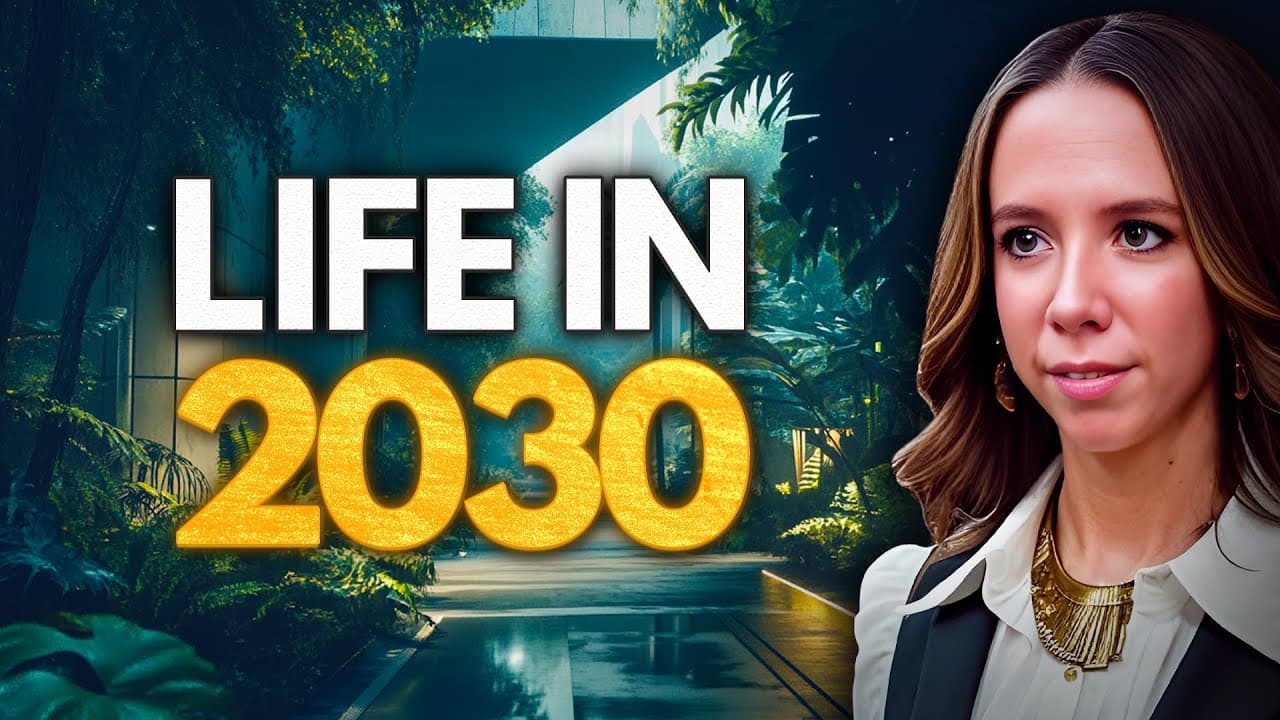
How will life look in a post labor economy by 2030
TL;DR
The post labor economy blends Universal Basic Income with decentralized ownership to preserve economic agency as traditional jobs decline. AI enhances creativity, learning, and daily life through personalized tutoring, health, and entertainment, while local communities and circular economies provide meaningful participation. It is a balanced transition focusing on human connection and purpose rather than utopia or dystopia.
Transcript
I want to tell you a story today about life in the future a story of a vision of day-to-day life in 2030 and Beyond we've achieved AGI we now live in a world of ASI here's what it looks like before we begin here's some context I co-created this story with Claude and it's grounded in real research by economists and my co-author Dave Shapiro this is ... Read More
Key Insights
- A hybrid model of UBI and decentralized ownership maintains economic agency as traditional employment declines.
- AI tools act as partners in creativity and learning, not replacements, making advanced education and writing more accessible.
- Local community centers enable skill sharing and collective improvement projects, strengthening social bonds and meaning beyond paid work.
- Investment dashboards and ownership stakes in community-driven platforms become routine parts of personal finance.
- Health monitoring and telepresence with AI support predictive, personalized healthcare while preserving human interpretation.
- Education shifts from career preparation to lifelong pursuit, with immersive simulations and real world examples guiding learning.
- Entertainment evolves through mixed reality collaborations between human artists and AI, creating new forms of shared experiences.
- Sociopolitical systems emphasize human connection, purpose, and equal access to essential services rather than purely productivity metrics.
Install to Summarize YouTube Videos and Get Transcripts
Explore YouTube Video Summarizer or Get YouTube Transcript Extractor
Questions & Answers
Q: What is the basic idea of a post labor economy in 2030
The basic idea is to shift away from traditional employment as the sole source of economic well being toward a hybrid model that combines Universal Basic Income with decentralized ownership. This arrangement preserves individual economic agency, funds living standards, supports ownership in automated systems, and enables people to contribute to communities through learning, creativity, and local projects without relying on standard jobs.
Q: How does AI contribute to daily life in this future
AI supports daily life by personalizing education with immersive simulations, assisting creative processes in writing and design, monitoring health with immersive telepresence, and enabling more reliable, efficient management of home tasks. AI tutors adapt to individual learning styles, while AI health systems track biomarkers and guide preventive care through human clinicians.
Q: What role do local communities play
Local communities act as hubs for knowledge sharing, skill building, and collaborative production. Community centers host workshops such as gardening, combine traditional practices with AI optimized methods, and serve as centers for social connection. In this model people contribute through teaching, organizing events, or working on community improvement projects rather than solely through employment.
Q: How is food produced in this world
Food production relies on a mix of automated systems and local initiatives. An automated vertical farm collective supplies much of the food, while individuals maintain personal gardens for hobby and connection to nature. The system is designed to be resilient and accessible through decentralized ownership and local energy networks.
Q: What does healthcare look like
Healthcare becomes more predictive and personalized, with AI tracking vital signs and guiding preventive measures. Immersive telepresence allows patients to consult doctors remotely, while clinicians provide the human interpretation needed to discuss results. This combination increases accuracy and accessibility without reducing the human-centered care experience.
Q: What happens to meaning and purpose in work
Meaning emerges from diverse contributions such as education, art, community service, and creative pursuits that AI enables rather than replaces. People pursue interests like biological systems design or novel writing, integrate learning with daily life, and contribute to circular economies, all while safe guarding personal autonomy and a sense of purpose beyond traditional jobs.
Q: How is ownership and wealth distributed in this model
Wealth is distributed through universal basic income and decentralized ownership structures that let individuals own stakes in automated systems, renewables networks, and community production facilities. This arrangement aims to reduce desperation linked to job loss, maintain economic participation, and stimulate local investment and collaboration within a shared, non centralized economic framework.
Q: What challenges might arise
Challenges include inequality and transition friction as workers adjust to new models of participation, ensuring equitable access to ownership opportunities, and managing the complexity of decentralized systems. The narrative acknowledges these difficulties and emphasizes human connection, continued learning, and a balanced approach to technology so society can adapt without falling into utopian or dystopian extremes.
Summary & Key Takeaways
-
In 2030, daily life is shaped by a hybrid model of UBI and decentralized ownership that funds a comfortable standard of living and reduces paycheck dependence, enabling people to pursue interests and community work.
-
Education becomes lifelong and personalized with AI tutors, allowing people to learn biological systems design or creative writing for enjoyment and growth rather than for employment necessity.
-
Healthcare, housing, food, and energy infrastructure are supported by automation and community-driven systems, increasing access and personalization while maintaining human-centered care and social participation.
Read in Other Languages (beta)
Share This Summary 📚
Summarize YouTube Videos and Get Video Transcripts with 1-Click
Try YouTube Summary with ChatGPT & Claude or YouTube Transcript Generator
Explore More Summaries from Julia McCoy 📚

Summarize YouTube Videos and Get Video Transcripts with 1-Click
Try YouTube Summary with ChatGPT & Claude or YouTube Transcript Generator