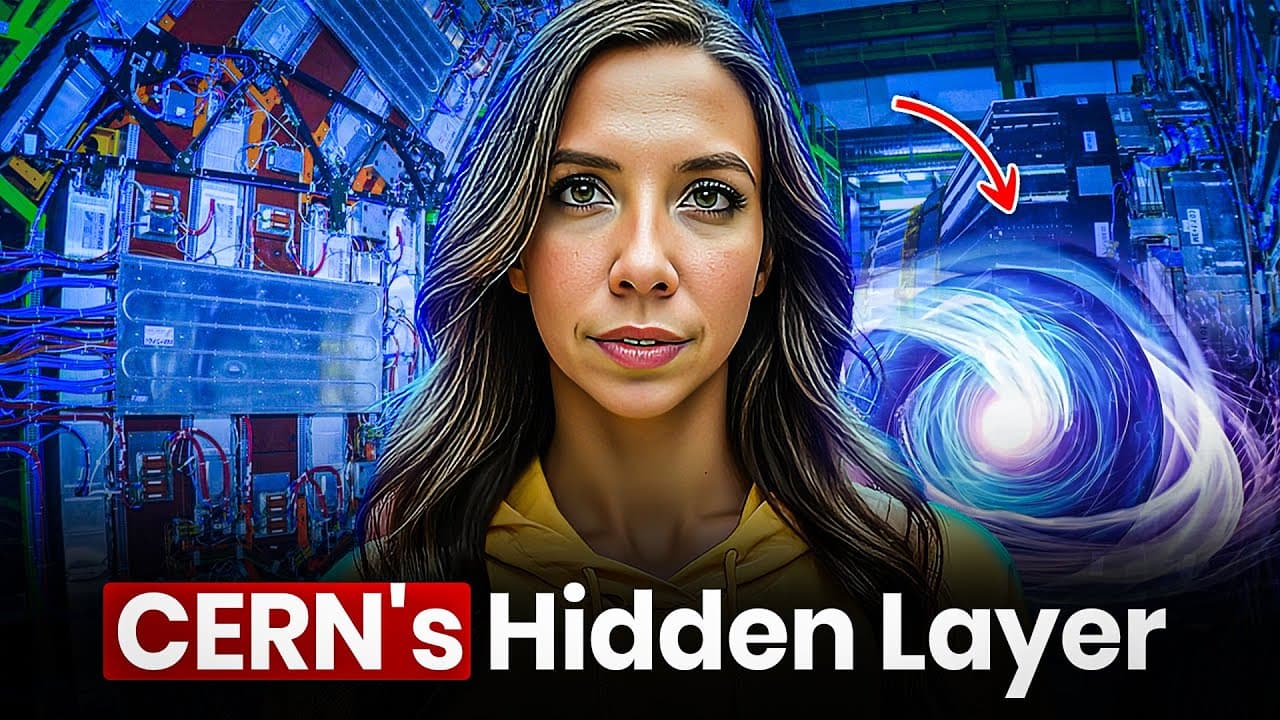
How could a lattice beneath spacetime reshape physics
TL;DR
The lattice observed in CERN simulations forms a repeating, self organizing pattern that persists beyond normal energy conditions. If real, it could help explain dark matter and quantum entanglement and even suggest a hidden substrate for information flow, but verification across platforms and experiments is still underway over the next few years.
Transcript
The next 3 years may reveal something that changes everything we thought we knew about the fabric of reality itself. And it started with an anomaly at 3:47 a.m. in spring of 2024 deep beneath the France Switzerland border. What I'm about to share with you isn't science fiction. It's happening right now in the most advanced physics labs on Earth. [m... Read More
Key Insights
- The lattice is a repeating self organizing pattern observed in a quantum simulation at CERN.
- The pattern only shifts when simulated energy density crosses a threshold and in a specific region of spacetime.
- The lattice resembles hidden scaffolding beneath quantum fields, not random noise.
- The lattice persists when energy returns to normal, indicating spacetime memory.
- If real, the lattice could link dark matter to a gravitational shadow of hidden structure.
- Entanglement could be a shortcut through a lattice based network beneath spacetime.
- There is a cautious debate about whether consciousness might be influenced by underlying infrastructure.
- Verification requires independent platforms reproducing the run and reanalyzing data from gravitational waves and Webb observations.
Install to Summarize YouTube Videos and Get Transcripts
Explore YouTube Video Summarizer or Get YouTube Transcript Extractor
Questions & Answers
Q: What is the lattice observed at CERN and why is it important?
The lattice is a repeating, self organizing structure that appeared in a quantum simulation under extreme conditions at CERN. If it reflects real spacetime architecture, it could provide a mechanism behind dark matter and quantum entanglement, offering a potential substrate for how information moves beyond current theories. The finding prompts new questions and verification efforts across platforms.
Q: How does the lattice behave when energy density changes?
The lattice only shifts its pattern when the simulated energy density crosses a specific threshold and only in a particular region of spacetime. Below that threshold, the system behaves as standard models predict. This selective response suggests the lattice is tied to particular energetic conditions rather than being a universal feature.
Q: What could dark matter be if the lattice is real?
If the lattice is real, dark matter might not be a new particle but a gravitational shadow of the hidden spacetime structure. This means the extra mass observed in galaxies could arise from the lattice influencing gravity rather than from unseen matter, changing how we interpret astrophysical observations.
Q: How could entanglement be related to a lattice beneath spacetime?
Entanglement could be facilitated by hidden pathways within a lattice beneath spacetime, making correlations between distant particles less mysterious. Rather than instantaneous spooky action at a distance, information might traverse a structured network that connects points in a latent layer, aligning with a substrate hypothesis.
Q: What is meant by spacetime memory in the context of the lattice?
Spacetime memory refers to the lattice persisting after energy returns to normal, effectively retaining information about its prior state. This persistence is unusual and suggests a deeper layer in reality where past configurations continue to influence current behavior, which would require new modeling of information flow.
Q: What experiments are planned to verify the lattice?
Independent platforms are being used to replicate the CERN run, while gravitational wave data is being rechecked and Webb observations reanalyzed to search for supporting hints. These cross platform verifications help determine whether the lattice is a real feature of spacetime or a simulation artifact.
Q: Why is the idea of a lattice controversial among physicists?
The idea challenges the conventional view of spacetime as a smooth surface and suggests an underlying structure that could unify disparate phenomena like dark matter, entanglement, and complex information processing. It requires caution, replication, and skepticism because simulations may reflect models rather than nature itself.
Q: What does the video imply about the future of physics if the lattice is confirmed?
If confirmed, physics could enter a new chapter where reality has layered structure, with hidden architecture governing fundamentals. It would prompt revisions to the standard model, spark new experimental designs, and potentially unify concepts across quantum computing, cosmology, and consciousness research while guiding future discoveries over the next few years.
Summary & Key Takeaways
-
A lattice beneath reality could represent hidden spacetime architecture that orders quantum fields, potentially linking dark matter and entanglement. The observation arose in a high energy CERN simulation where a persistent structure appeared and did not vanish after energy return. Verification is ongoing across multiple experimental platforms.
-
If confirmed, the lattice would imply spacetime has a memory or scaffolding, guiding how information moves beyond standard models. Researchers compare it to ice crystals forming under a temperature change, signaling a phase-like behavior in spacetime. The outcome could redefine fundamental physics and inform future experiments.
-
Regardless of confirmation, the discovery illustrates how simulations act as prediction engines and reveal where current theories may fail. It highlights the need for cross platform replication, scrutiny of data, and careful interpretation to avoid over claiming a new layer of reality.
Read in Other Languages (beta)
Share This Summary 📚
Summarize YouTube Videos and Get Video Transcripts with 1-Click
Try YouTube Summary with ChatGPT & Claude or YouTube Transcript Generator
Explore More Summaries from Julia McCoy 📚




Summarize YouTube Videos and Get Video Transcripts with 1-Click
Try YouTube Summary with ChatGPT & Claude or YouTube Transcript Generator