How Does Fertilization Occur in Humans?
TL;DR
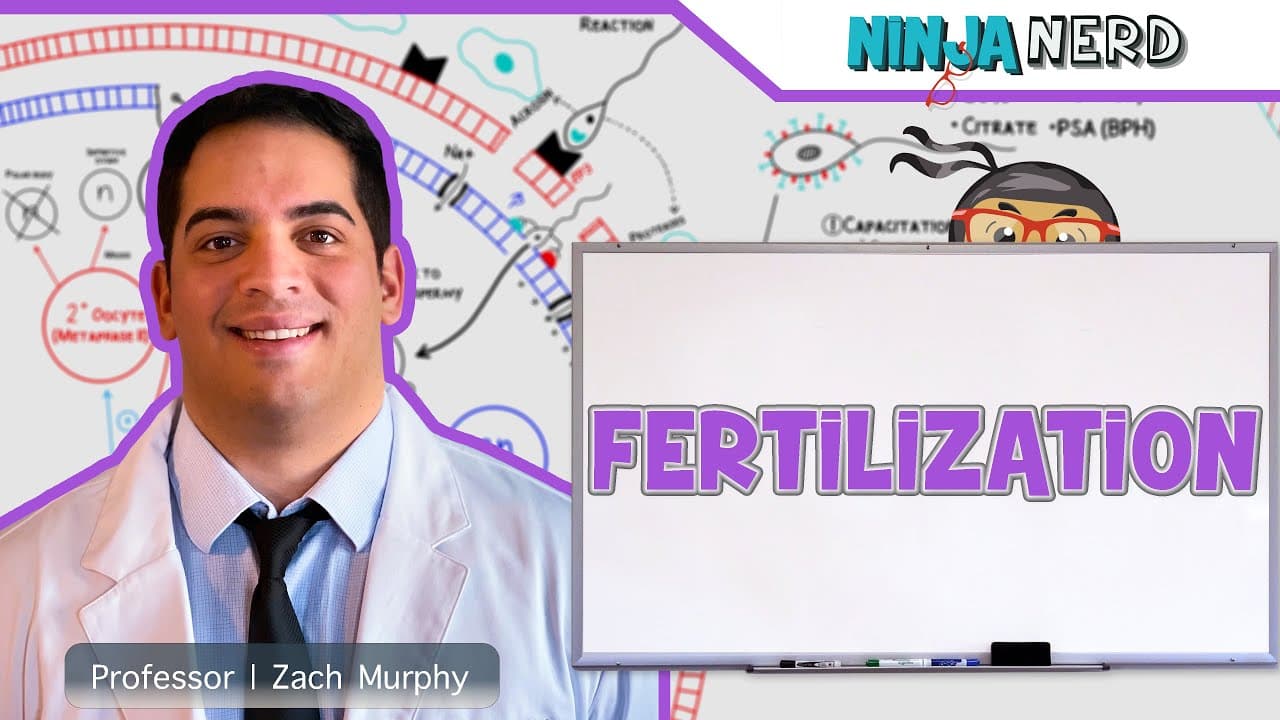
Fertilization occurs when a sperm cell penetrates a secondary oocyte, resulting in the formation of a zygote. The process involves the sperm's journey through the female reproductive tract, capacitation, the acrosomal reaction, and mechanisms to prevent polyspermy. The fusion of male and female pronuclei completes fertilization, restoring diploidy and initiating embryonic development.
Transcript
all right nja nerds in this video we're going to talk about fertilization so if you remember if you watched our ejaculation video we got to that point of where the sperm has been actually ejaculated from the actual male genital tract right and depending upon if copulation is occurring so copulation is just basically the intercourse right so sexual ... Read More
Key Insights
- Fertilization begins with the sperm's journey through the female reproductive tract, aiming to reach the oocyte.
- Capacitation is a crucial process that cleans the sperm's head and increases its motility.
- The acrosomal reaction allows the sperm to penetrate the zona pellucida by releasing hydrolytic enzymes.
- Polyspermy is prevented by fast and slow blocks, ensuring only one sperm fertilizes the oocyte.
- The fusion of male and female pronuclei restores diploidy, forming a zygote.
- Calcium ions play a significant role in triggering the cortical reaction and completing meiosis II in the oocyte.
- The zygote is the first cell of the new organism, marking the start of embryonic development.
- Fertilization triggers subsequent developmental milestones, including cleavage and blastocyst formation.
Install to Summarize YouTube Videos and Get Transcripts
Explore YouTube Video Summarizer or Get YouTube Transcript Extractor
Questions & Answers
Q: How does capacitation occur in sperm?
Capacitation involves the removal of proteins and cholesterol from the sperm's head, which occurs as the sperm travels through the female reproductive tract. This process enhances the sperm's motility and prepares it for the acrosomal reaction. Estrogen plays a role in producing uterine and cervical fluids that aid in capacitation.
Q: What is the acrosomal reaction in fertilization?
The acrosomal reaction is a process where the sperm binds to the zona pellucida of the oocyte, leading to the release of hydrolytic enzymes from the acrosome. These enzymes, including acrasin and proteases, help the sperm penetrate the zona pellucida, allowing it to reach the oocyte's cell membrane.
Q: Why is preventing polyspermy important?
Preventing polyspermy is crucial to ensure that only one sperm fertilizes the oocyte, maintaining the correct chromosome number in the zygote. Mechanisms like the fast block, involving sodium ion influx, and the slow block, involving cortical granule release, prevent additional sperm from entering the oocyte after the first sperm has fused.
Q: What role do calcium ions play in fertilization?
Calcium ions play a pivotal role in fertilization by triggering the cortical reaction, which prevents polyspermy. They also stimulate the completion of meiosis II in the oocyte, leading to the formation of the definitive ovum and the expulsion of the second polar body, essential for successful fertilization.
Q: How do male and female pronuclei fuse during fertilization?
The fusion of male and female pronuclei occurs after the sperm's nuclear material is released into the oocyte's cytoplasm. The pronuclei move towards each other, eventually fusing to form a diploid zygote. This fusion marks the completion of fertilization and the beginning of embryonic development.
Q: What is the significance of the zygote in human development?
The zygote is the initial cell formed when a sperm fertilizes an oocyte, containing a complete set of chromosomes. It marks the beginning of a new organism and undergoes subsequent mitotic divisions, leading to cleavage and the formation of a blastocyst, which implants in the uterine wall to continue development.
Q: What happens during the cortical reaction in fertilization?
During the cortical reaction, cortical granules in the oocyte release enzymes that alter the zona pellucida, preventing additional sperm from binding. This slow block to polyspermy ensures that only one sperm fertilizes the oocyte, maintaining the correct chromosome number in the resulting zygote.
Q: How does fertilization restore diploidy in the zygote?
Fertilization restores diploidy by combining the haploid sets of chromosomes from the sperm and oocyte. The fusion of male and female pronuclei creates a diploid zygote with a complete set of chromosomes, essential for normal embryonic development and the formation of a genetically distinct individual.
Summary & Key Takeaways
-
Fertilization involves the sperm's journey to the oocyte, capacitation, and the acrosomal reaction. Capacitation cleans the sperm's head and enhances motility, while the acrosomal reaction releases enzymes to penetrate the zona pellucida. Polyspermy is prevented by fast and slow blocks, allowing only one sperm to fertilize the oocyte.
-
The fusion of male and female pronuclei restores diploidy, forming a zygote, the first cell of a new organism. Calcium ions trigger the cortical reaction and complete meiosis II in the oocyte. This event initiates embryonic development, leading to cleavage and blastocyst formation.
-
Fertilization is a complex process involving multiple cellular and molecular events. It ensures the formation of a genetically distinct zygote and sets the stage for subsequent developmental milestones, including the first mitotic divisions and the eventual formation of a blastocyst.
Read in Other Languages (beta)
Share This Summary 📚
Summarize YouTube Videos and Get Video Transcripts with 1-Click
Try YouTube Summary with ChatGPT & Claude or YouTube Transcript Generator
Explore More Summaries from Ninja Nerd 📚





Summarize YouTube Videos and Get Video Transcripts with 1-Click
Try YouTube Summary with ChatGPT & Claude or YouTube Transcript Generator