What Are Continuous and Discrete Time Signals?
TL;DR
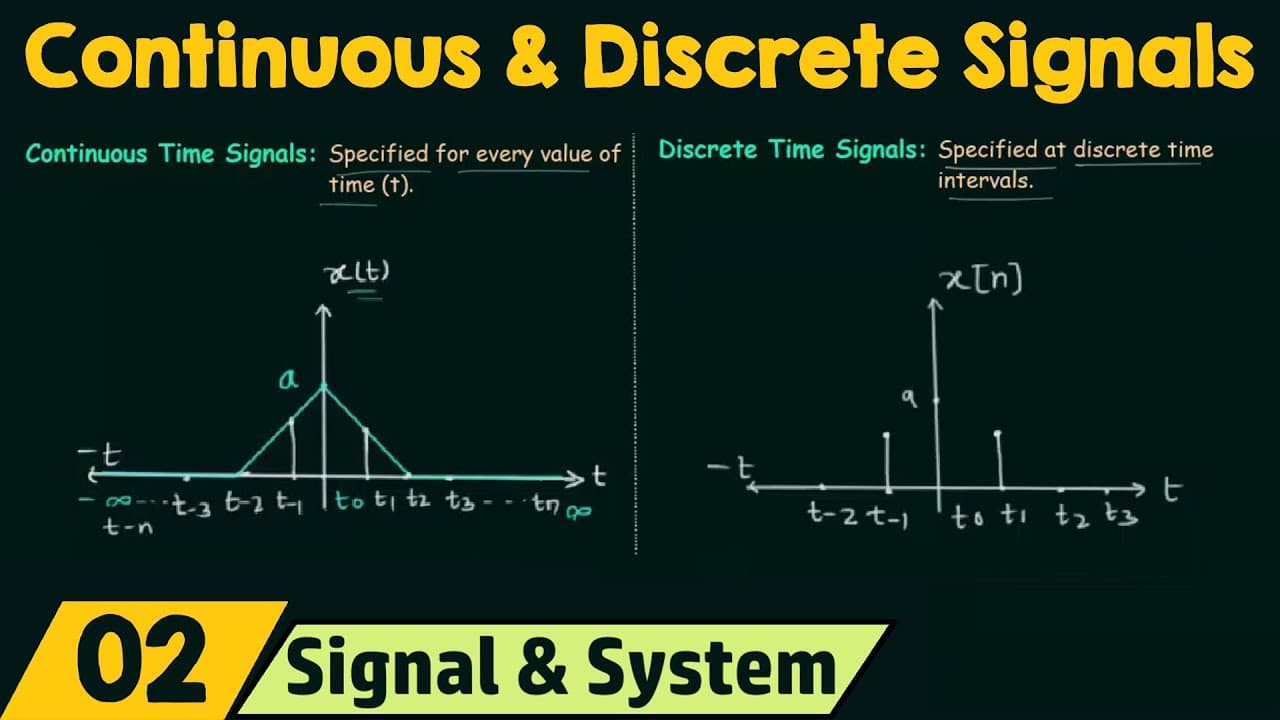
Continuous time signals are defined for every value of time, whereas discrete time signals are specified at distinct time intervals. Continuous signals use time 'T' as the independent variable, while discrete signals use integers. Understanding these concepts is crucial for signal processing in various applications.
Transcript
in this lecture we will discuss continuous and discreet time signals we can broadly classify signals into two types the first one is continuous time signals and the second one is discrete time signals we will start our discussion with continuous time signals the signals which are specified for every value of time T are called as continuous time sig... Read More
Key Insights
- Continuous time signals are defined for every value of time T.
- Discrete time signals are specified at discrete intervals of time.
- Continuous time signals are represented using parentheses with time T.
- Discrete time signals use square brackets with integer n as the independent variable.
- Uniformly sampled discrete signals have equal time intervals.
- Non-uniformly sampled signals have varying time intervals.
- The independent variable for discrete signals is an integer derived from uniform sampling.
- Correct representation of discrete signals requires specifying both amplitude and integer n.
Install to Summarize YouTube Videos and Get Transcripts
Explore YouTube Video Summarizer or Get YouTube Transcript Extractor
Questions & Answers
Q: What is a continuous time signal?
A continuous time signal is a type of signal that is defined for every value of time T. It is represented using the dependent variable X and the independent variable T, allowing for the signal to be analyzed continuously over any time period. This makes continuous time signals crucial for applications requiring uninterrupted signal flow.
Q: How is a discrete time signal represented?
A discrete time signal is represented using square brackets with an integer n as the independent variable. Unlike continuous time signals, discrete signals are specified only at discrete time intervals, making them suitable for digital signal processing where signals are sampled at specific points for analysis.
Q: What is the difference between continuous and discrete time signals?
The primary difference is that continuous time signals are defined for every time value, while discrete time signals are defined only at specific intervals. Continuous signals use time T as the independent variable, whereas discrete signals use integers, making them ideal for digital processing where signals are sampled at distinct intervals.
Q: What does uniformly sampled mean in the context of discrete time signals?
Uniformly sampled discrete time signals have equal time intervals between samples, which ensures a consistent representation of the signal. This means that the difference between consecutive time points is constant, allowing for a straightforward analysis and processing of the signal in digital systems.
Q: Why is integer n used in discrete time signals?
Integer n is used as the independent variable in discrete time signals because these signals are defined at specific intervals rather than continuously. The integer n represents the sample number, derived from uniform sampling, which simplifies the representation and analysis of the signal in digital systems.
Q: How are continuous time signals represented?
Continuous time signals are represented using the dependent variable X inside parentheses with the independent variable T. This representation signifies that the signal is defined for every value of time T, allowing for a continuous flow and analysis over any time period, essential for analog signal processing.
Q: What happens if a discrete signal is non-uniformly sampled?
If a discrete signal is non-uniformly sampled, the time intervals between samples are not equal, which can complicate the analysis and processing of the signal. Non-uniform sampling may lead to inconsistencies in signal representation, requiring more complex methods to accurately analyze and process the signal.
Q: How can you ensure the correct representation of a discrete signal?
To ensure the correct representation of a discrete signal, it is essential to specify both the amplitude of the signal and the integer n, which denotes the sample number. This information allows for accurate plotting and analysis of the signal, ensuring that each amplitude is correctly associated with its respective sample point.
Summary & Key Takeaways
-
Continuous time signals are defined for every time value and represented by the variable T. They are characterized by a continuous flow without interruption, allowing for detailed analysis over any time period. Discrete time signals, however, are defined only at specific time intervals, using integers as the independent variable, which makes them suitable for digital processing.
-
In a continuous time signal, the amplitude is defined at every point on the time axis, whereas in a discrete time signal, the amplitude is defined only at specific points. This distinction is crucial for applications in digital signal processing, where signals must be sampled at discrete intervals for analysis and processing.
-
Uniform sampling in discrete signals means that the time intervals between samples are equal, leading to a consistent representation of the signal. If the time intervals are not equal, the signal is non-uniformly sampled, which can complicate the analysis and processing of the signal in digital systems.
Read in Other Languages (beta)
Share This Summary 📚
Summarize YouTube Videos and Get Video Transcripts with 1-Click
Try YouTube Summary with ChatGPT & Claude or YouTube Transcript Generator
Explore More Summaries from Neso Academy 📚


Summarize YouTube Videos and Get Video Transcripts with 1-Click
Try YouTube Summary with ChatGPT & Claude or YouTube Transcript Generator