How Many Religions Are There?: Crash Course Religions #2
TL;DR
Explores the constructed nature of 'world religions' and its implications.
Transcript
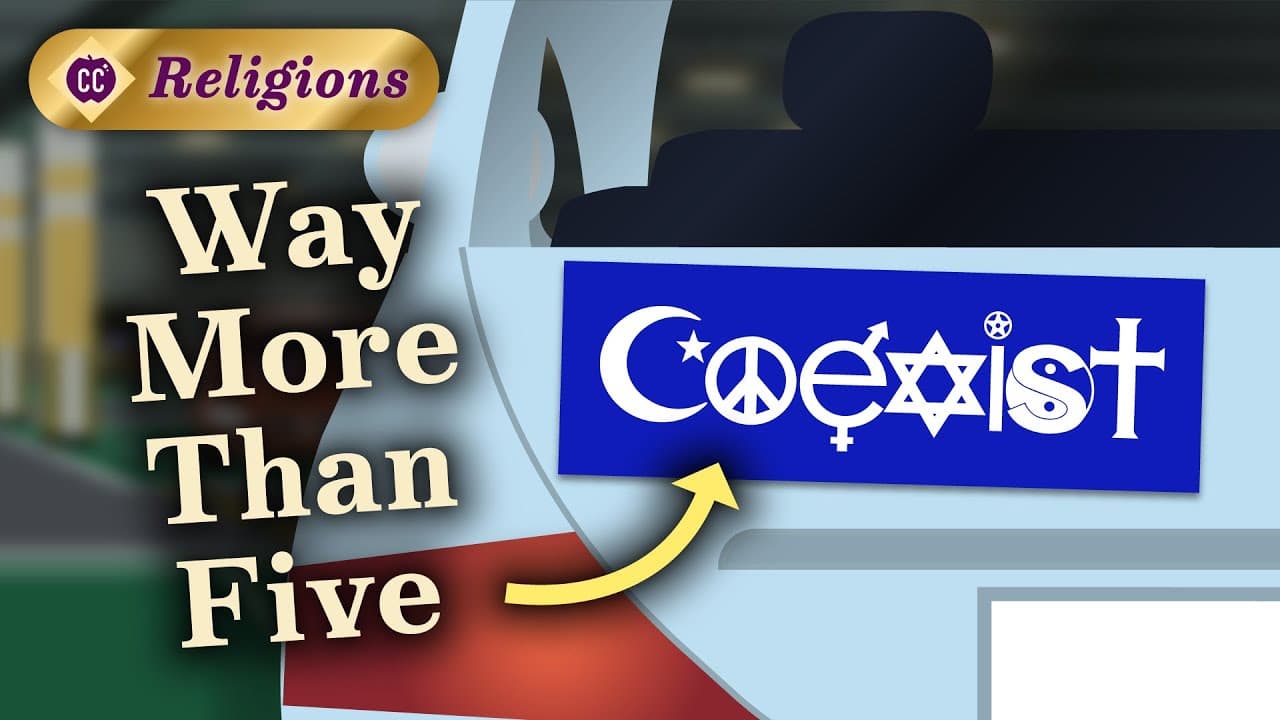
Hi! I'm John Green. Welcome to Crash Course Religions. Does this look familiar? You probably know it as the “Coexist” design— a smattering of symbols that come together to spell the word. This is just one of thousands of car bumpers that uses its design to proclaim a desire for peace and religious tolerance to… other drivers I guess? Now, viewers ... Read More
Key Insights
- The 'Coexist' bumper sticker symbolizes religious tolerance but omits many religions, highlighting the selective representation of world religions.
- The 'Big Five' religions—Islam, Christianity, Judaism, Hinduism, and Buddhism—are often highlighted, yet they do not represent the most practiced religions globally.
- The concept of 'religion' emerged in 16th-century Western Europe, shaped by Christian norms, influencing how other cultures' beliefs were perceived.
- Colonialism imposed a Christian-centric view of religion, often dismissing indigenous beliefs as lacking civilization, justifying colonial expansion.
- Religions are dynamic and diverse, challenging the notion of them being unchanging or uniform systems, which can lead to harmful stereotypes.
- Religious nationalism often uses rigid interpretations of traditions to exert control and exclude other interpretations, impacting societal norms.
- The boundaries between religions are porous, with many traditions blending practices and beliefs, challenging the rigid classification of 'major religions.'
- Understanding religions requires questioning the categories we've created, recognizing their role in reinforcing power dynamics and societal biases.
Install to Summarize YouTube Videos and Get Transcripts
Explore YouTube Video Summarizer or Get YouTube Transcript Extractor
Questions & Answers
Q: Why is the 'Coexist' bumper sticker significant in the discussion of world religions?
The 'Coexist' bumper sticker is significant because it symbolizes religious tolerance using symbols from major world religions. However, it also highlights the selective representation of religions, as it omits many others, such as Sikhism and Shintō, which are widely practiced. This exclusion reflects broader issues of representation and understanding in discussions about world religions.
Q: What are the 'Big Five' religions, and why are they often highlighted?
The 'Big Five' religions are Islam, Christianity, Judaism, Hinduism, and Buddhism. They are often highlighted due to historical, cultural, and scholarly traditions that have prioritized these religions in discussions of world religions. However, they do not represent the most practiced religions globally, and this focus excludes many other significant religious traditions, impacting their visibility and understanding.
Q: How did colonialism influence the perception of religion?
Colonialism influenced the perception of religion by imposing a Christian-centric view on other cultures. European colonizers often dismissed indigenous beliefs as lacking civilization or religion, using this narrative to justify colonial expansion. This perspective shaped how religions were classified and understood, often marginalizing non-Christian beliefs and practices.
Q: Why is it important to understand religions as dynamic and diverse?
Understanding religions as dynamic and diverse is important because it challenges stereotypes of them being unchanging or uniform systems. This perspective allows for a more accurate appreciation of the internal diversity and evolution within religions over time. Recognizing this diversity helps prevent harmful stereotypes and acknowledges the complex realities of religious practices and beliefs.
Q: What role does religious nationalism play in society?
Religious nationalism plays a role in society by using rigid interpretations of religious traditions to exert control and exclude other interpretations. This can lead to the enforcement of specific societal norms and laws based on these interpretations, as seen in various countries. It impacts the rights and freedoms of individuals and groups, often leading to discrimination and conflict.
Q: How does the blending of religious practices challenge the classification of 'major religions'?
The blending of religious practices challenges the classification of 'major religions' by demonstrating that religious boundaries are not rigid. Many traditions incorporate elements from different religions, creating hybrid practices that defy simple categorization. This blending highlights the fluidity and interconnectedness of religious traditions, questioning the validity of rigid classifications.
Q: What are the implications of questioning religious categories?
Questioning religious categories has significant implications, as it allows for a more nuanced understanding of how religions are practiced and perceived. It challenges the power dynamics and biases inherent in traditional classifications, promoting a more equitable and inclusive approach to understanding religious diversity. This can lead to greater empathy and collaboration among different religious communities.
Q: How can expanding our understanding of religion benefit society?
Expanding our understanding of religion can benefit society by fostering greater tolerance, empathy, and cooperation among diverse religious communities. Recognizing the complexities and intersections of different belief systems can help address stereotypes and discrimination, promoting social harmony. It also encourages critical thinking about the power structures that shape religious narratives and their impact on individuals and communities.
Summary & Key Takeaways
-
The video discusses the concept of 'world religions' as a human construct, often limited to the 'Big Five'—Islam, Christianity, Judaism, Hinduism, and Buddhism. It highlights how this categorization excludes many other practiced religions, affecting how they are perceived and treated globally.
-
The historical context of religion as a category is explored, tracing its roots to 16th-century Western Europe and the colonial era. This perspective imposed a Christian-centric view on other cultures, often dismissing indigenous beliefs as uncivilized, which justified colonial expansion.
-
Religions are portrayed as dynamic and diverse, challenging stereotypes of them being unchanging systems. The video emphasizes the importance of questioning religious categories to better understand and appreciate the complexities and intersections of different belief systems.
Read in Other Languages (beta)
Share This Summary 📚
Summarize YouTube Videos and Get Video Transcripts with 1-Click
Try YouTube Summary with ChatGPT & Claude or YouTube Transcript Generator
Explore More Summaries from CrashCourse 📚






Summarize YouTube Videos and Get Video Transcripts with 1-Click
Try YouTube Summary with ChatGPT & Claude or YouTube Transcript Generator