The Caucasian Languages (of The Caucasus Mountains)
TL;DR
The video explores the unique features of Caucasian languages.
Transcript
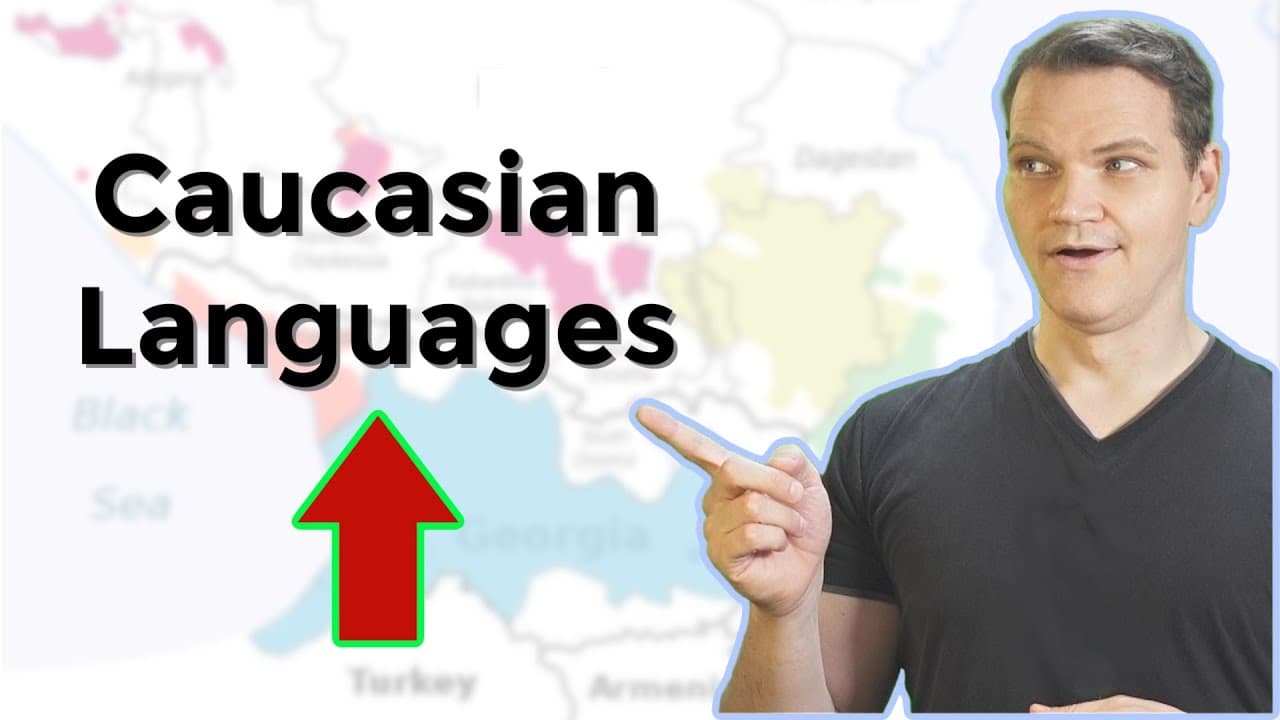
hello everyone welcome to the Laing focused Channel and my name is Paul today we're going to talk about the Caucasian languages the Caucasian languages are named after the Caucasus Mountains which are situated between the Black Sea and the Caspian Sea and more or less serve as a geographic border between Europe and Asia the Caucasian languages are ... Read More
Key Insights
- The Caucasian languages are not a single family but a regional grouping, including Kartvelian, Northwest Caucasian, and Northeast Caucasian families.
- Kartvelian languages, like Georgian, have around 5.2 million speakers, mainly in Georgia, with mutual intelligibility among some dialects.
- Northeast Caucasian languages are spoken by 3.8 million people, with Chechen being the most widely spoken language in this group.
- Northwest Caucasian languages include Circassian, with mutual intelligibility between its East and West branches, and are known for their extensive consonant inventories.
- Caucasian languages are characterized by large consonant clusters and rich consonant inventories, with some languages having over 80 distinct consonants.
- A common feature among these languages is the use of ejective consonants, which involve closing the glottis to create a popping sound.
- Agglutination is a key feature, where words are formed by gluing morphemes, each representing a piece of meaning, unlike fusional languages.
- The genetic links of Caucasian languages to other language families remain unknown, leading to theories about connections to Basque and other distant languages.
Install to Summarize YouTube Videos and Get Transcripts
Explore YouTube Video Summarizer or Get YouTube Transcript Extractor
Questions & Answers
Q: What are the main language families within the Caucasian languages?
The Caucasian languages comprise three main language families: Kartvelian, Northwest Caucasian, and Northeast Caucasian. These families are part of a regional grouping rather than a single language family, each with distinct characteristics and a variety of languages spoken in and around the Caucasus Mountains.
Q: How are Kartvelian languages distributed geographically?
Kartvelian languages, including Georgian, are primarily spoken in Georgia, with around 5.2 million speakers. They also have minority speakers across the borders in Turkey, Azerbaijan, and Russia. Georgian serves as a common written language for Kartvelian speakers, contributing to mutual intelligibility among its dialects.
Q: What distinguishes Northwest Caucasian languages in terms of consonant usage?
Northwest Caucasian languages are notable for their extensive consonant inventories, with some languages having over 80 distinct consonants. This is achieved through secondary articulation, where consonants are pronounced in two places in the vocal tract simultaneously, such as with ejective consonants, which involve a popping sound.
Q: What is agglutination, and how is it used in Caucasian languages?
Agglutination in Caucasian languages involves forming words by gluing together a sequence of morphemes, each representing a distinct piece of meaning. This is different from fusional languages, where morphemes can contain multiple meanings. An example is the Chechen verb 'mullah,' meaning 'to drink,' which changes form to indicate tense and evidentiality.
Q: What is the role of evidentiality in Caucasian languages?
Evidentiality in Caucasian languages refers to verbs being inflected to indicate whether the speaker has evidence of the action described. This feature is present in all three language families, with Kartvelian languages adopting it through Turkic influence, while it likely existed independently in the other families.
Q: How does the concept of ergativity manifest in Caucasian languages?
Ergativity in Caucasian languages means that the subject of an intransitive verb and the direct object of a transitive verb are treated similarly, both in the absolutive case. This is seen in languages like Georgian, though it does not consistently appear across all tenses or verbs, unlike some other Caucasian languages.
Q: What are some theories about the genetic links of Caucasian languages?
The genetic links of Caucasian languages to other families are unknown, leading to various theories. Some suggest a connection to Basque due to shared features like ergativity and polypersonal verbs. The Dene-Caucasian hypothesis proposes links to languages across Eurasia and North America, though it remains controversial and widely unaccepted.
Q: Why are the Caucasian languages considered unique and fascinating?
The Caucasian languages are unique due to their extensive consonant inventories, complex phonetic features like ejective consonants, and linguistic phenomena such as agglutination and evidentiality. Their genetic isolation and the region's linguistic diversity make them a compelling subject for linguistic study and exploration.
Summary & Key Takeaways
-
The Caucasian languages, named after the Caucasus Mountains, are a regional grouping rather than a single family. They include the Kartvelian, Northwest Caucasian, and Northeast Caucasian language families, each with unique characteristics and a rich diversity of languages and dialects.
-
Kartvelian languages, particularly Georgian, have significant mutual intelligibility among dialects, while Northwest and Northeast Caucasian languages are known for their extensive consonant inventories and the use of ejective consonants. These languages also exhibit agglutination and evidentiality.
-
The genetic relationships of Caucasian languages to other families are unknown, sparking theories about links to languages like Basque. The region's linguistic diversity and unique features make it a fascinating area of study for linguists and language enthusiasts.
Read in Other Languages (beta)
Share This Summary 📚
Summarize YouTube Videos and Get Video Transcripts with 1-Click
Try YouTube Summary with ChatGPT & Claude or YouTube Transcript Generator
Explore More Summaries from Langfocus 📚
Summarize YouTube Videos and Get Video Transcripts with 1-Click
Try YouTube Summary with ChatGPT & Claude or YouTube Transcript Generator