What Is Correlation in Statistics?
TL;DR
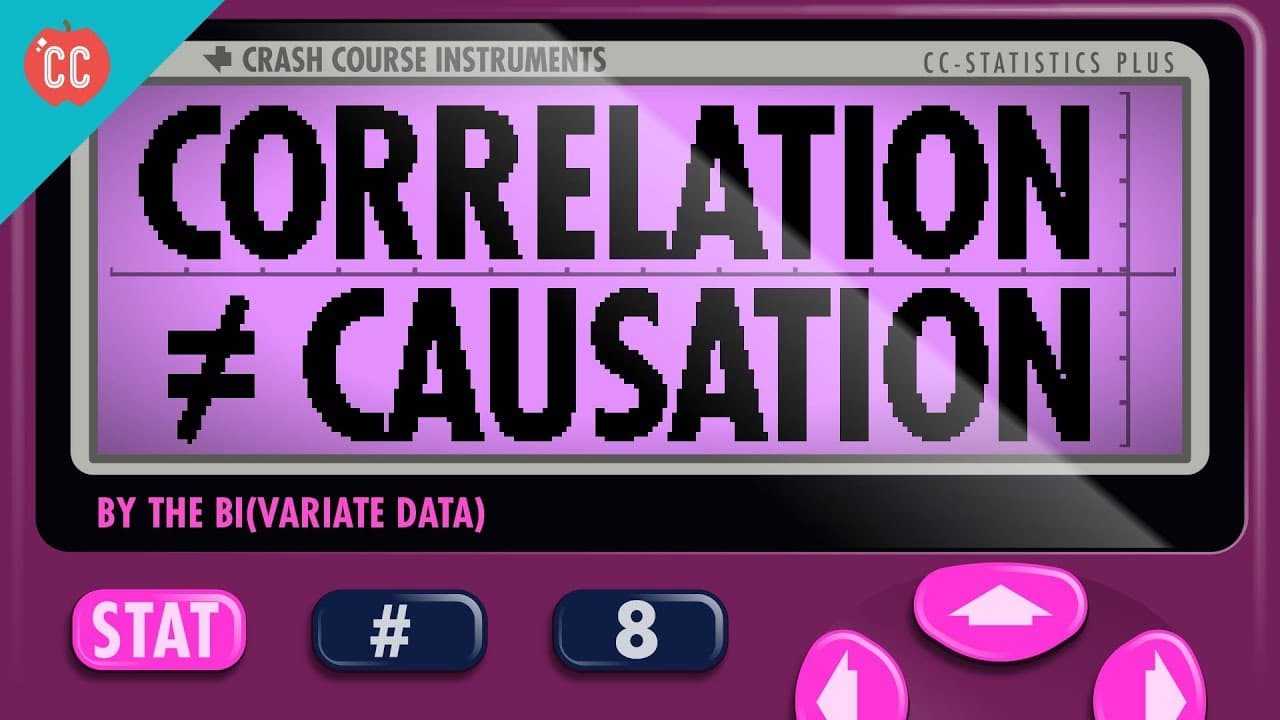
Correlation measures how two variables move together, indicating a relationship but not causation. A regression line helps predict one variable from another, but it's essential to remember that correlation does not imply causation. Scatter plots are useful for visualizing these relationships, and the correlation coefficient (r) quantifies their strength and direction.
Transcript
Hi., I’m Adriene Hill and Welcome back to Crash Course Statistics. Today we’re talking about relationships. No, not why you and your bestie are platonic soulmates, or why your cat just doesn’t seem to like you, we’re talking about data relationships like how you can use one variable to predict another. Like if you can predict whether people who wri... Read More
Key Insights
- Correlation measures the way two variables move together, indicating the direction and strength of their relationship.
- A scatter plot is a tool used to visualize data relationships between two continuous variables, showing clusters or patterns.
- The regression line, represented as y = mx + b, helps predict one variable based on another, with the slope (m) indicating the rate of change.
- The correlation coefficient (r) ranges from -1 to 1, showing whether variables move in the same direction (positive) or opposite directions (negative).
- R^2, the squared correlation coefficient, indicates how much of the variance in one variable is explained by the other.
- Correlation does not imply causation; two correlated variables may be influenced by a third variable or be coincidentally related.
- Spurious correlations are misleading relationships between unrelated variables, often arising by chance or through data manipulation.
- Visual inspection of scatter plots is crucial, as the same correlation coefficient can represent different data relationships.
Install to Summarize YouTube Videos and Get Transcripts
Explore YouTube Video Summarizer or Get YouTube Transcript Extractor
Questions & Answers
Q: How to interpret the correlation coefficient?
The correlation coefficient (r) ranges from -1 to 1, where a positive value indicates that two variables move in the same direction, while a negative value shows they move in opposite directions. The magnitude of r indicates the strength of the relationship, with values closer to -1 or 1 signifying a stronger correlation.
Q: What is the role of a regression line in data analysis?
A regression line, described by the equation y = mx + b, helps predict the value of one variable based on another. The slope (m) indicates the rate of change, showing how much one variable is expected to increase or decrease as the other changes. It's a useful tool for identifying trends and making predictions.
Q: Why doesn't correlation imply causation?
Correlation does not imply causation because two variables may be correlated due to a third, unmeasured variable influencing both, or they might be correlated by coincidence. Understanding the underlying reasons for a correlation requires additional analysis beyond the statistical relationship observed.
Q: What are spurious correlations?
Spurious correlations are misleading relationships between unrelated variables, often occurring by chance or through data manipulation. These correlations may suggest a connection where none exists, leading to incorrect conclusions if not critically evaluated with context and additional analysis.
Q: How does R^2 help in understanding data relationships?
R^2, the squared correlation coefficient, indicates how much of the variance in one variable is explained by the other. It ranges from 0 to 1, with higher values signifying a better fit of the regression line to the data, thus providing a measure of predictive accuracy in the relationship.
Q: When should scatter plots be used?
Scatter plots should be used when analyzing the relationship between two continuous variables. They help visualize patterns, clusters, and outliers, providing a clear picture of how variables interact. They are especially useful when assessing the strength and direction of a correlation or identifying trends.
Q: What factors can affect the slope of a regression line?
The slope of a regression line, representing the rate of change between variables, can be affected by the units of measurement. Changing units alters the numerical value of the slope, though the underlying relationship remains the same. It's crucial to consider unit consistency when interpreting the slope.
Q: Why is visual inspection of scatter plots important?
Visual inspection of scatter plots is important because the same correlation coefficient can represent different data patterns. Scatter plots reveal the actual distribution and relationship of data points, helping identify clusters, outliers, and non-linear relationships that numerical measures alone might miss.
Summary & Key Takeaways
-
Correlation is a statistical measure that describes how two variables move together, but it does not imply causation. It is visualized using scatter plots, which show the relationship between variables. The correlation coefficient (r) quantifies this relationship, ranging from -1 to 1, indicating positive or negative correlation.
-
Regression lines, represented by the formula y = mx + b, help predict one variable from another, with the slope indicating the rate of change. However, the slope's significance can change with different units, emphasizing the importance of understanding the context of data.
-
Spurious correlations are misleading as they suggest relationships between unrelated variables. It's essential to analyze scatter plots visually to understand the true nature of data relationships, as identical correlation coefficients can represent different patterns or clusters.
Read in Other Languages (beta)
Share This Summary 📚
Summarize YouTube Videos and Get Video Transcripts with 1-Click
Try YouTube Summary with ChatGPT & Claude or YouTube Transcript Generator
Explore More Summaries from CrashCourse 📚





Summarize YouTube Videos and Get Video Transcripts with 1-Click
Try YouTube Summary with ChatGPT & Claude or YouTube Transcript Generator