How to Use Regular Expressions in Python
TL;DR
Regular expressions (regex) are powerful tools in Python for searching and matching patterns within strings. They enable validation of data, like emails and passwords, by checking for specific patterns. The 're' module in Python provides functions like 'search' to find patterns, returning a match object if successful.
Transcript
in this presentation we will understand the basics of regular Expressions we need to understand the basics of regular Expressions because in the next lecture we will write the program where we will use the regular expressions and hence it makes sense to have some basics of regular Expressions beforehand so that there will be no problem in understan... Read More
Key Insights
- Regular expressions are used to check if a string contains a specified search pattern.
- The 're' module in Python provides functions related to regular expressions.
- The 'search' function from the 're' module checks for a pattern in a string and returns a match object if found.
- A match object contains information about the start and stop positions of a match.
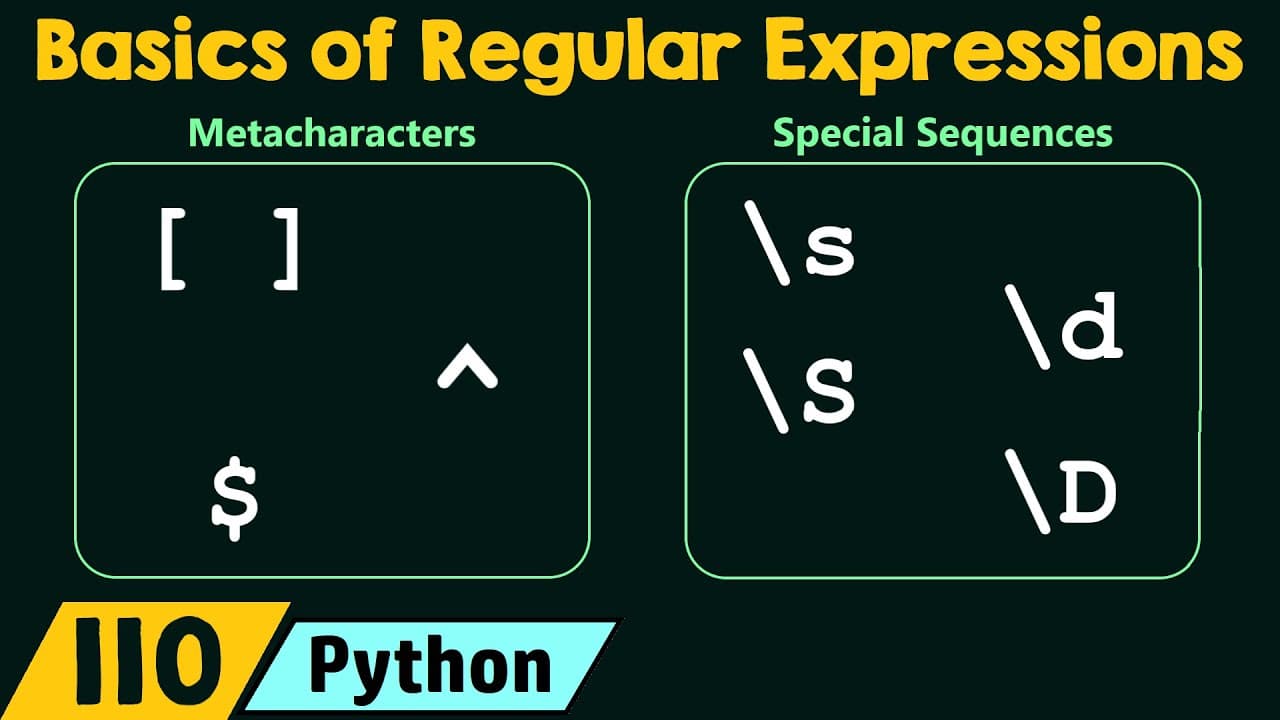
- Meta characters, like '^' and '$', have special meanings for pattern matching.
- Special sequences start with a backslash and are followed by a single character, like '\s' for whitespace.
- The 'search' function returns only the first occurrence of a match in the string.
- Regular expressions can validate data such as email addresses and passwords by checking for specific patterns.
Install to Summarize YouTube Videos and Get Transcripts
Explore YouTube Video Summarizer or Get YouTube Transcript Extractor
Questions & Answers
Q: How to use regular expressions in Python?
To use regular expressions in Python, import the 're' module which provides functions like 'search' to find patterns in strings. Use regex patterns to define search criteria, and the 'search' function will return a match object if the pattern is found, allowing further analysis.
Q: What is the purpose of the 're' module in Python?
The 're' module in Python is used for working with regular expressions. It provides functions like 'search', 'match', and 'findall' that allow developers to search, match, and manipulate strings based on specific patterns, making it a powerful tool for text processing.
Q: What is a match object in regular expressions?
A match object is returned by functions like 'search' when a pattern is found in a string. It contains information about the match, such as the start and end positions, and can be used to extract matched portions of the string or to gather more detailed information about the match.
Q: How do meta characters function in regular expressions?
Meta characters in regular expressions have special meanings that help define search patterns. For example, '^' indicates the start of a string, '$' indicates the end, and '.' matches any character. They enhance the flexibility and precision of pattern matching in strings.
Q: What are special sequences in regular expressions?
Special sequences in regular expressions start with a backslash followed by a character, like '\s' for whitespace or '\d' for digits. They provide shortcuts for common patterns, allowing for more concise and readable regex patterns in string searching and matching.
Q: How does the 'search' function work in the 're' module?
The 'search' function in the 're' module searches a string for a pattern and returns a match object if the pattern is found. It only returns the first occurrence of the match, providing information about the match such as its position within the string.
Q: What is the difference between '\s' and '\S' in regex?
In regular expressions, '\s' matches any whitespace character, including spaces, tabs, and newlines, while '\S' matches any non-whitespace character. These special sequences help in identifying and manipulating text based on the presence or absence of whitespace.
Q: Why are regular expressions useful in programming?
Regular expressions are useful in programming for their ability to search, match, and manipulate text based on patterns. They simplify tasks like data validation, text parsing, and formatting by providing a concise way to specify complex search criteria, improving code efficiency and readability.
Summary & Key Takeaways
-
Regular expressions in Python are essential for pattern matching in strings. Using the 're' module, functions like 'search' help find patterns and return match objects with detailed information. Understanding meta characters and special sequences enhances regex capabilities.
-
The 're' module's 'search' function is crucial for searching patterns, returning match objects when patterns are found. Meta characters and special sequences offer powerful tools for precise pattern matching and validation in data such as emails and passwords.
-
Meta characters like '^' for starts with and '$' for ends with, along with special sequences such as '\s' for whitespace, provide flexible pattern matching. The 'search' function's match object reveals start and stop positions, aiding in detailed string analysis.
Read in Other Languages (beta)
Share This Summary 📚
Summarize YouTube Videos and Get Video Transcripts with 1-Click
Try YouTube Summary with ChatGPT & Claude or YouTube Transcript Generator
Explore More Summaries from Neso Academy 📚


Summarize YouTube Videos and Get Video Transcripts with 1-Click
Try YouTube Summary with ChatGPT & Claude or YouTube Transcript Generator