How Does Dante Liberate Human Imagination?
TL;DR
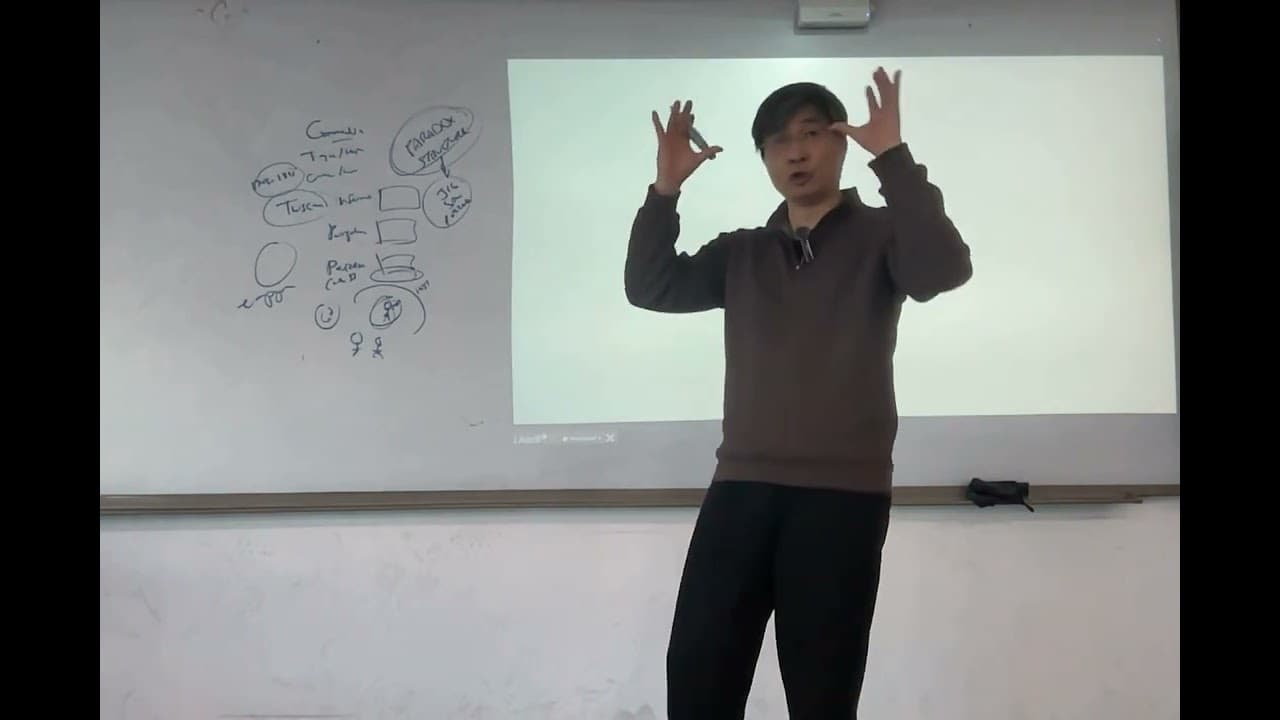
Dante presents human love and imagination as creative powers that continue God’s legacy and make a better world conceivable. The lecture interprets the Divine Comedy as a rebuttal to Augustine’s distrust of human nature, arguing that the poem’s paradoxes and precise structure helped form an intellectual blueprint for the Renaissance, Protestant Reformation, and Scientific Revolution.
Transcript
okay good morning so today we do Dante and Dante really is the height of civilization it does not get better than Dante um I've taught Dante for three years now this is my third time teaching Dante and what's amazing about it is that all students love Dante but also each time I teach Dante I'm able to discover new insights about Dante that I didn't... Read More
Key Insights
- The Comedia is a spiritual journey through Inferno, Purgatory, and Paradise in search of truth and God. Dante begins in a midlife crisis, travels first with Virgil, and reaches the final heavenly realm under the guidance of Saint Bernard.
- The poem’s original title is the Comedia, not the Divine Comedy. The lecture explains that comedy was a low literary mode concerned with ordinary people and common language, unlike the elevated tragic style associated with gods, kings, and sophisticated expression.
- Dante’s choice of Tuscan challenged Latin’s position as Europe’s high language. According to the lecture, the Comedia was produced so powerfully that the Florentine dialect became the official language of the Italian Peninsula and the basis of the language spoken in Italy.
- Paradox is a central method in the Divine Comedy. The poem repeatedly presents truths that resemble contradictions, compelling the reader’s mind to engage with puzzles, unravel their implications over time, and construct a changed understanding of humanity, God, and the universe.
- Mathematical structure gives the Divine Comedy its intellectual precision. The lecture compares the poem to an intricate jigsaw puzzle whose carefully organized parts draw readers into sustained reflection, allowing embedded contradictions and patterns to reshape their thinking without direct instruction.
- Augustine’s theology is presented as a negation of human will and agency. The lecture reads City of God as teaching that pride, self-love, bodily desire, and even Adam’s love for Eve lead humanity away from God and toward sin.
- Human limitation is the source of imagination in the lecture’s interpretation of Dante. Because people are flawed, weak, and incomplete, they can envision what they do not possess, strive to improve themselves, and imagine possibilities beyond the world immediately available to them.
- The Divine Comedy is described as an intellectual blueprint for three European transformations: the Renaissance, Protestant Reformation, and Scientific Revolution. Its defense of human love, imagination, and agency is presented as helping free European thought from the Augustinian mentality associated with the Dark Ages.
- More videos from this channel:
- More from this channel: Predictive History
Install to Summarize YouTube Videos and Get Transcripts
Explore YouTube Video Summarizer or Get YouTube Transcript Extractor
Questions & Answers
Q: Why did Dante call his poem the Comedia?
Dante called the poem the Comedia because it uses the literary mode associated with ordinary people and a common vernacular. The lecture contrasts this comic or low style with the tragic or high style, which usually concerns gods and kings and employs sophisticated language. The later title, the Divine Comedy, was not Dante’s original name for the work.
Q: Why did Dante write the Divine Comedy in Tuscan?
Dante chose Tuscan, the local language of Florence, instead of Latin, which the lecture identifies as Europe’s high language during his period. This choice made the poem accessible through a common vernacular and gave that vernacular extraordinary cultural authority. According to the lecture, the Comedia’s quality helped Tuscan become the official language of the Italian Peninsula.
Q: How is the Divine Comedy structured as a spiritual journey?
The Divine Comedy follows Dante as he seeks the spiritual truth underlying the universe and attempts to encounter God. Beginning from a midlife crisis, he travels with Virgil through Inferno and onward to Purgatory. He then enters Paradise and reaches the Empyrean, where Saint Bernard and the heavenly host seek Mary’s help so he can perceive God.
Q: How does Dante challenge Augustine’s view of humanity?
The lecture presents Augustine as teaching that human beings are inclined toward pride, self-love, bodily desire, and sin because they were created from nothing. Dante challenges this distrust of human nature by treating love, agency, limitation, and imagination as meaningful powers. Human flaws do not merely condemn people, but enable them to strive toward improvement and envision a better world.
Q: Why is Mary central in Dante’s vision of heaven?
Mary occupies the center of Dante’s heavenly arrangement because the lecture treats her motherhood as a profound theological paradox. It asks whether the greater miracle is God coming to Earth and dying for human sins, or a mortal woman giving birth to God. Bernard and the entire heavenly host invoke Mary’s love to empower Dante’s final vision.
Q: How do paradoxes work in the Divine Comedy?
Paradoxes work as intellectual puzzles that present truth in apparently contradictory forms. The lecture argues that the human mind dislikes unresolved contradiction, so sustained engagement with the poem prompts readers to keep examining its tensions. Over time, the mind begins to unravel them and form a new understanding of the universe, humanity, love, and God.
Q: Why does God lack imagination in the lecture’s interpretation?
The lecture argues that an omniscient and omnipresent God lacks imagination by definition because God already knows everything and is everywhere. Human beings, by contrast, possess weaknesses, flaws, and limitations that leave room for uncertainty and aspiration. These absences enable people to imagine what does not yet exist, pursue improvement, and continue God’s creative legacy.
Q: How did the Divine Comedy influence European civilization?
The lecture describes the Divine Comedy as an intellectual blueprint for the Renaissance, Protestant Reformation, and Scientific Revolution. Its paradoxes, mathematical structure, defense of human agency, and elevation of love and imagination offered an alternative to the Augustinian worldview associated with the Dark Ages. Dante is therefore presented as a father of modern European civilization.
Summary & Key Takeaways
-
Dante wrote the Comedia from 1308 to 1321 in Tuscan rather than Latin, the period’s high literary language. Its success helped make Tuscan the language of the Italian Peninsula. The title reflects its use of ordinary people and common vernacular, while its journey moves through Inferno, Purgatory, and Paradise toward God.
-
The lecture contrasts Dante with Augustine’s City of God. Augustine is presented as distrusting pride, bodily desire, self-love, romantic attachment, and human agency. Dante instead treats human limitations as sources of imaginative power. Love becomes a force that connects people and the universe, rather than merely a path toward disobedience and sin.
-
Paradiso Canto 33 concludes Dante’s spiritual journey in the Empyrean, where Bernard and the heavenly host appeal to Mary so Dante can perceive God. The lecture interprets this encounter as a transformation of apocalyptic literature: the poet does not simply receive divine truth, but uses imagination to confront and articulate its deepest mystery.
Read in Other Languages (beta)
Share This Summary 📚
Summarize YouTube Videos and Get Video Transcripts with 1-Click
Try YouTube Summary with ChatGPT & Claude or YouTube Transcript Generator
Explore More Summaries from Predictive History 📚
Summarize YouTube Videos and Get Video Transcripts with 1-Click
Try YouTube Summary with ChatGPT & Claude or YouTube Transcript Generator