Why Was Genesis Written as a National Cosmology?
TL;DR
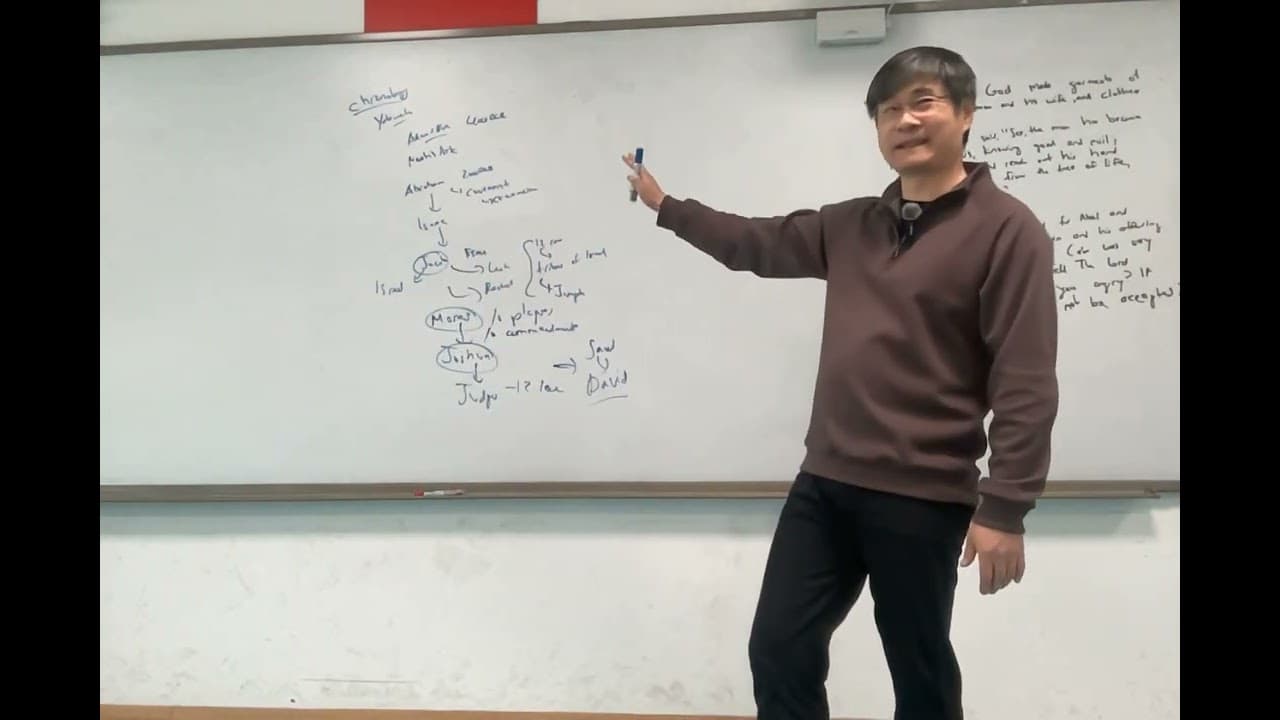
Genesis is presented as a cosmology that gave ancient Israel political legitimacy, a shared national identity, and differentiation from neighboring peoples. The lecture argues that its lasting power came from the Yahwist’s literary treatment of universal experiences such as loneliness, friendship, love, childbirth, and family, rather than from its reliability as a chronological historical record.
Transcript
okay so good morning we are continuing the Hebrew Bible today um last class we talked about King David of Israel and how he created the Bible the the project of the Bible in order to create legitimacy and Authority okay we're continuing along this theme today so let's go over the chronology of the Bible okay um so in the beginning there was God oka... Read More
Key Insights
- The biblical narrative appears chronological, moving from creation and the patriarchs through Moses, Joshua, the judges, Saul, and David, but the lecture argues that its episodes are not consistently interconnected and should not be interpreted as conventional historical documentation.
- Concrete historical or archaeological evidence is described as absent for Noah’s flood, the Garden of Eden, Abraham, Isaac, Jacob, Moses, the ten plagues, the parted sea, Joshua, and the judges, while evidence begins to appear only with David.
- The Bible is interpreted as a cosmology created to explain Israel’s world and identity, not simply as a chronology or a work of pure fiction. This framework makes its internal discontinuities and symbolic stories more understandable.
- Royal writing projects are presented as serving three purposes: establishing legitimacy and authority, creating national identity and cohesion, and differentiating a population from neighboring peoples whom it does not consider part of itself.
- David’s legitimacy problem is linked to his seizure of Saul’s throne. The biblical portrait answers that problem by presenting David as a sensitive poet-king whose qualities correspond to Yahweh’s identity as a poet-God.
- Yahweh is characterized as a poet-God because he creates through speech, evaluates what his words produce, and forms a world through language. His loneliness and desire for companionship also make creation part of a story about friendship.
- Covenants are presented as promises that structure relationships between Yahweh and humanity. The lecture identifies covenants involving Noah, Abraham, and Moses, including promises concerning preservation, loyalty, nationhood, land, and divine law.
- The Yahwist’s literary genius is located in domestic stories about Adam and Eve and the patriarchs. By emphasizing love, childbirth, conflict, and family life, these narratives turn a national cosmology into literature concerned with universal and enduring human experiences.
- More videos from this channel:
- More from this channel: Predictive History
Install to Summarize YouTube Videos and Get Transcripts
Explore YouTube Video Summarizer or Get YouTube Transcript Extractor
Questions & Answers
Q: Why does the lecture call the Bible a cosmology rather than a chronology?
The lecture calls the Bible a cosmology because its stories are interpreted as explanations of Israel’s world, identity, political legitimacy, and relationship with neighboring peoples. A chronological reading becomes confusing because the episodes are not consistently interconnected and concrete evidence is described as absent for events before David. The cosmological reading instead emphasizes the narrative’s social, political, and symbolic purposes.
Q: What political purposes did biblical writing serve for ancient Israel?
Biblical writing is presented as serving three political purposes. It established legitimacy and authority, created a shared national identity among disparate groups, and differentiated Israelites from Egyptians, Canaanites, Philistines, and other neighbors. In the lecture’s interpretation, these functions were especially important to David because he had taken Saul’s throne and therefore faced a serious problem of royal legitimacy.
Q: How does the biblical narrative legitimize King David?
The narrative legitimizes David by depicting him as a poet-king whose character resembles that of Yahweh, the poet-God. David sings, writes poetry, and appears as a sensitive person rather than merely an ambitious usurper. Yahweh likewise creates through speech and evaluates his creation. Their shared poetic identity provides a religious explanation for why David deserves to rule Israel.
Q: Why is Yahweh described as a poet-God in the lecture?
Yahweh is described as a poet-God because he brings the world into existence by speaking. He commands light, heaven, and earth to appear, then looks at what his words have produced and judges it good. The lecture compares this process to a writer creating and editing through language. Yahweh’s loneliness and search for companionship also give him a sensitive, poetic character.
Q: What evidence does the lecture discuss for early biblical events?
The lecture says that archaeologists and historians have not found concrete evidence for Noah’s flood, the ark, the Garden of Eden, Abraham, Isaac, Jacob, Moses, the ten plagues, the parting of the sea, Joshua, or the judges. It argues that historical records and proof begin to appear only with David, making a literal historical reading of the earlier narrative difficult.
Q: How did the Torah help create an Israelite national identity?
The Torah is presented as a shared national narrative that joined disparate groups within the new political entity of Israel. According to the description, the Bronze Age collapse permitted new multicultural entities to form in the Levant. The narrative gave these groups common ancestors, covenants, struggles, and a promised land, while defining them collectively against powerful Egyptian and Canaanite neighbors.
Q: What role do covenants play in the biblical narrative?
Covenants function as promises or contracts connecting Yahweh with human beings. After destroying the world, Yahweh promises Noah that he will not destroy it again as long as humans are not too evil. He promises Abraham that faithful descendants will become a great nation and receive Israel. The lecture also identifies a Mosaic covenant associated with Moses and divine law.
Q: What makes the Yahwist’s Genesis stories distinctive?
The Yahwist’s stories are presented as distinctive because they transform a political and national cosmology into compelling domestic literature. Stories about Adam and Eve and the patriarchs focus on recognizable experiences such as loneliness, friendship, love, childbirth, marriage, rivalry, and family conflict. The lecture argues that these universal and enduring themes helped make the Bible exceptionally powerful beyond its original national purpose.
Summary & Key Takeaways
-
The lecture reviews the biblical sequence from creation, Adam and Eve, Noah, Abraham, Isaac, Jacob, Joseph, and Moses through Joshua, the judges, Saul, and David. It then contrasts this apparent chronology with the absence of concrete archaeological or historical evidence for the principal people and events preceding David.
-
Rather than treating the Bible as straightforward history or pure fiction, the lecture interprets it as a cosmology serving political and social purposes. The narrative legitimizes David as a poet-king favored by the poet-God Yahweh, builds unity among disparate groups, and distinguishes Israelites from Egyptians, Canaanites, Philistines, and other neighbors.
-
The Yahwist’s distinctive literary contribution was to turn national cosmology into compelling stories about ordinary human concerns. Narratives involving Adam and Eve and the patriarchs function as domestic comedies centered on loneliness, friendship, marriage, love, childbirth, rivalry, and family, giving the work an appeal extending beyond its original political setting.
Read in Other Languages (beta)
Share This Summary 📚
Summarize YouTube Videos and Get Video Transcripts with 1-Click
Try YouTube Summary with ChatGPT & Claude or YouTube Transcript Generator
Explore More Summaries from Predictive History 📚




Summarize YouTube Videos and Get Video Transcripts with 1-Click
Try YouTube Summary with ChatGPT & Claude or YouTube Transcript Generator