How to Copy a Dictionary in Python
TL;DR
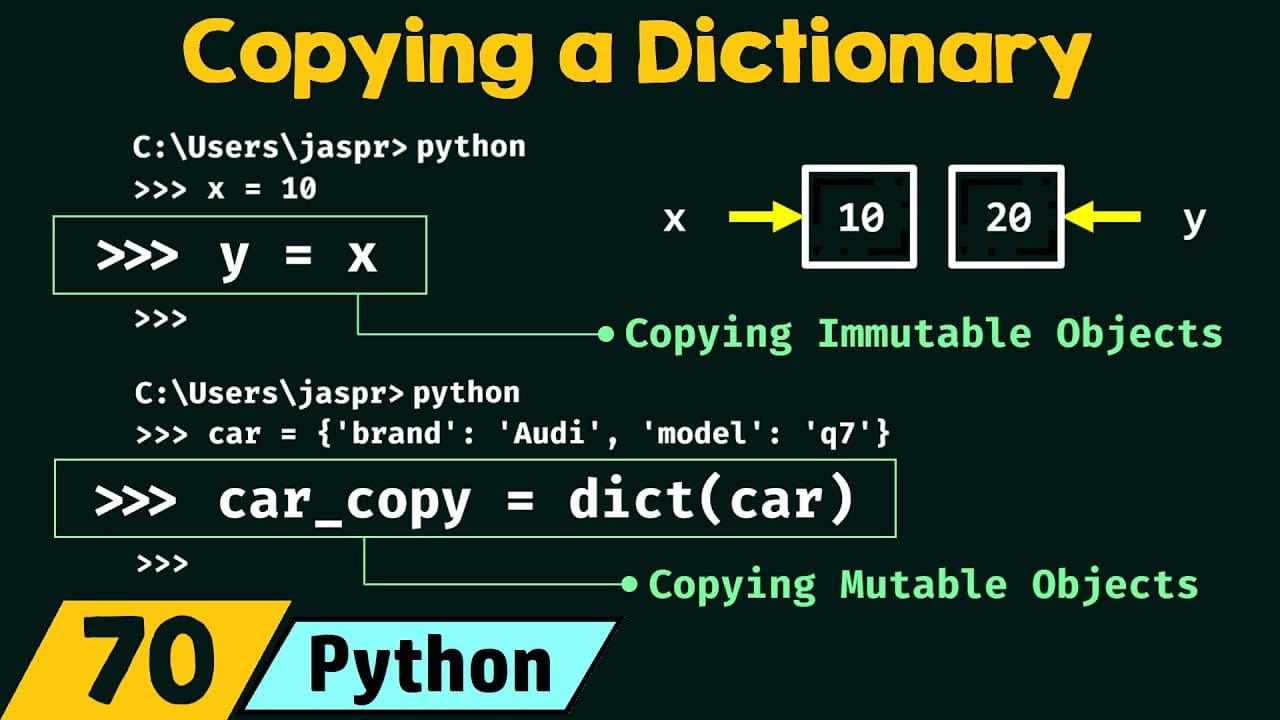
To copy a dictionary in Python, use copy() or dict() to create a new dictionary object instead of assigning the original dictionary to another variable. Assignment makes both variables reference the same mutable object, so changing one also changes the other. Read on to compare both copying methods and understand how mutability affects the result.
Transcript
foreign how to copy a dictionary so without any further delay let's get started the first topic of this presentation is Introduction to copying a dictionary the second topic is copying a dictionary using copy method and the third topic is copying a dictionary using dict method let's get started with the first topic that is Introduction to copying a... Read More
Key Insights
- Immutable objects can be copied using the assignment operator, as they do not change once created.
- Mutable objects, such as dictionaries, cannot be effectively copied using the assignment operator, as it only references the original object.
- The copy() method in Python creates a shallow copy of a dictionary, resulting in a new dictionary object.
- Using the copy() method ensures that changes to the copied dictionary do not affect the original dictionary.
- The dict() method can also be used to create a shallow copy of a dictionary, similar to the copy() method.
- When using the dict() method, a new dictionary object is created, preventing changes to the copy from affecting the original.
- Both copy() and dict() methods are effective for copying dictionaries, providing flexibility in Python programming.
- Understanding the distinction between mutable and immutable objects is crucial for effective object copying in Python.
Install to Summarize YouTube Videos and Get Transcripts
Explore YouTube Video Summarizer or Get YouTube Transcript Extractor
Questions & Answers
Q: How do you copy a dictionary in Python?
Use the copy() method or the dict() method. Both create a new dictionary object, so changes to the copied dictionary do not affect the original at the top level.
Q: How do you copy a dictionary using copy()?
Call copy() on the original dictionary to create a shallow copy. The result is a new dictionary object rather than another reference to the original.
Q: How do you copy a dictionary using dict()?
Pass the original dictionary to dict() to create a shallow copy. This produces a new dictionary object whose top-level changes do not affect the original.
Q: What is the difference between copy() and dict() for copying a dictionary?
Both methods create a shallow copy and produce a new dictionary object. They provide different syntax for achieving the same copying result described on the page.
Q: Why should you not copy a dictionary with the assignment operator?
A dictionary is mutable, and assignment only makes the new variable point to the same object. It does not create an independent dictionary.
Q: What happens when an assigned dictionary reference is changed?
The change also appears through the original variable because both variables point to the same dictionary. In the example, updating the copied car model from Q7 to Q8 also updates the original car dictionary.
Q: What is a mutable object in Python?
A mutable object is an object whose value can be changed. Dictionaries are mutable, which is why assigning one dictionary to another variable does not create an independent copy.
Q: What is a shallow copy of a Python dictionary?
A shallow copy creates a new dictionary object while retaining references to nested objects. Top-level changes to the copied dictionary do not affect the original, but changes to referenced nested objects can affect both.
Summary & Key Takeaways
-
Definition: An immutable object has a value that cannot be changed.
-
Definition: A mutable object has a value that can be changed.
-
Definition: A dictionary is mutable, so assignment does not create an independent copy.
-
Compare: Assignment makes both dictionary variables point to the same object.
-
Tool: The id() function verifies whether two variables point to the same object.
-
Tool: The copy() method creates a shallow copy as a new dictionary object.
-
Tool: The dict() method also creates a shallow copy as a new dictionary object.
-
Compare: copy() and dict() both prevent top-level changes to the copy from affecting the original.
-
Compare: Changing an assigned car copy from Q7 to Q8 also changes the original car dictionary.
-
Definition: A shallow copy retains references to nested objects even though the outer dictionary is new.
Read in Other Languages (beta)
Share This Summary 📚
Summarize YouTube Videos and Get Video Transcripts with 1-Click
Try YouTube Summary with ChatGPT & Claude or YouTube Transcript Generator
Explore More Summaries from Neso Academy 📚





Summarize YouTube Videos and Get Video Transcripts with 1-Click
Try YouTube Summary with ChatGPT & Claude or YouTube Transcript Generator