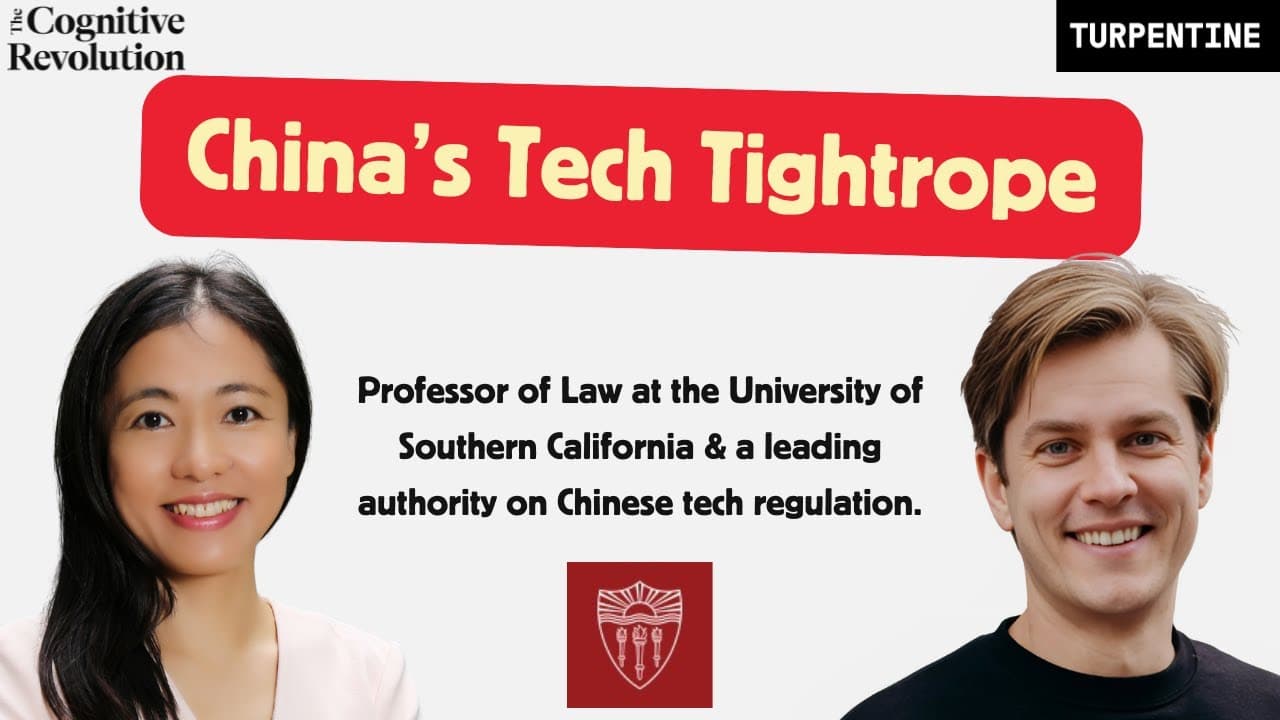
How Does China Regulate Big Tech and Compete in the AI Race? Angela Zhang Explains
TL;DR
China regulates technology through Angela Zhang’s “dynamic pyramid” model, marked by hierarchy, volatility, and fragility, with the state holding greater power than businesses. The conversation examines China’s exclusion of American tech companies, the 2020 big-tech crackdown, its recent lighter approach to AI, and tensions over US chip export controls. Read on to understand what these shifts could mean for China’s technology sector and the global AI race.
Transcript
hello and welcome back to the cognitive Revolution today we're continuing to build foundational context for understanding China as we enter the AI era my guest is Angela Jang professor at the G School of Law at USC and author of Highwire how China regulates big Tech and governs its economy having grown up in China lived in Europe and become a law s... Read More
Key Insights
- China's tech governance is characterized by a dynamic pyramid model with distinct hierarchy levels.
- The Chinese government maintains significant control over tech firms, influencing their operations and market dynamics.
- China's tech giants emerged from a competitive market, aided by barriers against foreign competition.
- Regulatory volatility in China can lead to abrupt policy shifts impacting tech firms significantly.
- China's AI regulation is currently lenient, allowing firms to innovate while monitoring developments closely.
- The US-China tech rivalry is fueled by geopolitical tensions and differing regulatory approaches.
- China's tech strategy focuses on self-sufficiency and innovation in critical sectors like AI and semiconductors.
- The global perception of China's tech policies is often shaped by misconceptions and media narratives.
Install to Summarize YouTube Videos and Get Transcripts
Explore YouTube Video Summarizer or Get YouTube Transcript Extractor
Questions & Answers
Q: How does China regulate big tech and AI?
Angela Zhang describes China’s regulatory approach through a “dynamic pyramid” model characterized by hierarchy, volatility, and fragility. The state holds the upper hand over businesses, although its approach to AI has so far been comparatively light-touch.
Q: What is Angela Zhang’s dynamic pyramid model of Chinese tech regulation?
The dynamic pyramid is Zhang’s framework for explaining China’s regulatory approach. It emphasizes three prevailing characteristics: hierarchy, volatility, and fragility.
Q: Who is Angela Zhang, and what is Highwire about?
Angela Zhang is a professor at the USC Gould School of Law and the author of Highwire. Her book examines how China regulates big tech and governs its economy.
Q: How does the balance of power between China’s government and technology companies work?
The conversation describes a stark power imbalance in which the state clearly has the upper hand over business. That relationship is compared with regulatory approaches in Europe and the United States.
Q: Why did China’s domestic technology sector gain room to develop?
The Chinese government excluded American technology companies, creating a market opportunity for domestic firms. The discussion identifies this decision as an important moment in the development of China’s technology sector.
Q: What happened during China’s 2020 crackdown on big tech?
The 2020 crackdown involved canceled IPOs, major destruction of Chinese technology firms’ market capitalization, and the sidelining of Jack Ma. Before that episode, Ma had been one of China’s leading technologists and global ambassadors.
Q: Has China’s relationship with its leading technology companies begun to improve?
The conversation notes a more recent apparent thaw between the Chinese Communist Party and leading Chinese technology companies. Some interpret it as recognition that China needs the most vibrant technology sector possible to compete effectively with the United States.
Q: Which AI and semiconductor issues does the conversation examine?
The discussion covers China’s light-touch approach to AI so far, its view of US export controls on chips and semiconductor manufacturing equipment, and the DeepSeek moment. It also considers whether another crackdown could happen soon and whether Xi Jinping might share concerns associated with the AI safety community.
Summary & Key Takeaways
-
China's tech regulation operates under a dynamic pyramid model, prioritizing government control over firms. This model is marked by hierarchy, volatility, and fragility, influencing tech policies and market dynamics. The government's approach to AI is currently permissive, fostering innovation while keeping a close watch on developments.
-
China's tech giants have risen through competitive markets, supported by barriers to foreign competition. Regulatory actions, such as the suspension of Ant Group's IPO, highlight the volatility and unpredictability within China's regulatory environment. This approach impacts the global tech landscape, particularly in the AI sector.
-
The US-China tech rivalry is driven by geopolitical tensions, with both nations pursuing different regulatory strategies. China's focus on self-sufficiency and innovation in key sectors like AI and semiconductors reflects its strategic priorities. Understanding these dynamics is crucial for navigating the global tech ecosystem.
Read in Other Languages (beta)
Share This Summary 📚
Summarize YouTube Videos and Get Video Transcripts with 1-Click
Try YouTube Summary with ChatGPT & Claude or YouTube Transcript Generator
Explore More Summaries from Cognitive Revolution "How AI Changes Everything" 📚





Summarize YouTube Videos and Get Video Transcripts with 1-Click
Try YouTube Summary with ChatGPT & Claude or YouTube Transcript Generator