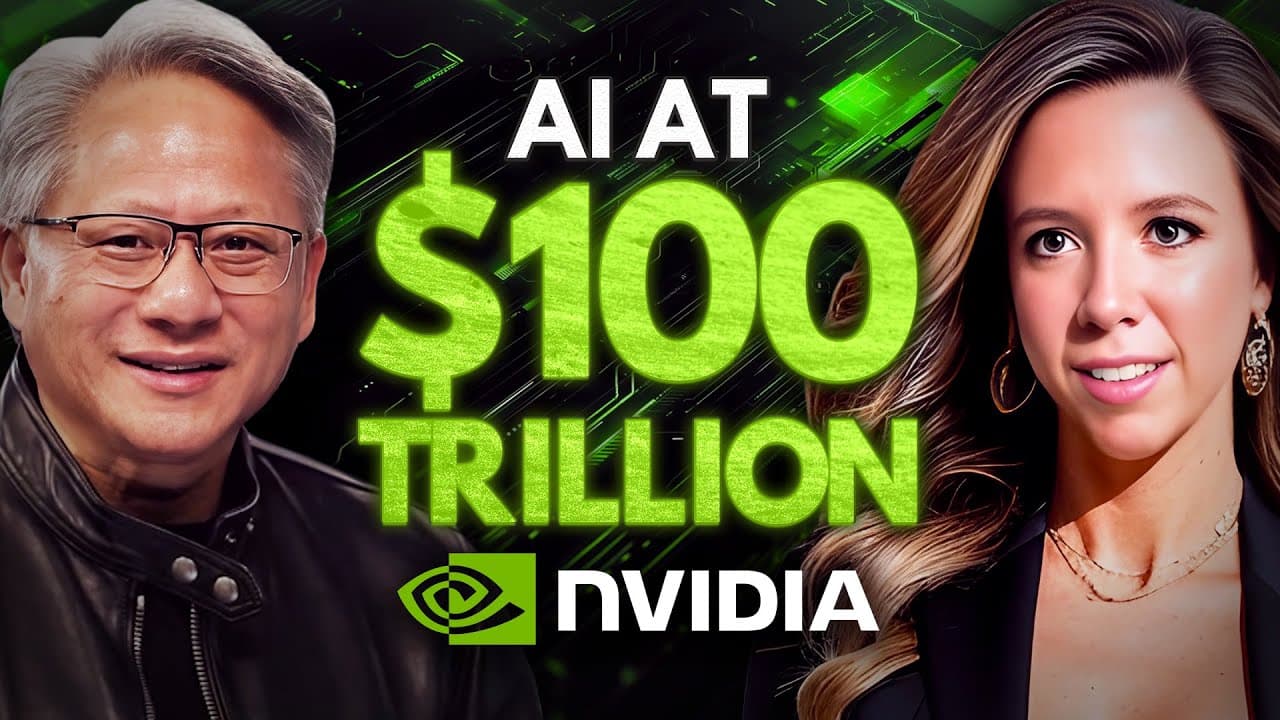
Why Does NVIDIA's CEO Say AI Is 100X Bigger Than We Thought and a $100 Trillion Opportunity?
TL;DR
AI is a $100 trillion opportunity because models, agents, and robots can perform work across every industry, extending its value far beyond information technology. NVIDIA supports this shift through accelerated computing, which combines CPUs with GPUs, and more than 350 specialized libraries for parallel workloads. Read on to understand the computing model, AI factories, and Japan's proposed intelligence infrastructure.
Transcript
Jensen Huang gave yet another special address. The rate at which this founder delivers mic drop keynotes is unprecedented. It seems like every time I look at the Nvidia YouTube channel, he's delivered another amazing keynote. But this one called AI Inspired Innovation in Japan was yes, that's not clickbait. Another special keynote inside this hour ... Read More
Key Insights
- Accelerated computing is a cooperative model in which CPUs manage sequential processing while GPUs offload computationally intensive parallel workloads. Jensen Huang emphasized that GPUs do not replace CPUs. The combination uses each processor's strengths to deliver faster and more capable computation.
- GPUs are processors designed to handle thousands of tasks simultaneously, unlike CPUs, which process complex work more sequentially. This difference makes GPUs suitable for neural networks, matrix multiplications, and tensor computations, all of which depend heavily on parallel execution.
- Traditional CPU software is not directly transferable to GPUs for parallel execution. NVIDIA created more than 350 supporting libraries for different applications, including CUDA, which helps software use GPUs for the parallel processing required by neural networks and other artificial intelligence workloads.
- The computing model is undergoing a fundamental shift after roughly 60 years of CPU-centered operation. Huang traced the established CPU era to 1964 and described accelerated computing, combining CPUs and GPUs, as a new model for handling modern computational demands.
- AI factories are large-scale systems intended to build and operate artificial intelligence capabilities. NVIDIA and SoftBank announced a partnership to develop Japan's largest AI infrastructure, connecting computing resources with telecommunications networks and potentially running AI models through SoftBank's radio infrastructure.
- Artificial intelligence is framed as a $100 trillion opportunity because models, large language models, agents, and robots can perform tasks and work. Huang distinguished this market from the roughly $1 trillion information technology industry by connecting AI to the much larger industry of work.
- AI is a transition affecting every industry, not merely another stage within the technology sector. Domain experts can describe their expertise through data, use that data to train models, and convert specialized knowledge into artificial intelligence applicable within their fields.
- Japan's proposed intelligence network would connect dense telecommunications infrastructure into what Masayoshi Son described as one large neural brain. The discussion identified robotics, medical AI, personal agents, startups, and research as areas that could benefit from increased infrastructure and government encouragement.
Install to Summarize YouTube Videos and Get Transcripts
Explore YouTube Video Summarizer or Get YouTube Transcript Extractor
Questions & Answers
Q: Why does NVIDIA's CEO describe AI as a $100 trillion opportunity?
Jensen Huang says AI addresses the industry of work because models, large language models, agents, and robots can perform tasks. He contrasts this opportunity with the roughly $1 trillion information technology industry and argues that AI will transform every industry.
Q: How do CPUs and GPUs work together in accelerated computing?
The CPU handles sequential processing, while the GPU receives computationally intensive workloads suited to parallel processing. Accelerated computing combines their strengths rather than replacing the CPU with the GPU.
Q: Why are GPUs important for AI workloads?
GPUs can handle thousands of tasks simultaneously. That parallel capability suits neural networks, matrix multiplications, and tensor computations better than CPU-centered sequential processing alone.
Q: What role does NVIDIA CUDA play in GPU computing?
CUDA helps applications use NVIDIA GPUs for parallel processing. It is necessary because traditional CPU software cannot simply be transferred to GPUs and automatically execute in parallel.
Q: Why has NVIDIA developed more than 350 supporting libraries?
Different applications require specialized software to use accelerated computing effectively. NVIDIA created more than 350 supporting libraries to help workloads take advantage of GPU-oriented parallel processing.
Q: What is an AI factory?
An AI factory is large-scale infrastructure used to build and operate AI capabilities. NVIDIA and SoftBank discussed connecting computing resources with telecommunications networks to support models and other AI applications in Japan.
Q: How could NVIDIA and SoftBank's AI infrastructure affect Japan?
Jensen Huang and Masayoshi Son discussed building Japan's largest AI infrastructure and an interconnected intelligence network. Potential beneficiaries include robotics, medical solutions, personal agents, startups, and researchers.
Q: How can domain expertise become an AI model?
Experts can represent their knowledge through data and use that data to train an AI model. This allows specialized knowledge to become an AI capability that organizations can apply within their industries and operations.
Summary & Key Takeaways
-
Definition: Accelerated computing combines CPUs and GPUs, assigning sequential work to CPUs and parallel workloads to GPUs.
-
Compare: CPUs excel at sequential processing, while GPUs can execute thousands of tasks simultaneously.
-
Tool: NVIDIA CUDA helps software use GPUs for the parallel processing required by AI workloads.
-
Number: NVIDIA developed more than 350 supporting libraries for accelerated computing applications.
-
When: CPU-centered computing has been used since the 1960s, before the shift toward accelerated computing.
-
Definition: AI factories are large-scale systems for building and operating artificial intelligence capabilities.
-
Number: Jensen Huang describes AI as a $100 trillion opportunity tied to the broader industry of work.
-
Compare: The information technology industry is roughly $1 trillion, while AI can address work across every industry.
-
Who: NVIDIA CEO Jensen Huang and SoftBank founder Masayoshi Son discussed Japan's AI infrastructure.
-
Who: Robotics, medical solutions, personal agents, startups, and researchers could benefit from Japan's connected intelligence infrastructure.
-
Step 1: Domain experts express their specialized knowledge through data.
-
Step 2: Organizations use that data to train an AI model that represents the expertise.
Read in Other Languages (beta)
Share This Summary 📚
Summarize YouTube Videos and Get Video Transcripts with 1-Click
Try YouTube Summary with ChatGPT & Claude or YouTube Transcript Generator
Explore More Summaries from Julia McCoy 📚






Summarize YouTube Videos and Get Video Transcripts with 1-Click
Try YouTube Summary with ChatGPT & Claude or YouTube Transcript Generator