How to Build a Successful Business From $0: A Step-by-Step Guide
TL;DR
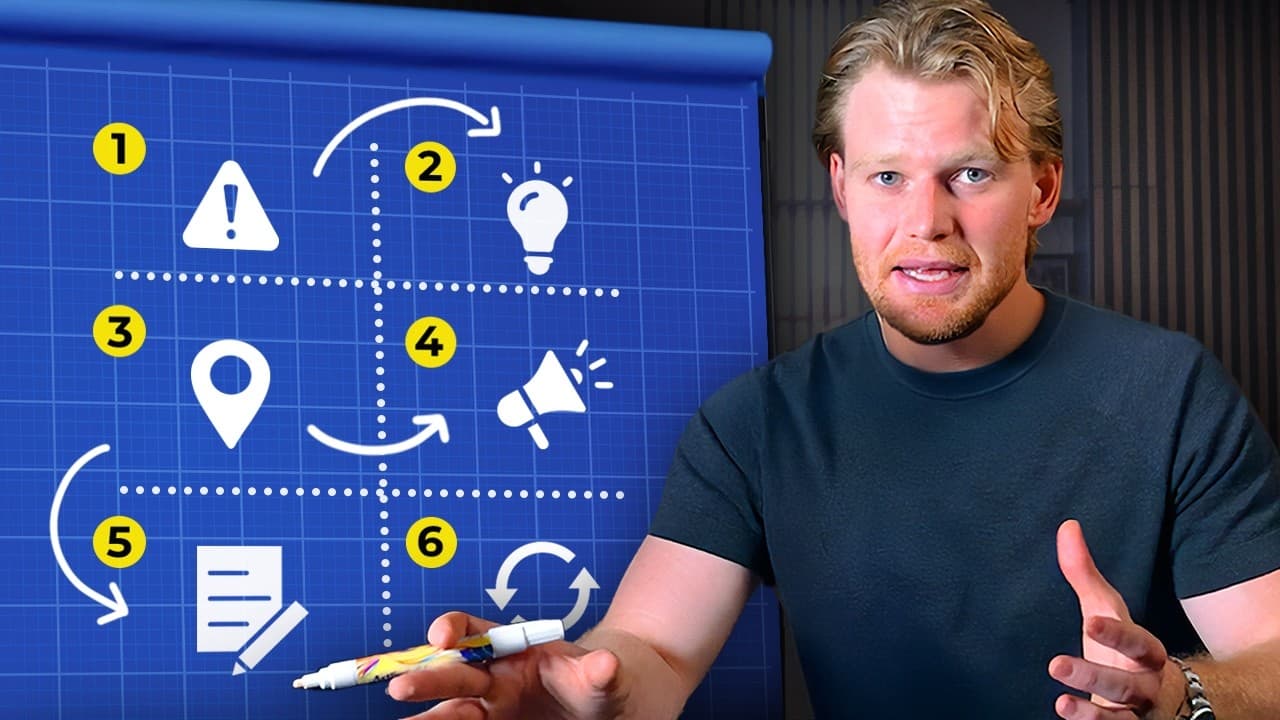
To build a business from $0, identify a problem in a field you understand, verify that customers recognize it, and enter before a dominant brand owns the market. The framework starts with a 3-by-3 matrix of three areas of proficiency and three problems in each, then narrows the idea through positioning, one customer avatar, one marketing channel, and viable unit economics. Read on for the complete validation process.
Transcript
after seeing so many people launch businesses and fail I analyzed all of my past 15 businesses that have helped me create over $800 million in sales and this is the exact framework that I came up with step one we need to analyze the business problem I start with three things that I am proficient in for me it's something like e-commerce and then we'... Read More
Key Insights
- A promising business problem is rooted in a field where the founder has genuine proficiency. Listing three areas of expertise and three specific problems in each creates a 3-by-3 matrix of opportunities that can be compared instead of relying on an unstructured idea.
- Friends' requests for advice are evidence of useful subject knowledge. When people repeatedly ask someone for guidance on a topic, that topic can help identify an area where the person is comfortable offering informed solutions and recognizing detailed customer problems.
- Reddit research is a method for discovering firsthand customer problems. Searching for the word "problems" inside a relevant subreddit can surface stories from people describing their difficulties, providing possible opportunities when personal expertise alone does not reveal enough issues.
- Customer awareness progresses from unaware to problem aware, product aware, and brand aware. A business must determine whether customers recognize their symptoms, understand the underlying problem, know that a type of solution exists, or already associate the solution with a specific brand.
- The preferred market opening is after problem awareness but before brand awareness. Entering too early requires substantial consumer education, while entering after large companies have established strong brand awareness makes the opportunity harder to capture through a similar product.
- Distinctive positioning can overcome disadvantages in spending and scale. A smaller company may not outspend or outmarket established competitors, but it can map what those competitors represent, take a sharply different stance, and serve a more specific audience.
- One marketing channel should match the founder's finances, skills, niche, and audience. Paid advertising may suit someone with money and content-production ability, while organic channels can suit limited budgets, natural copywriting ability, business audiences, or visually oriented younger audiences.
- Viable unit economics are essential even when a genuine problem exists. A solution fails as a scalable business if customers will not pay enough to cover fulfillment, so the one-page hypothesis must account for both willingness to pay and operating costs.
Install to Summarize YouTube Videos and Get Transcripts
Explore YouTube Video Summarizer or Get YouTube Transcript Extractor
Questions & Answers
Q: How do you start a business with no money step by step?
Start by listing three fields in which you are proficient and three specific customer problems within each, creating a 3-by-3 matrix. Research the strongest problem, assess whether customers are problem aware but not yet committed to a dominant brand, and define a distinct solution and position. Then choose one customer avatar and one suitable marketing channel, capture the hypothesis on one page, and confirm that the expected price can cover fulfillment costs.
Q: How do you identify a business problem worth solving?
Focus first on subjects where you have genuine proficiency, because that expertise helps you recognize specific customer difficulties. If you cannot identify your strongest subjects, consider what friends regularly ask you for advice about. Write three detailed problems for each of three subjects so you can compare nine possible opportunities.
Q: How can Reddit help with business idea research?
Enter a subreddit related to your chosen field and search within it for the word "problems." The results can surface firsthand stories from people describing their difficulties. These accounts can reveal possible opportunities when your own expertise does not produce enough specific problems.
Q: What are the four stages of customer awareness?
The four stages are not aware, problem aware, solution or product aware, and brand aware. Customers may notice symptoms without understanding the underlying problem, recognize the problem, know that a type of solution exists, or already associate that solution with a particular brand.
Q: When is the best time to enter a market?
The preferred opening is after customers recognize the problem but before they are strongly aware of a dominant brand. Entering while customers are unaware requires substantial education, while entering a brand-aware market means competing against established companies. The calming-blanket example entered when customers were problem or product aware but not yet brand aware.
Q: How can you check whether a market opportunity exists?
Research firsthand customer discussions, then search for the proposed solution in the specific market where you plan to sell it. A lack of competitors may indicate an opportunity. In e-commerce, this can look like a product selling in another country while remaining unavailable on AliExpress or through readily accessible dropshipping channels.
Q: How can a small business stand out from larger competitors?
Map what major competitors represent, then take a distinct position for a narrower audience. The framework argues that a smaller company may not outspend or outmarket established competitors but can outposition them. Dr. Squatch is contrasted with Dove as an example of using sharply different messaging in a competitive soap market.
Q: What should a one-page business plan include?
The one-page hypothesis should identify one problem, one solution, distinctive positioning, one target customer, and one marketing channel. It should also explain why the offer may work and test whether customers will pay enough to cover fulfillment. Genuine demand alone does not create a scalable business when the margins are unworkable.
Summary & Key Takeaways
-
The framework begins with three fields in which the founder is proficient, followed by three specific problems within each field. Friends' requests for advice can reveal useful expertise, while searches inside relevant Reddit communities can uncover firsthand accounts of unresolved problems that may represent commercial demand.
-
Each opportunity should be evaluated through customer awareness, from unaware to problem aware, product aware, and brand aware. The preferred opening comes after customers recognize the problem but before they strongly favor an established brand, because an unaware market requires extensive education and a brand-aware market is difficult to enter.
-
The final strategy combines one problem, one solution, distinctive positioning, one customer avatar, and one marketing channel in a short business one-pager. Paid or organic marketing should match the founder's resources, skills, niche, and audience. The model must also produce workable margins after fulfillment costs are considered.
Read in Other Languages (beta)
Share This Summary 📚
Summarize YouTube Videos and Get Video Transcripts with 1-Click
Try YouTube Summary with ChatGPT & Claude or YouTube Transcript Generator
Explore More Summaries from Davie Fogarty 📚



Summarize YouTube Videos and Get Video Transcripts with 1-Click
Try YouTube Summary with ChatGPT & Claude or YouTube Transcript Generator