How to concatenate and repeat strings in Python
TL;DR
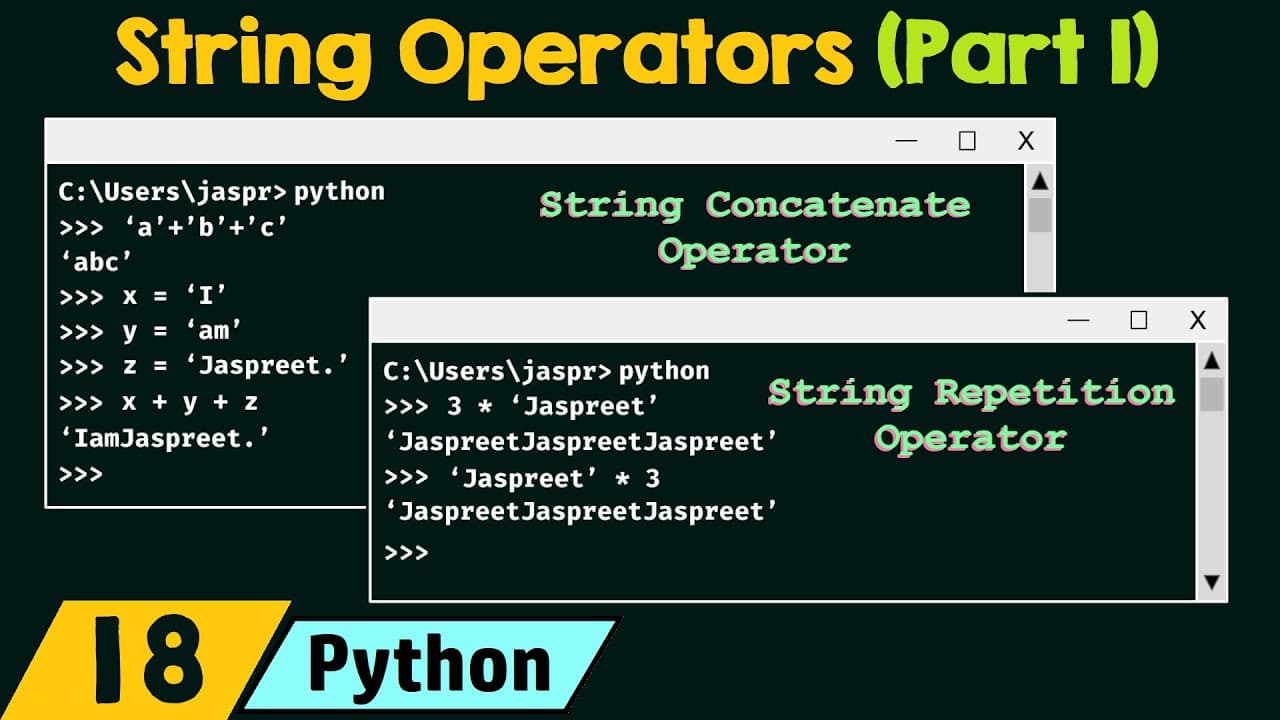
The plus operator concatenates two strings to form one string. The repetition operator uses a number to create multiple copies of a string, with 0 or negative values yielding an empty string. You can combine variables and literals to build longer strings, and you can repeat strings in any order with the star syntax.
Transcript
foreign we will understand a few string operators in Python so without any further delay let's get started and let's see what are the different topics we will understand in this presentation the first topic we need to understand is string concatenate operator and the second topic is string repetition operator in this presentation we will understand... Read More
Key Insights
- The video covers two operators: string concatenate and string repetition.
- Concatenate uses the plus sign to join two strings at a time.
- Multiple strings can be joined by chaining several plus operations.
- Variables pointing to strings can substitute for literals during concatenation.
- Python displays concatenated results in single quotes when printed.
- Repetition uses the star operator with a numeric value to create copies of a string.
- n star s and s star n both produce n copies of s.
- Zero or negative values for n yield an empty string in repetition.
Install to Summarize YouTube Videos and Get Transcripts
Explore YouTube Video Summarizer or Get YouTube Transcript Extractor
Questions & Answers
Q: How do you concatenate two strings in Python using the plus operator
Concatenating two strings in Python is done by placing a plus sign between them, which tells Python to join the strings into a single string. For example, a plus b creates a new string that combines the contents of a and b. This method can be extended by chaining additional plus operators to join more strings sequentially.
Q: What happens when you concatenate three strings
To concatenate three strings you place two plus operators between them, such that a plus b plus c yields the combined result a b c if a and b and c are the respective strings. The runtime replaces each variable with its string value and produces a single output string.
Q: Can you concatenate strings using variables instead of literals
Yes, you can concatenate strings by using variables that reference string values. For example, assign x to be a string, y to be another string, and z to be a third string, then use x plus y plus z to produce a new string that merges all three, with the runtime substituting the variables’ values.
Q: What is the output format of a concatenated string in Python
When Python displays a concatenated string, the result is shown as a standard string surrounded by single quotes, indicating the whole combined sequence. This demonstrates that the strings were joined into one continuous string without introducing additional characters unless they were part of the original strings.
Q: How does the repetition operator work in Python
The repetition operator uses a numeric value and the star symbol with a string to create multiple copies of that string. The two forms, n star s and s star n, produce the same result, duplicating the string s a total of n times.
Q: What happens if you use 0 or a negative number with repetition
Using 0 or a negative number with repetition yields an empty string. This means no copies of the original string are produced, so the result is an empty output regardless of the string involved, which is a useful edge case to understand when building dynamic strings.
Q: Can you mix concatenation and repetition in the same expression
Yes, you can mix concatenation and repetition by combining strings with plus operators and star repetition in the same expression. For example, you could compute a string by repeating a base segment several times and then concatenating additional segments to form the final result, enabling flexible string construction.
Q: Why would you prefer repetition over multiple concatenations in some cases
Repetition is often more efficient than chaining many concatenations because it avoids creating multiple intermediate strings. Repeating a string the required number of times and then performing a final concatenation with other strings reduces memory churn and can improve readability when the goal is to generate repeated substrings.
Summary & Key Takeaways
-
This video introduces two Python string operators, the concatenate operator and the repetition operator, and explains how to apply them to join strings and replicate strings multiple times. It also shows practical examples using variables and literals, including how spaces affect concatenation and how empty results occur with zero or negative repetition.
-
The lesson demonstrates that concatenation requires two strings and uses the plus sign, while repetition relies on the star operator and an integer to determine copies. It clarifies how to chain operations for building longer strings and highlights the output format in Python.
-
The content emphasizes understanding when to use each operator, providing concrete examples like joining I, am, just breathe, and repeating strings such as Just Breathe to illustrate results and potential edge cases such as empty strings.
Read in Other Languages (beta)
Share This Summary 📚
Summarize YouTube Videos and Get Video Transcripts with 1-Click
Try YouTube Summary with ChatGPT & Claude or YouTube Transcript Generator
Explore More Summaries from Neso Academy 📚





Summarize YouTube Videos and Get Video Transcripts with 1-Click
Try YouTube Summary with ChatGPT & Claude or YouTube Transcript Generator