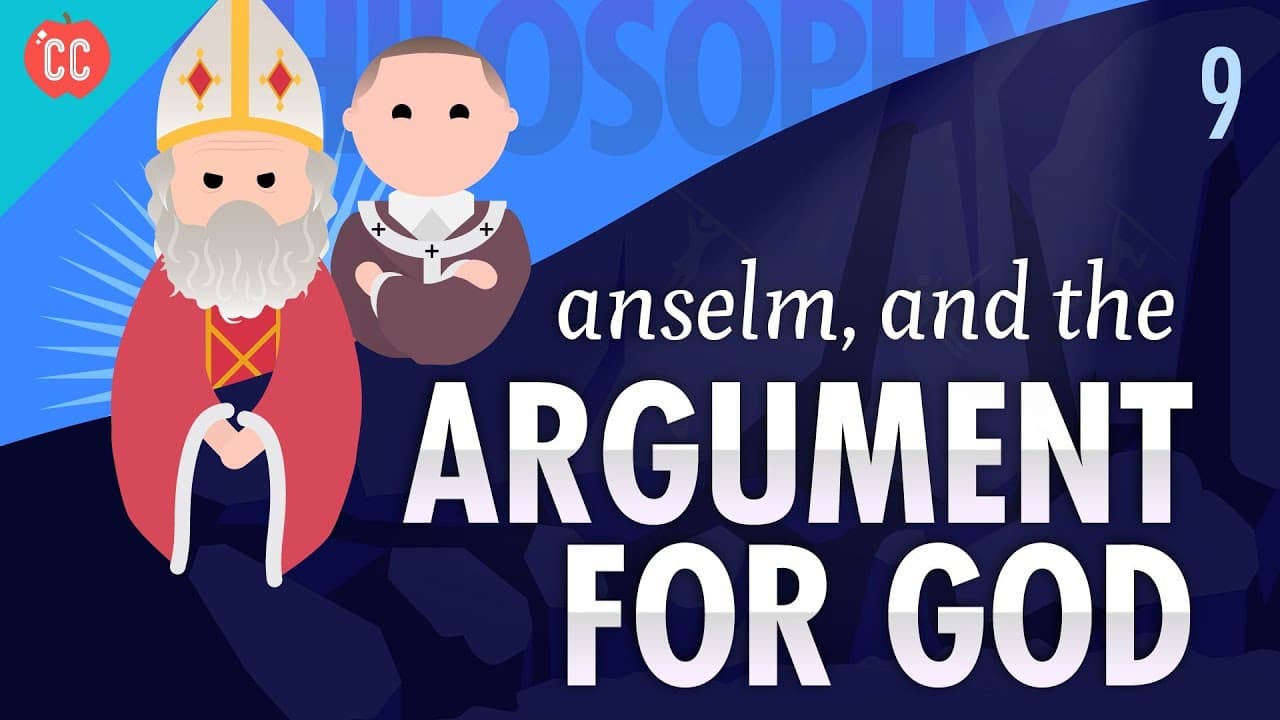
Anselm & the Argument for God: Crash Course Philosophy #9
TL;DR
Anselm's argument for God's existence is analyzed and critiqued.
Transcript
Crash Course Philosophy is brought to you by Squarespace. Squarespace: share your passion with the world. It’s about time that we had a serious talk about religion. The philosophy of religion is often confused with theology, which makes sense, because they both take God and religion as their subjects. But theology starts by assuming that God exists... Read More
Key Insights
- The philosophy of religion differs from theology by not assuming God's existence and requiring evidence for religious beliefs.
- Anselm of Canterbury argued that God's existence is provable through a deductive ontological argument based on God's definition.
- Anselm defined God as the greatest conceivable being, suggesting that a real God would be greater than an imaginary one.
- Gaunilo critiqued Anselm's argument by suggesting the same logic could prove anything's existence, like a perfect island.
- Anselm's response to Gaunilo involved the concept of a necessary being, which he claimed only applied to God.
- The fallacy of begging the question is present in Anselm's argument by assuming God's existence within his definition.
- Immanuel Kant critiqued Anselm by arguing that existence is not a predicate and cannot define an entity's essence.
- The parable of the invisible gardener illustrates ongoing philosophical debates about proving God's existence.
Install to Summarize YouTube Videos and Get Transcripts
Explore YouTube Video Summarizer or Get YouTube Transcript Extractor
Questions & Answers
Q: What distinguishes the philosophy of religion from theology?
The philosophy of religion differs from theology by not assuming God's existence as a given. It requires arguments and evidence to support religious beliefs, whereas theology often starts with the assumption that God exists and explores the implications of that belief. Philosophers of religion examine religious concepts critically, allowing for atheism as a possibility.
Q: What is Anselm's ontological argument for God's existence?
Anselm's ontological argument defines God as the greatest conceivable being. He posits that something existing in reality is greater than something existing only in the mind. Therefore, if God is the greatest being we can imagine, God must exist in reality, as a real God would be greater than an imaginary one.
Q: How did Gaunilo critique Anselm's argument?
Gaunilo critiqued Anselm's argument by suggesting that the same reasoning could prove the existence of anything imagined, such as a perfect island. He argued that imagining the greatest island doesn't make it real, highlighting a flaw in Anselm's logic that could be misapplied to prove anything's existence without evidence.
Q: What is the fallacy of begging the question in Anselm's argument?
The fallacy of begging the question occurs when an argument assumes the very point it is trying to prove. In Anselm's case, by defining God as a necessary being, he assumes God's existence within the argument's premise. This circular reasoning undermines the argument's validity by presupposing the conclusion that God exists.
Q: How did Immanuel Kant critique Anselm's argument?
Immanuel Kant critiqued Anselm's argument by stating that existence is not a predicate or a defining characteristic of a being. He argued that predicates add to the essence of subjects but cannot prove their existence. Kant suggested that while God might be the greatest being if He exists, this does not mean God necessarily exists.
Q: What is the parable of the invisible gardener about?
The parable of the invisible gardener, created by John Wisdom, is a thought experiment illustrating the difficulty of proving God's existence. Two people debate whether an unseen gardener tends a garden, paralleling debates about God's existence. The parable questions the difference between an undetectable gardener and no gardener, reflecting ongoing philosophical discussions.
Q: What does Anselm mean by a 'necessary being'?
Anselm's concept of a 'necessary being' refers to a being that must exist by its very nature, as opposed to contingent beings that may or may not exist. Anselm argued that God is a necessary being, meaning God's existence is intrinsic to the definition of God, a point he used to counter critiques of his ontological argument.
Q: Why did Kant believe existence is not a predicate?
Kant believed existence is not a predicate because it does not add to the essence or characteristics of a being. Predicates describe qualities or attributes, but existence simply indicates that something is real. Kant argued that existence cannot be used to define or prove the existence of an entity, such as God, within logical arguments.
Summary & Key Takeaways
-
Philosophy of religion examines religious beliefs without assuming God's existence, contrasting with theology. Anselm's ontological argument attempts to prove God exists by defining God as the greatest conceivable being, arguing that existence in reality is greater than in imagination.
-
Gaunilo challenged Anselm's argument by using the analogy of a perfect island, suggesting that Anselm's logic could be misapplied to prove anything's existence. Anselm countered by claiming his argument only applies to necessary beings, which he defined as God.
-
Immanuel Kant critiqued Anselm's argument by stating that existence is not a predicate or defining characteristic. The invisible gardener parable highlights the difficulty in proving God's existence, a debate that has persisted for centuries.
Read in Other Languages (beta)
Share This Summary 📚
Summarize YouTube Videos and Get Video Transcripts with 1-Click
Try YouTube Summary with ChatGPT & Claude or YouTube Transcript Generator
Explore More Summaries from CrashCourse 📚



Summarize YouTube Videos and Get Video Transcripts with 1-Click
Try YouTube Summary with ChatGPT & Claude or YouTube Transcript Generator