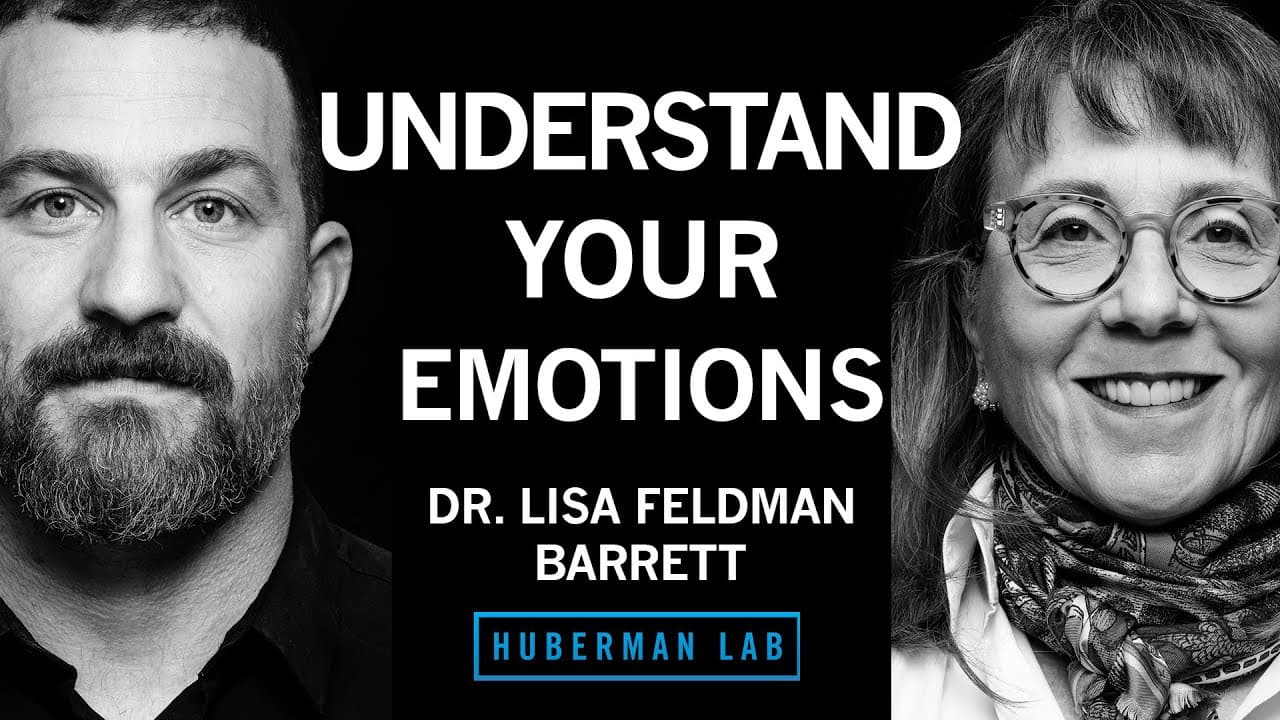
Dr. Lisa Feldman Barrett: How to Understand Emotions | Huberman Lab Podcast
TL;DR
In this podcast episode, Dr. Lisa Feldman Barrett discusses the neural circuits and psychological aspects of emotions, challenging the traditional notions of facial expressions and the universality of emotions.
Transcript
welcome to the huberman Lab podcast where we discuss science and science-based tools for everyday life I'm Andrew huberman and I'm a professor of neurobiology and Opthalmology at Stanford School of Medicine my guest today is Dr Lisa Feldman Barrett Dr Lisa Feldman Barrett is a distinguished professor of psychology at Northeastern University she als... Read More
Key Insights
- 🧠 Emotions are a complex and debated topic in the field of psychology and neuroscience.
- 🤔 There is disagreement among scientists about the definition and nature of emotions.
- 🌍 Emotions are not easily defined by a set of physical markers or facial expressions, as these can vary greatly across individuals and cultures.
- 😊 Language is inadequate to fully capture the nuances and complexities of emotions.
- 🤝 Understanding and interpreting emotions requires knowledge of the neural circuits, psychology, and context in which they occur.
- 💡 Emotions are not static, but rather dynamic and evolving over time.
- 🔀 The brain engages in pattern recognition and prediction to reduce uncertainty and make sense of the world.
- 💪 Practical tools for regulating and interpreting emotions are important for personal well-being and understanding others.
Install to Summarize YouTube Videos and Get Transcripts
Explore YouTube Video Summarizer or Get YouTube Transcript Extractor
Questions & Answers
Q: How does Dr. Feldman Barrett challenge the traditional understanding of emotions and facial expressions?
Dr. Feldman Barrett challenges the traditional understanding by highlighting the lack of consensus on the definition of emotions and the variability of facial expressions across cultures and situations. She emphasizes that facial expressions are not universally linked to specific emotional states.
Q: What factors influence the interpretation of emotional signals?
The interpretation of emotional signals is influenced by various factors, including the context, cultural background, and individual experiences. Facial expressions are not the sole indicator of emotional states and should be considered in conjunction with other signals from the body and the environment.
Q: How does the brain categorize emotions?
The brain constructs categories of emotions based on past experiences and the signals received from the sensory surfaces of the body. It continuously predicts and updates its understanding of emotions, constantly narrowing down possibilities and reducing uncertainty.
Q: How does language play a role in understanding emotions?
Language is important in conveying and sharing emotional experiences, but it is not sufficient on its own to capture the complexity of emotions. Different languages and cultures may have different concepts and labels for emotions, highlighting the limitations of language in fully capturing the nuances of emotional states.
Summary & Key Takeaways
-
Dr. Lisa Feldman Barrett challenges the traditional understanding of emotions and facial expressions, highlighting the lack of consensus on the definition of emotions in the scientific community.
-
Facial expressions are not universally linked to specific emotional states, and the context and cultural factors play a significant role in interpreting emotional signals.
-
Emotions are not static, and the brain continuously constructs categories based on past experiences and the signals from the sensory surfaces of the body.
-
Language is not sufficient to capture the complexity of emotions, and cultural and linguistic differences affect how emotions are labeled and understood.
Read in Other Languages (beta)
Share This Summary 📚
Summarize YouTube Videos and Get Video Transcripts with 1-Click
Try YouTube Summary with ChatGPT & Claude or YouTube Transcript Generator
Explore More Summaries from Andrew Huberman 📚



Summarize YouTube Videos and Get Video Transcripts with 1-Click
Try YouTube Summary with ChatGPT & Claude or YouTube Transcript Generator