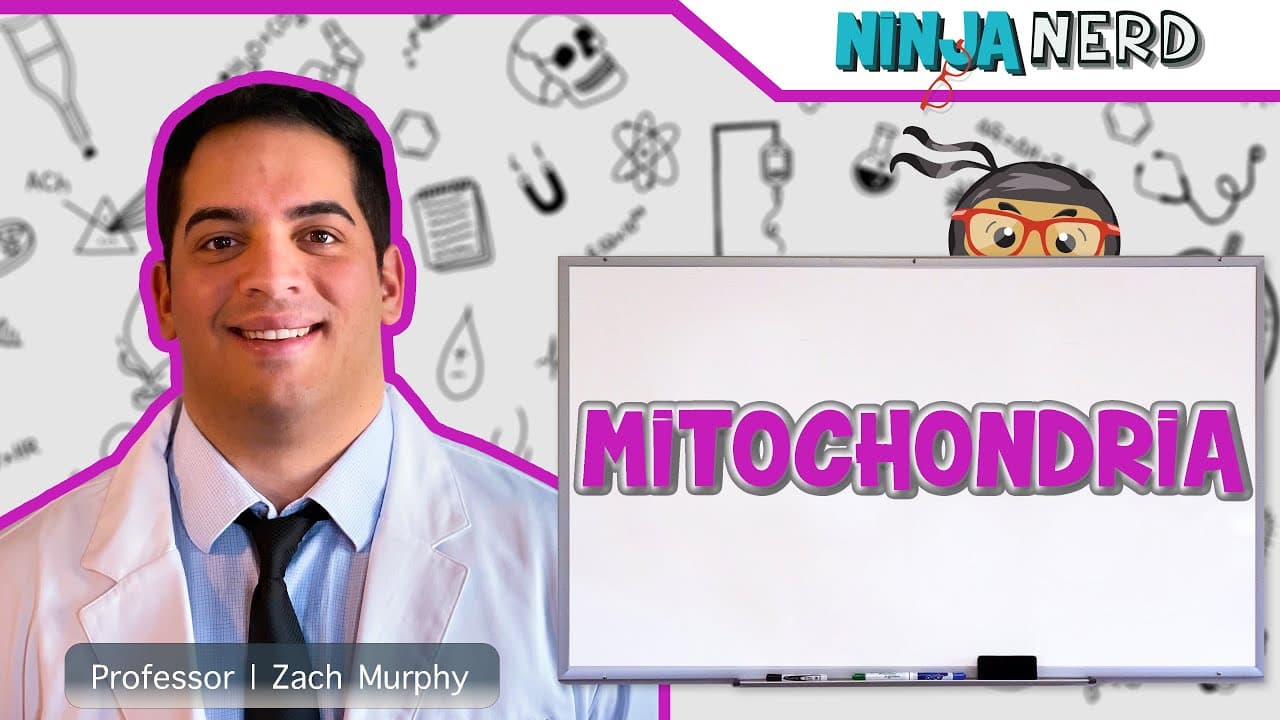
How do mitochondria work and their structure explained
TL;DR
The mitochondrion is a double membrane organelle with an outer membrane that is highly permeable and an inner membrane that is tightly regulated. The inner membrane folds into cristae to increase surface area, the matrix contains mitochondrial DNA and ribosomes, and proteins are imported via TOM and TIM gateways for function, including energy production through the electron transport chain.
Transcript
foreign what's up Ninja nerds in this video today we're going to be talking about the structure and function of the mitochondria before we get started if you guys like this video makes sense helps you benefits you please support us well wait can you do that hit that like button comment down the comment section please subscribe also you want some gr... Read More
Key Insights
- Outer mitochondrial membrane is highly permeable, enabling broad exchange with the cytoplasm.
- Inner mitochondrial membrane is less permeable and contains selective transporters that regulate substance entry and exit.
- Intermembrane space is proton-rich, supporting the proton gradient needed for ATP production.
- Cristae are folds of the inner membrane that increase surface area for metabolic reactions.
- Mitochondrial matrix houses mitochondrial DNA and ribosomes for local protein synthesis.
- Most mitochondrial proteins are encoded by nuclear DNA and imported as unfolded polypeptides.
- Transport of proteins into mitochondria uses TOM complexes in the outer membrane and TIM complexes in the inner membrane.
- Mitochondria are the powerhouse of the cell, producing ATP through cellular respiration.
Install to Summarize YouTube Videos and Get Transcripts
Explore YouTube Video Summarizer or Get YouTube Transcript Extractor
Questions & Answers
Q: What is the outer mitochondrial membrane and why is it important?
The outer mitochondrial membrane is a phospholipid bilayer that is highly permeable, allowing many molecules to pass between the cytoplasm and the mitochondrion. This permeability facilitates the exchange of ions, nutrients, and metabolites necessary for mitochondrial function and coordination with the rest of the cell. It also hosts the TOM complex that helps import unfolded proteins.
Q: What role does the inner membrane play in mitochondrial function?
The inner membrane is a selectively permeable phospholipid bilayer with transporters that tightly regulate what moves into and out of the mitochondrion. It houses the components of the electron transport chain and creates the proton gradient across the membrane, which drives ATP synthesis via ATP synthase during oxidative phosphorylation.
Q: What are cristae and why are they important?
Cristae are invaginations of the inner membrane that increase the surface area available for metabolic reactions, including electron transport chain activity. By expanding the area where enzymes and transporters reside, cristae enhance the efficiency of ATP production and other mitochondrial processes.
Q: What is the mitochondrial matrix and what does it contain?
The mitochondrial matrix is the space inside the inner membrane that contains mitochondrial DNA and ribosomes. It is the site of some metabolic reactions and allows certain proteins to be produced locally, though most mitochondrial proteins are encoded in the nucleus and imported into the mitochondrion.
Q: How are proteins transported into mitochondria?
Proteins synthesized in the cytoplasm as unfolded polypeptides are imported through the outer membrane TOM translocase, pass into the intermembrane space, and are then handed off to the TIM translocase in the inner membrane. There they are guided and folded into active enzymes within the matrix.
Q: Why is the intermembrane space proton-rich and how does that relate to energy?
The intermembrane space is rich in protons, creating a proton gradient across the inner membrane. This gradient powers ATP synthesis as protons flow back into the matrix through ATP synthase, a central step in the electron transport chain during cellular respiration.
Q: What is the mitochondrial DNA and its significance?
Mitochondrial DNA is a small circular genome located in the matrix and is inherited maternally. It encodes some RNAs and proteins needed for mitochondrial function, but most mitochondrial proteins are encoded by nuclear genes and imported into the organelle to support its activities.
Q: How does the mitochondrion function as the cell’s powerhouse?
The mitochondrion generates ATP through cellular respiration, using substrates from the cytosol, the proton gradient across the inner membrane, and the electron transport chain to drive ATP synthesis. Cells with higher energy demand typically have more mitochondria to meet energy needs.
Summary & Key Takeaways
-
The mitochondrion has an outer membrane that is highly permeable, allowing many substances to pass, and an inner membrane that is less permeable and houses transporters that regulate movement into the organelle. The space between membranes is the intermembrane space, rich in protons and essential for energy generation.
-
Cristae are invaginations of the inner membrane that greatly increase surface area, enabling more metabolic reactions to occur, particularly those involved in the electron transport chain and ATP synthesis.
-
The mitochondrial matrix contains mitochondrial DNA and ribosomes, enabling some gene expression within the organelle, but most proteins come from the nucleus and are imported through specific protein transport systems using unfolded proteins transported by TOM and TIM complexes.
Read in Other Languages (beta)
Share This Summary 📚
Summarize YouTube Videos and Get Video Transcripts with 1-Click
Try YouTube Summary with ChatGPT & Claude or YouTube Transcript Generator
Explore More Summaries from Ninja Nerd 📚





Summarize YouTube Videos and Get Video Transcripts with 1-Click
Try YouTube Summary with ChatGPT & Claude or YouTube Transcript Generator