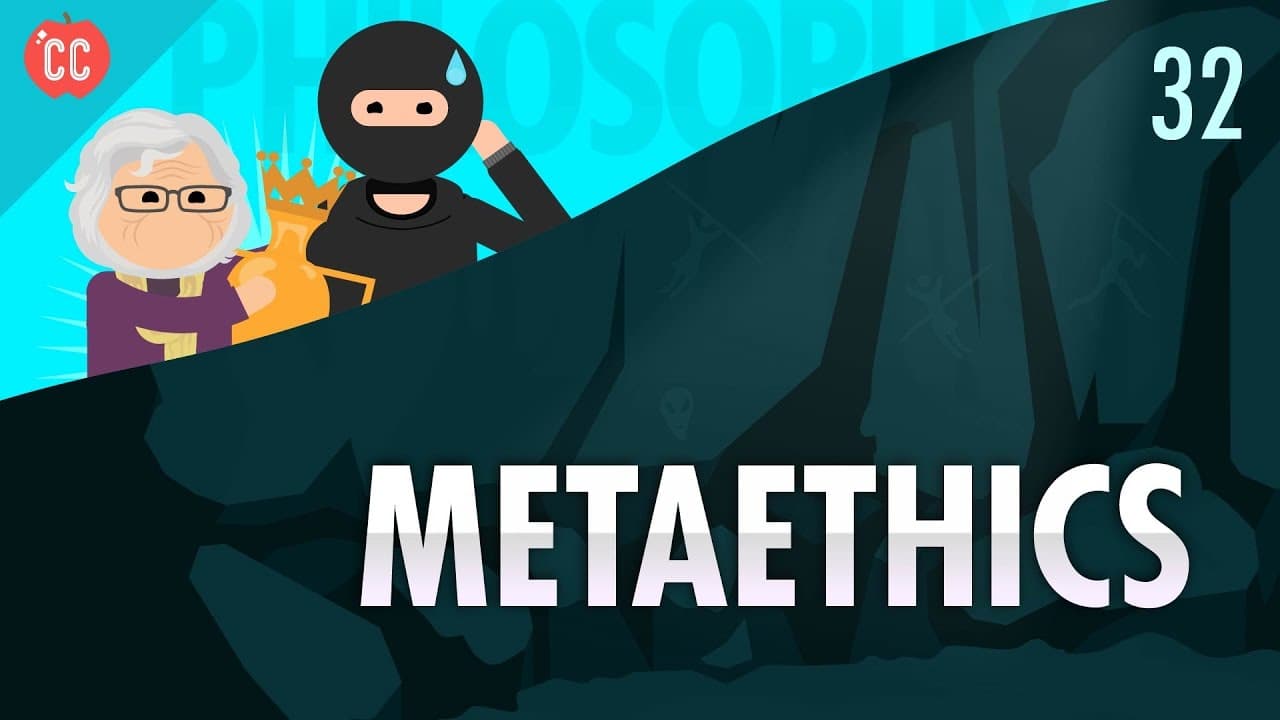
Metaethics: Crash Course Philosophy #32
TL;DR
The video explores metaethics, moral realism, and ethical theories.
Transcript
Is it wrong to steal to feed your family? Is there such a thing as a good lie? Questions like these are the domain of ethics – the branch of philosophy that studies morality, or right and wrong behavior. But before we can parse questions like these, we need to go deeper – into metaethics, which studies the very foundations of morality itself. Metae... Read More
Key Insights
- Metaethics examines the foundational questions of morality, such as the nature of morality and whether it is objective or subjective.
- Moral Realism posits that there are objective moral facts, similar to scientific facts, but faces challenges such as the grounding problem.
- Moral Antirealism denies the existence of objective moral facts, suggesting morality is subjective and based on personal attitudes.
- Moral Absolutism asserts unchanging moral facts, while Moral Relativism allows for multiple correct moral positions, varying by culture.
- Descriptive Cultural Relativism acknowledges differing moral beliefs across cultures, whereas Normative Cultural Relativism claims moral facts differ by culture.
- Moral Subjectivism, a form of antirealism, suggests moral statements reflect personal attitudes rather than objective truths.
- Ethical theories provide frameworks for consistent moral reasoning, each with starting assumptions and moral principles.
- Understanding various ethical theories helps individuals refine their own moral views, incorporating principles from multiple theories.
Install to Summarize YouTube Videos and Get Transcripts
Explore YouTube Video Summarizer or Get YouTube Transcript Extractor
Questions & Answers
Q: What is the main focus of metaethics?
Metaethics focuses on the foundational questions of morality, examining the nature and existence of moral facts. It explores whether morality is objective, like scientific facts, or subjective, based on personal preferences or cultural conventions. Metaethics seeks to understand what morality is and how moral truths, if any, are determined.
Q: How does Moral Realism view moral facts?
Moral Realism posits that moral facts exist objectively, much like scientific facts. It suggests that moral propositions can be true or false, independent of personal opinions or cultural beliefs. However, Moral Realism faces challenges, such as the grounding problem, which questions the source and nature of these moral facts.
Q: What is the grounding problem in ethics?
The grounding problem in ethics refers to the challenge of identifying a solid foundation for moral beliefs that would establish them as objectively true. It questions where moral facts come from and how they can be known, especially given the lack of consensus on moral issues compared to scientific facts.
Q: What is Moral Antirealism?
Moral Antirealism is the belief that there are no objective moral facts. It suggests that moral propositions do not refer to any real features of the world, but rather to individual or cultural attitudes. Moral Antirealism views morality as subjective, denying the existence of universal moral truths.
Q: How does Moral Absolutism differ from Moral Relativism?
Moral Absolutism holds that there are unchanging moral facts that apply universally, regardless of culture or circumstance. In contrast, Moral Relativism allows for multiple correct moral positions on a given topic, suggesting that moral truths can vary based on cultural or contextual factors.
Q: What is the difference between Descriptive and Normative Cultural Relativism?
Descriptive Cultural Relativism is the belief that people's moral beliefs differ across cultures, which is generally undisputed. Normative Cultural Relativism goes further, claiming that moral facts themselves differ from culture to culture, suggesting that what is morally right in one culture may be wrong in another.
Q: What is Moral Subjectivism?
Moral Subjectivism is a form of Moral Antirealism that suggests moral statements reflect individual attitudes rather than objective truths. According to this view, moral propositions are true or false based on personal preferences, not on any inherent moral facts. It emphasizes the subjective nature of moral judgments.
Q: What role do ethical theories play in moral reasoning?
Ethical theories provide frameworks for consistent moral reasoning, offering starting assumptions and moral principles to guide judgments about right and wrong conduct. Individuals often draw from multiple ethical theories to form their own moral views, using these frameworks to refine and articulate their gut moral intuitions.
Summary & Key Takeaways
-
The video introduces metaethics, focusing on the nature of morality and its foundations. It explores whether morality is objective or subjective and presents various metaethical views like Moral Realism and Moral Antirealism. The discussion includes moral dilemmas to illustrate different perspectives on moral facts and their implications.
-
Moral Realism is examined as a belief in objective moral facts, akin to scientific facts, but it faces challenges like the grounding problem. In contrast, Moral Antirealism denies objective moral truths, viewing morality as subjective. The video also discusses Moral Absolutism and Moral Relativism, highlighting their differing approaches to moral facts.
-
The video introduces ethical theories, which help navigate moral questions by providing consistent frameworks for right and wrong conduct. These theories include starting assumptions and moral principles, and individuals often draw from multiple theories to form their own moral views. The video sets the stage for further exploration of ethical theories.
Read in Other Languages (beta)
Share This Summary 📚
Summarize YouTube Videos and Get Video Transcripts with 1-Click
Try YouTube Summary with ChatGPT & Claude or YouTube Transcript Generator
Explore More Summaries from CrashCourse 📚




Summarize YouTube Videos and Get Video Transcripts with 1-Click
Try YouTube Summary with ChatGPT & Claude or YouTube Transcript Generator