What Are the Main Themes of Slaughterhouse-Five?
TL;DR
Slaughterhouse-Five explores the impact of war and trauma through the experiences of Billy Pilgrim, who is 'unstuck in time.' The novel examines the absurdity of human suffering and the role of literature in addressing violence, using non-linear storytelling and elements like aliens and humor to reflect on the complexities of trauma and morality.
Transcript
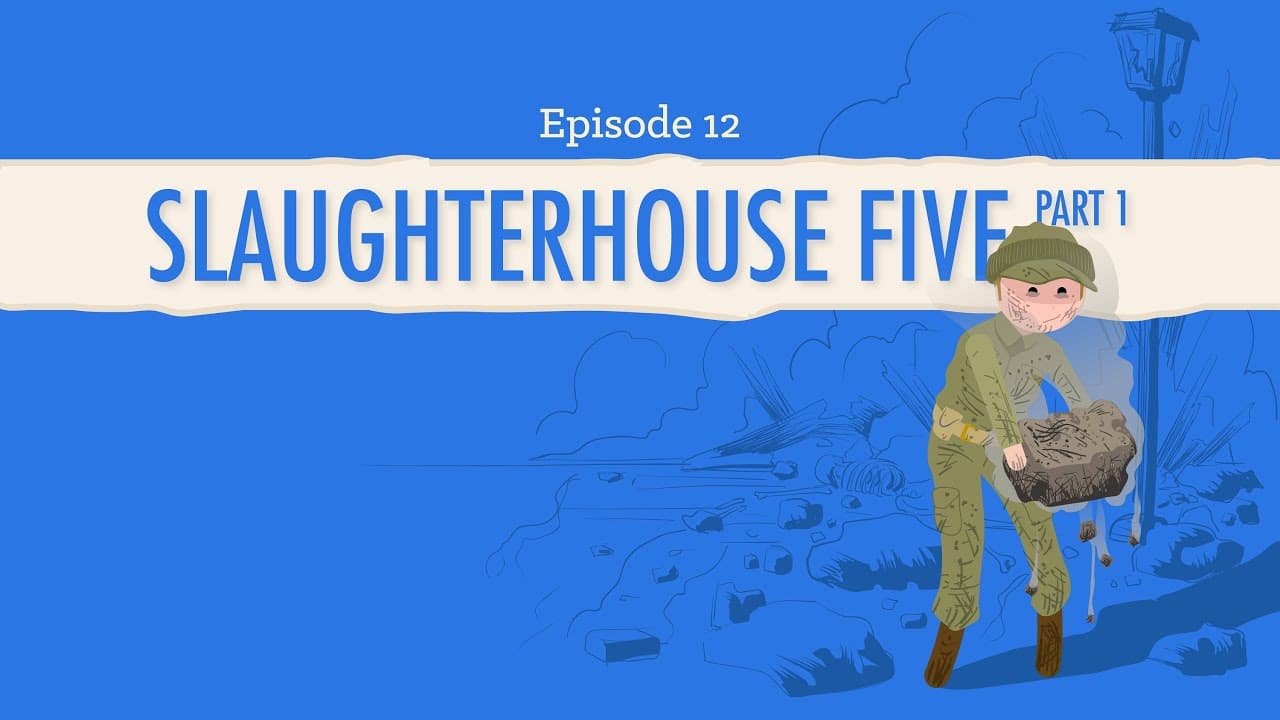
Hi, I’m John Green, this is Crash Course Literature, and today we’re gonna talk about Kurt Vonnegut’s Slaughterhouse Five. Mr. Green, Mr. Green! You mean, like the Motown group that sings that song - glad all over! No singing, Me From the Past! And no, it is not a Motown group! You’re thinking of the Dave Clark Five, and for the record, they were n... Read More
Key Insights
- Slaughterhouse-Five is an antiwar novel written by Kurt Vonnegut during the Vietnam War, reflecting on World War II's impact, especially the bombing of Dresden.
- The protagonist, Billy Pilgrim, experiences time non-linearly, symbolizing the trauma and disorientation caused by war, which mirrors Vonnegut's own experiences.
- Vonnegut uses a fictional narrative to explore the limits of literature in addressing large-scale violence and the complexities of human suffering.
- The novel's structure, with a non-linear timeline and first-person narrative, challenges readers' expectations and immerses them in the chaos of war.
- Vonnegut's inclusion of aliens and time travel serves as metaphors for the absurdity and unpredictability of life, further highlighting the novel's antiwar message.
- The narrative employs vague language and clichés to convey the unspeakable horrors of war, illustrating how humans cope with trauma through evasion.
- Vonnegut's use of humor and absurdity, such as the barbershop quartet metaphor, forces readers to confront their own reactions to tragedy and violence.
- The novel questions the morality of profiting from recounting traumatic events, as Vonnegut expresses guilt over benefiting from the book's success.
Install to Summarize YouTube Videos and Get Transcripts
Explore YouTube Video Summarizer or Get YouTube Transcript Extractor
Questions & Answers
Q: What is the main theme of Slaughterhouse-Five?
The main theme of Slaughterhouse-Five is the absurdity and destructiveness of war. Through the non-linear narrative of Billy Pilgrim, who becomes 'unstuck in time,' Vonnegut explores the impact of war on the human psyche, particularly focusing on the bombing of Dresden. The novel questions the role of literature in addressing large-scale violence and uses humor and absurdity to challenge readers' perceptions of war and trauma.
Q: How does Vonnegut's personal experience influence the novel?
Kurt Vonnegut's personal experiences heavily influence Slaughterhouse-Five, as he himself was a prisoner of war during World War II and witnessed the bombing of Dresden. These experiences are mirrored in the protagonist, Billy Pilgrim's journey, providing an authentic and poignant exploration of the trauma and disorientation caused by war. Vonnegut's firsthand knowledge adds depth and credibility to the novel's antiwar message.
Q: What narrative techniques does Vonnegut use in the novel?
Vonnegut employs several narrative techniques in Slaughterhouse-Five, including a non-linear timeline, first-person narration, and metafictional elements. These techniques challenge traditional storytelling and immerse readers in the chaos and unpredictability of war. The use of vague language and clichés conveys the unspeakable horrors of war, while humor and absurdity, such as the inclusion of aliens and time travel, highlight the novel's antiwar themes.
Q: What role does humor play in Slaughterhouse-Five?
Humor in Slaughterhouse-Five serves to highlight the absurdity of war and human suffering. Vonnegut uses comedic elements, such as the barbershop quartet metaphor and the repeated phrase 'so it goes,' to force readers to confront their own reactions to tragedy. This use of humor not only provides a coping mechanism for the characters but also challenges readers to question their perceptions of violence and trauma.
Q: How does the novel address the morality of profiting from trauma?
Slaughterhouse-Five addresses the morality of profiting from trauma through Vonnegut's own reflections on the success of the novel. He expresses guilt over benefiting from recounting the horrors of Dresden, questioning the ethics of gaining acclaim and wealth from others' suffering. This introspection adds complexity to the narrative, highlighting the tension between the necessity of bearing witness and the personal gain derived from it.
Q: What is the significance of the Tralfamadorians in the novel?
The Tralfamadorians in Slaughterhouse-Five symbolize the novel's exploration of time and the absurdity of human existence. Their perception of time as non-linear reflects Billy Pilgrim's experiences of being 'unstuck in time,' emphasizing the disorientation caused by trauma. The Tralfamadorian philosophy, encapsulated by the phrase 'and so it goes,' challenges readers to reconsider their understanding of life, death, and the inevitability of war.
Q: How does the novel challenge readers' expectations of fiction?
Slaughterhouse-Five challenges readers' expectations of fiction through its non-linear narrative, metafictional elements, and the blending of reality with absurdity. Vonnegut calls attention to the act of storytelling, reminding readers that they are engaging with a constructed narrative. This approach unmoors readers from traditional storytelling conventions, immersing them in the chaos and unpredictability of war, and encouraging them to question their perceptions of reality.
Q: What is the importance of the novel's opening line?
The novel's opening line, 'All this happened, more or less,' sets the tone for Slaughterhouse-Five's exploration of truth and fiction. This phrase challenges readers' expectations by blurring the line between reality and narrative, highlighting the complexities of recounting traumatic events. It underscores the novel's themes of memory, perception, and the difficulty of conveying the true horrors of war, inviting readers to question the reliability of the narrative.
Summary & Key Takeaways
-
Slaughterhouse-Five, by Kurt Vonnegut, is an antiwar novel that reflects on the horrors of World War II, particularly the bombing of Dresden, through the experiences of Billy Pilgrim, who becomes 'unstuck in time.'
-
The novel challenges traditional narrative structures by using a non-linear timeline and first-person perspective, immersing readers in the chaos and trauma of war, while questioning the role of literature in addressing violence.
-
Vonnegut uses humor and absurdity, including aliens and time travel, to highlight the absurdity of war and human suffering, ultimately questioning the morality of profiting from recounting traumatic events.
Read in Other Languages (beta)
Share This Summary 📚
Summarize YouTube Videos and Get Video Transcripts with 1-Click
Try YouTube Summary with ChatGPT & Claude or YouTube Transcript Generator
Explore More Summaries from CrashCourse 📚



Summarize YouTube Videos and Get Video Transcripts with 1-Click
Try YouTube Summary with ChatGPT & Claude or YouTube Transcript Generator