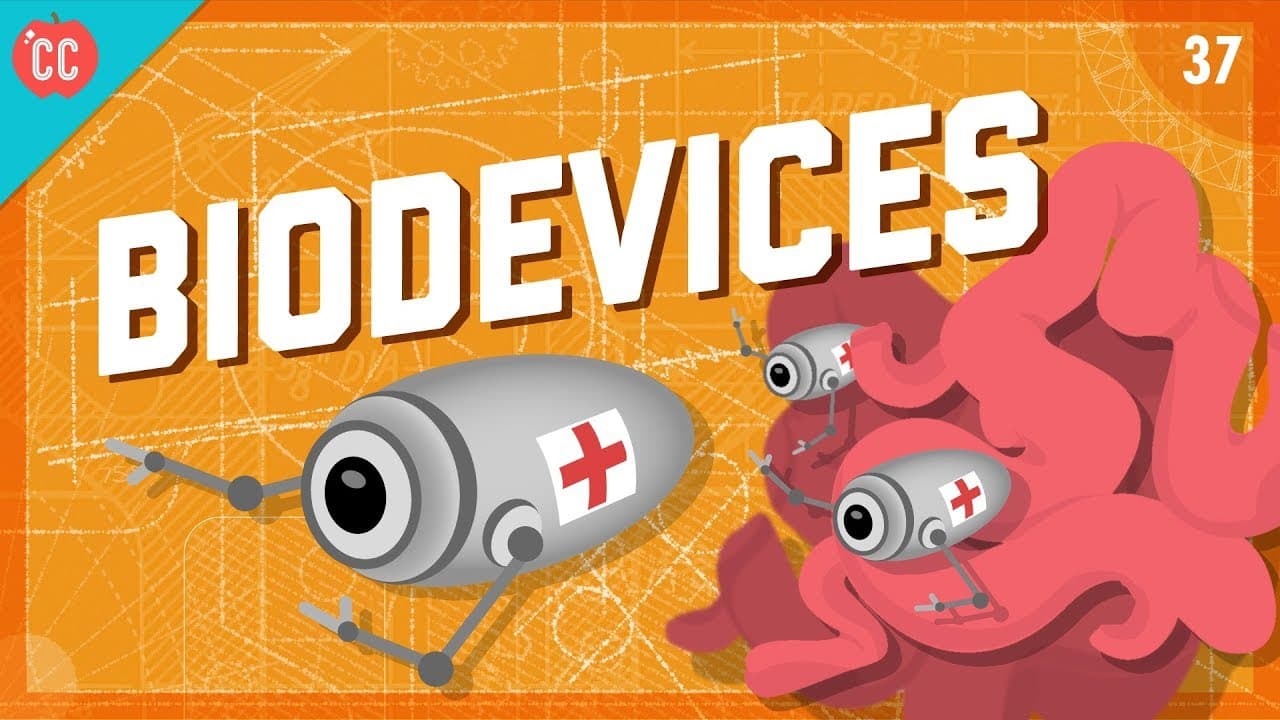
Smart Tattoos & Tiny Robots: Crash Course Engineering #37
TL;DR
Implantable biodevices assist the body by monitoring conditions, restoring functions, managing diseases, or delivering treatment. An ICD continuously tracks heart rhythm and responds with an electrical pulse when trouble is detected, while successful devices also require biocompatibility, sterilization, reliable power, connectivity, protective packaging, and minimally invasive delivery. Read on to see how engineers address these constraints and explore smart tattoos, MEMS drug delivery, and tiny robots.
Transcript
The human body is a complex place, and our immune systems are powerful allies. If you get sick, doctors can often rely on strengthening what’s already inside you. But sometimes you need an assist: technology that can be put inside the body. Things like biodevices. [Theme Music] We’ve all seen a TV show where someone has a heart attack, only to be ... Read More
Key Insights
- 😚 Implantable biodevices, like ICDs and cochlear implants, have revolutionized healthcare by restoring lost bodily functions and managing diseases.
- 🎨 Designing a successful biodevice requires considering biocompatibility, power and connectivity, packaging, structural design, delivery systems, and device management.
- ⌛ Smart tattoos with flexible electronic sensors have the potential to monitor body signals and provide real-time diagnostics.
- 🤗 Micro-Electro-Mechanical Systems (MEMS) enable the development of compact, active implantable drug delivery systems, opening doors to new possibilities in healthcare.
- 👻 Biodevices made from biodegradable metallic materials are being researched to allow for temporary devices that disappear into the body after their job is done.
- 🤖 The future potential of biodevices includes advancements in genetic engineering, tiny robots for drug delivery and DNA repair, and advanced diagnostics.
Install to Summarize YouTube Videos and Get Transcripts
Explore YouTube Video Summarizer or Get YouTube Transcript Extractor
Questions & Answers
Q: What are implantable biodevices, and what do they do?
An implantable biodevice is placed wholly or partly inside the body for an extended period. Such devices can rebuild lost bodily functions, manage diseases, and help people live longer; examples include ICDs and cochlear implants.
Q: How does an implantable cardioverter-defibrillator (ICD) work?
An ICD continuously monitors a person’s heartbeat. When it detects that a rhythm problem is about to occur, it delivers an electrical pulse to restore a normal rhythm before the situation becomes life-threatening.
Q: How common are implantable biodevices?
Around 8% of Americans and 5% of people in developed countries have used an implantable biodevice of some sort. That amounts to millions of people using devices such as ICDs and cochlear implants.
Q: What must engineers consider when designing an implantable biodevice?
Engineers must account for biocompatibility, sterilization, power, connectivity, packaging, structural design, delivery systems, and device management. The device must coexist with changing temperatures, electrical signals, and chemical reactions without disrupting the body’s carefully balanced systems.
Q: How can biodevices be sterilized before implantation?
One CDC-recommended technique is dry heat sterilization with moisture-free air. The transcript gives two options: 160°C for around 2 hours or 170°C for about an hour; materials that cannot survive that heat require another sterilization method.
Q: Why are power and connectivity important in implantable devices?
Many biodevices contain tiny computers, so they may need a battery for power and Wi-Fi to communicate externally. Neglecting these requirements can produce an impractical device, prevent it from working, or cause it to stop soon after implantation.
Q: How are implantable electronics protected from the body?
Their packaging should be airtight and watertight, or hermetically sealed, because water in the body can damage electronics. Titanium can block radio waves and require an external antenna, so ceramic or glass may be a better enclosure when wireless communication is needed.
Q: What future biodevice technologies could improve monitoring and treatment?
Flexible electronic sensors in smart tattoos could monitor body signals and provide real-time diagnostics. MEMS may enable compact active drug-delivery systems, while research also explores biodegradable metallic devices and tiny robots for drug delivery and DNA repair.
Summary & Key Takeaways
-
Biodevices, like the ICD, monitor a person's heartbeat and deliver electrical pulses to restore a normal rhythm, preventing life-threatening situations.
-
Implantable biodevices, including ICDs and cochlear implants, are already in widespread use, with millions of people benefitting from their functionalities.
-
Designing biodevices involves considering factors such as biocompatibility, power and connectivity, packaging, structural design, delivery systems, and device management.
Read in Other Languages (beta)
Share This Summary 📚
Summarize YouTube Videos and Get Video Transcripts with 1-Click
Try YouTube Summary with ChatGPT & Claude or YouTube Transcript Generator
Explore More Summaries from CrashCourse 📚





Summarize YouTube Videos and Get Video Transcripts with 1-Click
Try YouTube Summary with ChatGPT & Claude or YouTube Transcript Generator