How to Build and Sell n8n AI Agents Without Coding (8+ Hour Course)
TL;DR
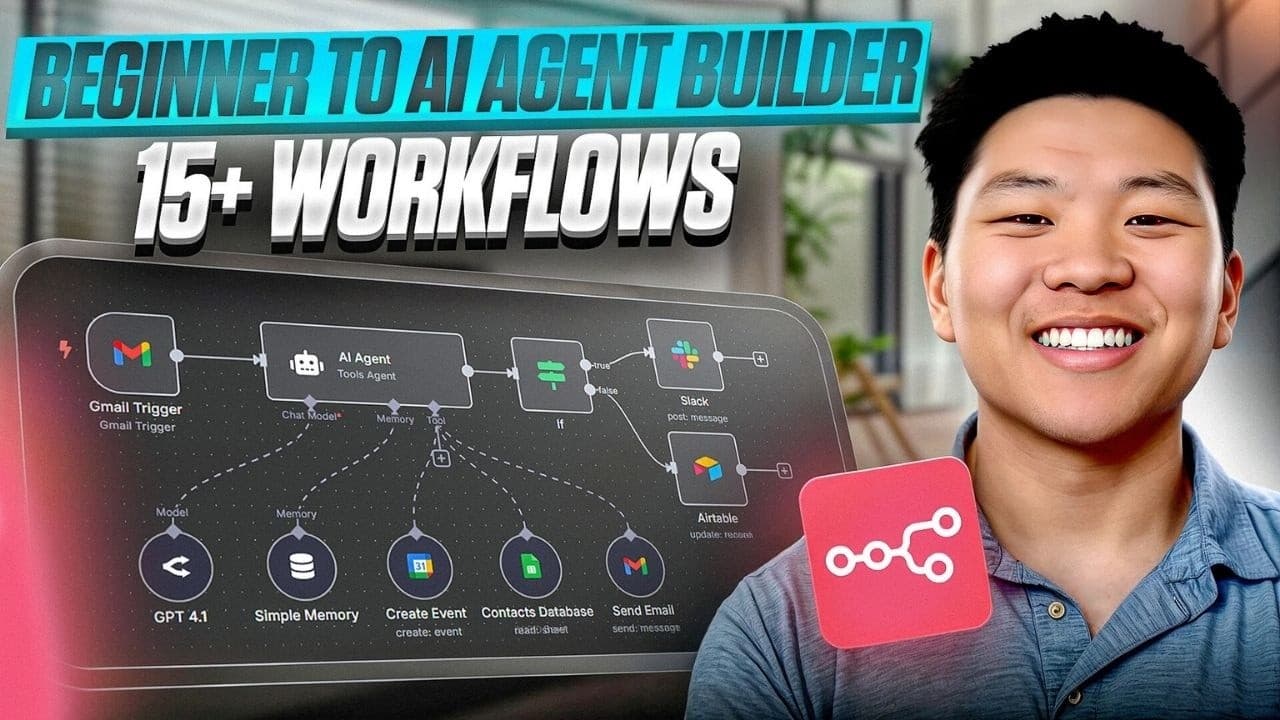
You can build n8n AI agents without coding by first learning predictable AI workflows, then adding an LLM, memory, system instructions, and tools for autonomous tasks. The course progresses from a free n8n trial and credentials through APIs, HTTP requests, webhooks, multi-agent architectures, MCP servers, and self-hosting, with over 15 AI automations built by the end. Read on to understand the core architecture and when an agent is actually the right choice.
Transcript
in this course I'm going to take you from a complete beginner to building powerful noode AI agents i don't have any coding experience and you don't need any either in the past eight months I've made over half a million dollars in revenue by building and teaching people how to build AI agents in this video together we're going to set up your 2e free... Read More
Key Insights
- AI agents are tools that can make decisions and act autonomously based on inputs.
- A vector database is a multi-dimensional space used to store data in vector form, allowing for efficient data retrieval.
- n8n allows automation of business processes without coding, using a visual interface and a variety of integrations.
- RAG (Retrieval Augmented Generation) combines AI with a vector database to enhance response accuracy by retrieving relevant information.
- Open Router provides access to multiple AI models, offering flexibility in choosing the best model for specific tasks.
- System prompts guide AI agents by defining their roles and instructions, improving their task performance.
- Embedding models convert text into vectors, enabling efficient data storage and retrieval in vector databases.
- JSON is a key data format in n8n, used for structuring data in workflows and integrations.
Install to Summarize YouTube Videos and Get Transcripts
Explore YouTube Video Summarizer or Get YouTube Transcript Extractor
Questions & Answers
Q: How do you build AI agents using n8n without coding?
Start by setting up a free n8n trial, adding credentials, learning the interface, and building step-by-step workflows with integrations. Then connect an LLM to memory, system instructions, and tools that can perform actions. The course also covers APIs, HTTP requests, webhooks, multi-agent architectures, MCP servers, and a self-hosted n8n setup.
Q: What is the difference between an AI workflow and an AI agent?
An AI workflow follows a fixed sequence and cannot deviate from the guardrails you define. An AI agent uses an LLM as its brain to decide which tools to use based on each input. The transcript recommends workflows for predictable processes and agents for unpredictable processes requiring autonomous decisions.
Q: When should you use an AI workflow instead of an AI agent?
Use an AI workflow when the process is deterministic, linear, or follows the same ordered steps every time. The example workflow receives a HubSpot lead, researches it with Perplexity, drafts a personalized email with an LLM, and sends the email. Compared with an agent, this approach offers greater reliability and consistency, cost efficiency, easier debugging and maintenance, and scalability.
Q: What are the main components of an AI agent?
The described agent has an input, an output, a brain, and instructions. Its brain consists of a large language model plus short-term or long-term memory, while its instructions are provided through a system prompt. Tools allow the agent to take actions such as sending an email, updating a CRM row, or checking a database.
Q: What does memory do in an AI agent?
Memory preserves context so the agent does not forget the conversation after every sentence. Short-term memory retains the current context window, while long-term memory can preserve information discussed further in the past. The agent can check that memory before deciding how to respond or act.
Q: What is a system prompt for an AI agent?
A system prompt defines the agent’s role, goal, available tools, and instructions for when to use each tool. It functions like a job description and generally remains consistent throughout the agent’s operation unless its role changes. This differs from a user prompt, which is the dynamic input sent with each request.
Q: What does the n8n AI agents course cover?
The course begins with AI-agent foundations, a free n8n trial, credentials, the interface, and foundational workflow knowledge. It then covers integrations, APIs, HTTP requests, agent tools and memory, prompting, multi-agent architectures, webhooks, MCP servers, and self-hosted n8n. By the end, learners are expected to have built over 15 AI automations.
Q: What experience does the instructor share about building AI agents?
The instructor says he had no coding experience and that learners do not need any either. He reports making over half a million dollars in revenue during the previous eight months by building AI agents and teaching others to build them. The course closes with lessons from his first six months of building AI agents.
Summary & Key Takeaways
-
This course teaches how to build AI automations using n8n, a no-code platform. It covers key concepts like AI agents, workflows, APIs, and vector databases. By the end, you'll have practical skills to create and sell AI automations.
-
You'll learn to use tools like Open Router for AI model selection and Pine Cone for vector database management, enhancing your automation capabilities.
-
The course emphasizes hands-on learning, guiding you through setting up various workflows, understanding data types, and leveraging system prompts for AI agents.
-
(Content reviewed on 2026-08-27.)
Read in Other Languages (beta)
Share This Summary 📚
Summarize YouTube Videos and Get Video Transcripts with 1-Click
Try YouTube Summary with ChatGPT & Claude or YouTube Transcript Generator
Explore More Summaries from Nate Herk | AI Automation 📚

Summarize YouTube Videos and Get Video Transcripts with 1-Click
Try YouTube Summary with ChatGPT & Claude or YouTube Transcript Generator