What Causes Recessions and How They End Explained
TL;DR
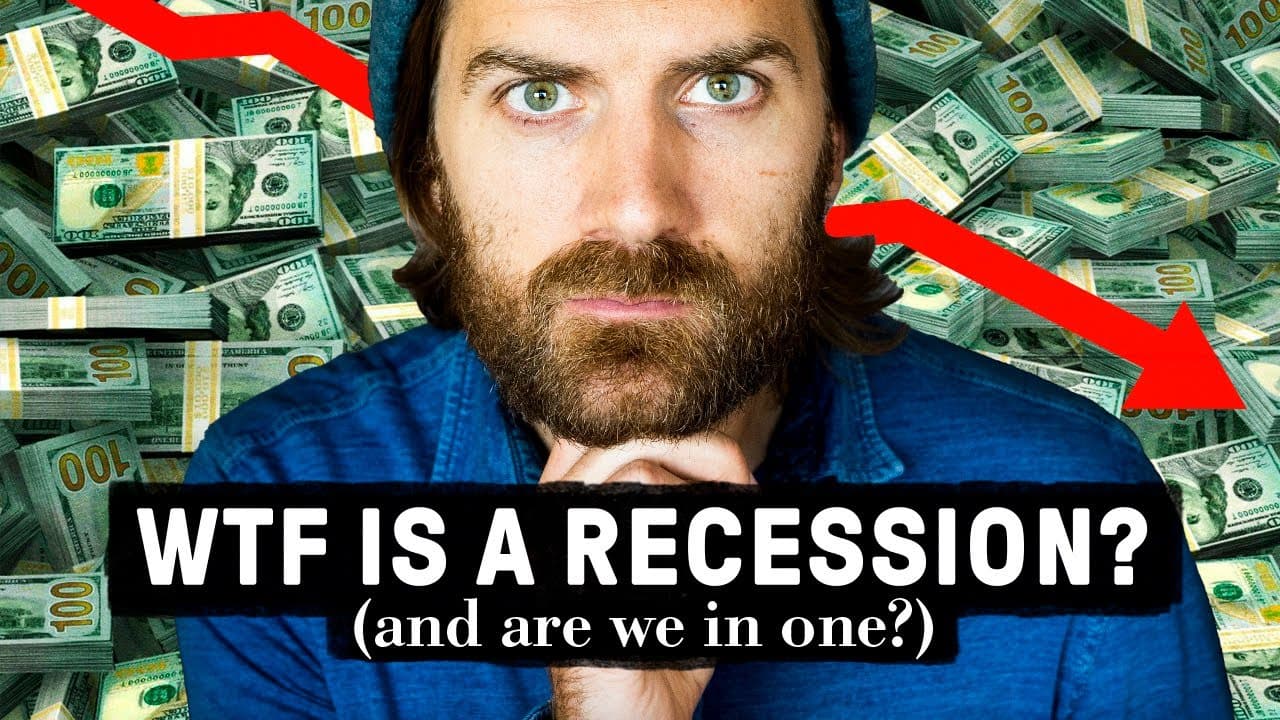
Recessions occur when demand for goods and services slows after businesses cut back on hiring and investment due to higher costs or uncertainty. The economy shrinks as household spending drops, lenders pull back, and ripple effects spread through firms and workers. A recession is a downturn in GDP caused by a chain reaction of micro decisions.
Transcript
- One, two, three, four, five. Hello, hello, hello. Okay, here we go. I wanna explain to you what a recession is. I'm doing this because you're gonna hear this word a lot lately. And depending on how bad it gets, you'll likely feel its effects. So give me 12 minutes to explain recession. Plus, of course, the inevitable time it takes me to read an a... Read More
Key Insights
- GDP is like the economy’s receipt, summing all purchases in a year.
- Capitalism plus industry fuels growth by rewarding productive innovation.
- Recessions are dips in the GDP line that precede recoveries.
- Micro-decisions by households and firms cause macro outcomes.
- Inflation, interest rates, and uncertainty can trigger downturns.
- Unemployment rises when firms lay off workers during weak demand.
- A domino effect occurs as less spending leads to fewer jobs.
- The entire economy is a network of interdependent buyers and sellers.
- More videos from this channel:
- More from this channel: Johnny Harris
Install to Summarize YouTube Videos and Get Transcripts
Explore YouTube Video Summarizer or Get YouTube Transcript Extractor
Questions & Answers
Q: What is GDP and why is it used to measure recession?
GDP is the total value of all goods and services produced in an economy over a year. It acts as a single numerical summary of economic activity, allowing us to see whether the economy is expanding or contracting. A recession is identified when this measure declines for multiple periods, reflecting reduced production and spending.
Q: How does capitalism relate to economic growth and recessions?
Capitalism, paired with industry, created incentives to produce more and better goods, pushing GDP upward year after year. When those incentives fail to translate into higher output or when demand weakens, the line can dip, indicating a recession. The system’s success depends on steady growth and healthy demand.
Q: Who are the main players in the economy according to the video?
The video identifies households and firms as the core players. Households buy goods and supply labor, while firms produce goods and hire workers. Investors provide capital to expand production. Together these actors create demand, supply, and employment, forming the economy’s fabric.
Q: What triggers a recession in the neighborhood analogy?
In the analogy, a rise in bread prices or costs causes buyers to tighten spending. People save more, demand falls, and firms lay off workers. The reduced income leads to even less spending, creating a domino effect where unemployment rises, lending slows, and overall output declines.
Q: Why can’t we immediately tell if we are in a recession?
Because recession signals are data-driven and can be noisy. GDP movements, unemployment, and spending data are reported over time. A single dip might be temporary, but a sustained decline over several periods signals a recession. The timing depends on which indicators are observed and how they’re interpreted.
Q: What role do inflation and interest rates play in recessions?
Inflation and higher interest rates raise the cost of borrowing and erode purchasing power. This makes households and firms more cautious about spending and investment, reducing demand and potentially triggering a downturn. These tools influence the perceived risk and future profitability of spending.
Q: How does unemployment contribute to a recession?
Unemployment rising reduces household income, which lowers overall demand for goods and services. Less income leads to less spending, which further reduces production and hiring in a feedback loop. This cycle is central to the recessionary spiral described in the video.
Q: Can you explain the domino effect the video describes?
A decrease in spending by one household or firm reduces revenue for others, leading to more layoffs and lower investment. As more actors cut back, the economy’s total output contracts. This cascading process explains how small shocks can evolve into a broad recession.
Summary & Key Takeaways
-
A recession is a downturn in GDP driven by cascades of micro decisions across households and firms. It begins when demand falls and unwinds the connections between spending, hiring, and investment. The video uses a neighborhood bakery to illustrate how layoffs and reduced spending trigger a broader contraction.
-
Capitalism drives growth by incentivizing production and innovation, but when growth stalls, the system reveals its vulnerability to drops in demand, lending, and investment. The narrative links historical capitalism with modern recessions and highlights the interdependence of economic actors.
-
The portrayal emphasizes that recessions are not isolated incidents but systemic phenomena that emerge from many small, connected decisions. It also notes the difficulty in declaring a recession precisely, since data evolves as prices, employment, and production shift month to month.
Read in Other Languages (beta)
Share This Summary 📚
Summarize YouTube Videos and Get Video Transcripts with 1-Click
Try YouTube Summary with ChatGPT & Claude or YouTube Transcript Generator
Explore More Summaries from Johnny Harris 📚




Summarize YouTube Videos and Get Video Transcripts with 1-Click
Try YouTube Summary with ChatGPT & Claude or YouTube Transcript Generator