How did the Panama Canal reshape global power?
TL;DR
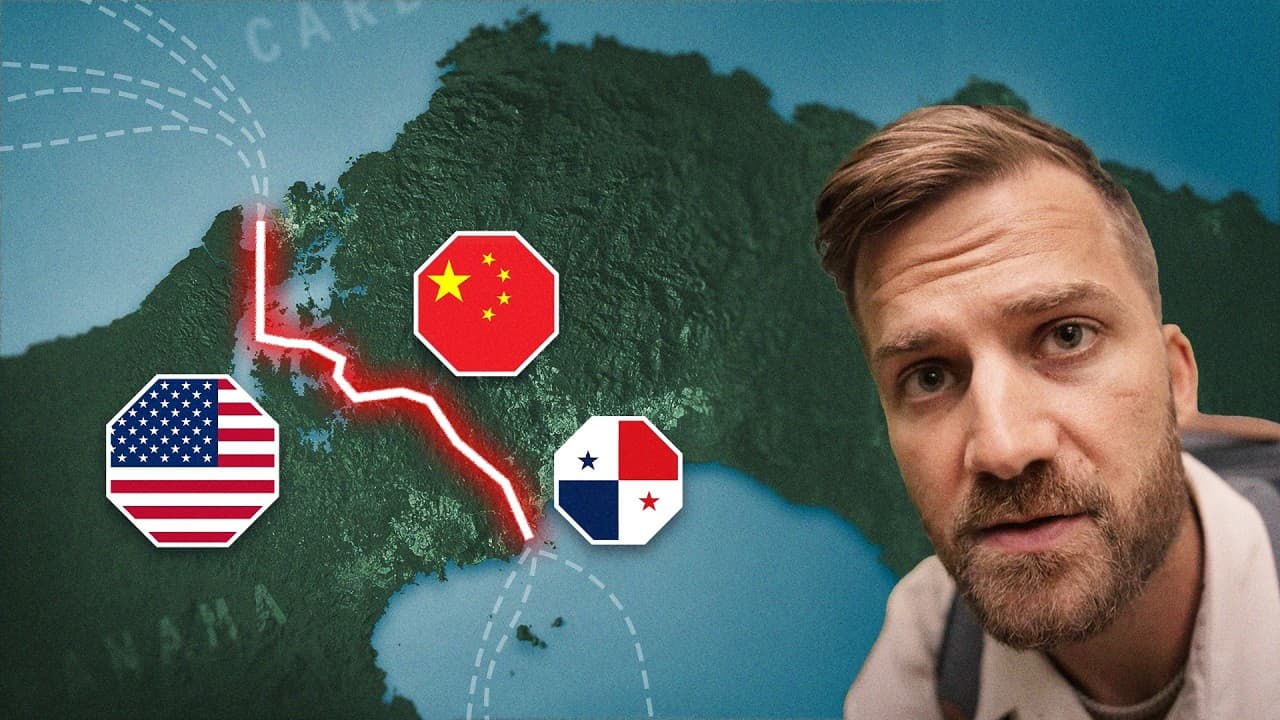
The canal redefined trade and military strategy by providing a sea level shortcut between oceans and enabling faster global links. It was achieved by damming the river to form a large artificial lake and using gravity driven locks to lift ships, while attracting labor from many nations and influencing regional power dynamics.
Transcript
(soft eerie music) - [Johnny] Wait, that's a ship? - [Driver] Yes, it is. - It's so big. (light music) There's just a giant, I've never seen them this close. Look at that, it's just right there, I'm just looking at this container ship. (boat honking echoing) - China is operating the Panama Canal and we didn't give it to China, we gave it to Panama,... Read More
Key Insights
- The canal uses gravity and water to lift ships through a series of locks.
- The locks raise vessels by 85 feet to connect oceanic routes.
- Damming the river created a large artificial lake that forms part of the canal route.
- Labor for the canal came from a global workforce including the Caribbean, India, Asia, and beyond.
- The canal is described as a crossroads to the world, linking oceans and economies.
- Military installations and airstrips were built to protect the canal’s strategic value.
- A legacy of diverse immigrant communities surrounds the canal and Panama City.
- The project reshaped Panama’s identity by integrating it into a global trade network.
- More videos from this channel:
- More from this channel: Johnny Harris
Install to Summarize YouTube Videos and Get Transcripts
Explore YouTube Video Summarizer or Get YouTube Transcript Extractor
Questions & Answers
Q: A real search query question about the canal’s strategic value, How did the Panama Canal influence global power
The canal became a strategic chokepoint that connected two oceans and allowed faster naval and commercial movement, boosting the United States as a maritime power during its construction and thereafter. Its existence shifted regional security interests and made Panama a critical hub in global trade routes, influencing diplomatic and military planning across hemispheres.
Q: How does the canal actually move ships between elevations, Why are locks necessary
Ships are lifted by gravity driven locks that use water to raise and lower vessels as they pass through different elevations. The process begins when a ship enters a lock chamber, water levels are adjusted to match the next section, and the gate opens to continue the voyage, enabling a 10 hour transit through the canal.
Q: Why did the US support Panama's independence in exchange for canal rights, Why did US back Panama independence
The US backed Panama’s independence from Colombia in 1903 in exchange for control of the critical canal zone. This move gave the United States leverage to complete the canal project, protect its strategic interests, and ensure a secure route between the Atlantic and Pacific, reinforcing its military and economic influence in the region.
Q: Who built the canal and what challenges did they face, Who were the workers and what obstacles did they overcome
Labor for the canal came from many parts of the world, including the Caribbean, India, China, and beyond. Workers faced extreme conditions, brutal heat, and deadly disease, with tens of thousands dying. The effort required living quarters, dynamite, and unparalleled endurance to create the locks, dam, and supporting infrastructure.
Q: How did canal labor and immigration shape Panama’s demographics, How did labor shape Panama
The canal project drew a diverse workforce and helped transform Panama’s demographic landscape. Immigrant communities settled around the canal corridor, contributing to Panama City’s cultural makeup and forging a multiethnic society that persisted as the canal became central to national identity and economic life.
Q: What role did the canal play in World War I era power dynamics, How did the canal affect world power during the early 20th century
During the World War I era, the canal amplified US power by providing a crucial maritime shortcut that supported two-ocean naval reach and rapid deployment. Its strategic significance shaped military planning and international diplomacy as nations sought access to the global trade network it enabled.
Q: Why is the Panama Canal described as a crossroads of the world, What makes the canal a global crossroads
The canal sits at a narrow land bridge connecting the Caribbean and Pacific, allowing vessels to bypass long routes around South America. This chokepoint handles a vast share of international trade and military movement, linking continents, economies, and cultures in a way that makes Panama a central hub in global commerce.
Q: How did the canal’s evolution reflect broader historical forces, How does history show in the canal
The canal’s evolution mirrors colonial and post-colonial dynamics, from European exploration to American engineering and regional independence. Its development showcases how labor mobility, technology, and geopolitics intersect to create a critical piece of infrastructure that reshaped trade, national identities, and power structures in the hemisphere.
Summary & Key Takeaways
-
The canal’s design uses gravity and water to operate the locks that lift ships up 85 feet, creating a navigable pathway between oceans. This engineering feat shortened global routes and increased Panama’s strategic importance.
-
Labor for the canal came from many parts of the world, shaping the demographic and cultural landscape of Panama City and its surrounding communities.
-
The canal became a focal point of U.S. geopolitical power, with military bases and protection measures reflecting its role in hemispheric security and global trade.
Read in Other Languages (beta)
Share This Summary 📚
Summarize YouTube Videos and Get Video Transcripts with 1-Click
Try YouTube Summary with ChatGPT & Claude or YouTube Transcript Generator
Explore More Summaries from Johnny Harris 📚




Summarize YouTube Videos and Get Video Transcripts with 1-Click
Try YouTube Summary with ChatGPT & Claude or YouTube Transcript Generator