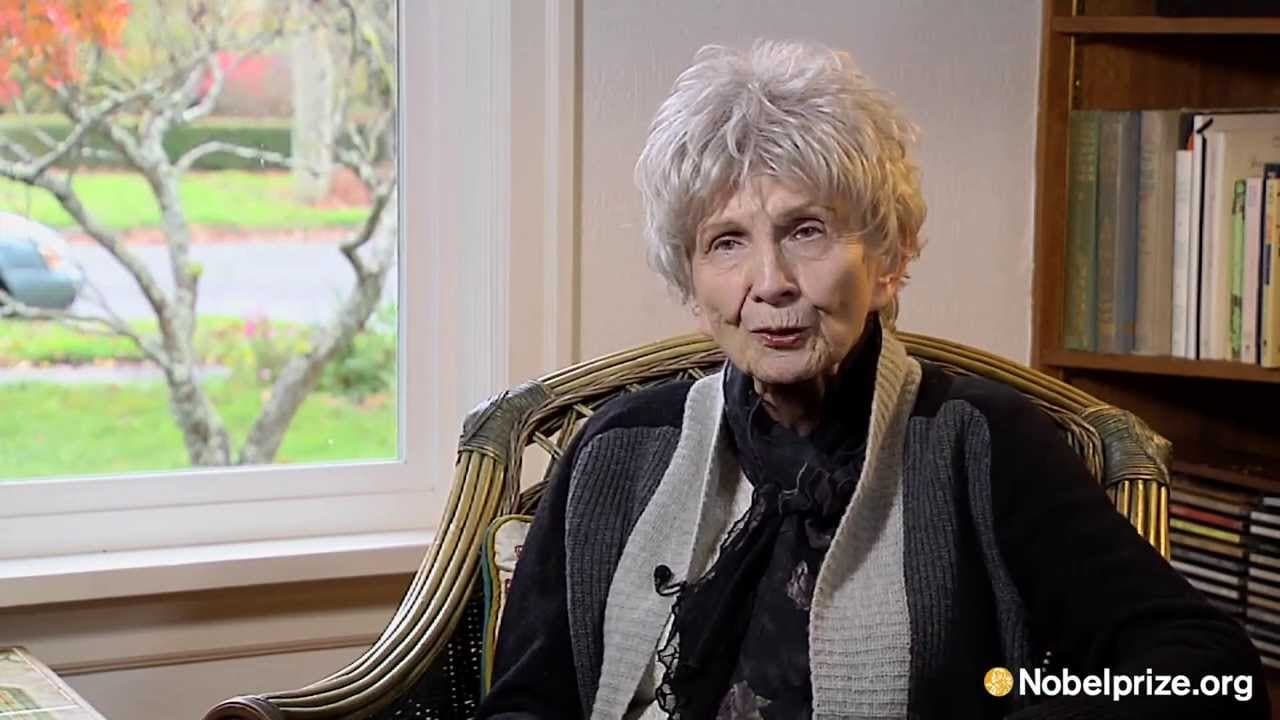
Alice Munro, In Her Own Words: 2013 Nobel Prize in Literature
TL;DR
Alice Munro traces her writing back to hearing Hans Christian Andersen's The Little Mermaid as a child, when she invented a happier ending she believed was 'published' once imagined. She insists any life or place can be interesting, that good writing takes hard work over inspiration, and that a story succeeds when it leaves the reader feeling like a different person.
Transcript
I got interested in reading very early, because a story was read to me, by Hans Christian Andersen, which was The Little Mermaid, and I don't know if you remember The Little Mermaid, but it's dreadfully sad. The little mermaid falls in love with this prince, but she cannot marry him, because she is a mermaid. And it's so sad I can't tell you the de... Read More
Key Insights
- Munro's writing began with The Little Mermaid, read to her as a child; the story was so sad she walked around her house inventing a happy ending, feeling she had 'published' the new version simply by imagining it.
- Storytelling grew from a long walk to school, during which she made up stories that increasingly cast herself as a heroine, satisfying to her without any need for other people to read or know them.
- Growing up in a part of Ontario where women did most of the reading and storytelling gave Munro no sense of inferiority as a woman writer, since men stayed outside doing 'important things' and did not go in for stories.
- The hardest part of writing, for Munro, is rereading a story and realizing how bad it is; she treats a weak story as her own fault, not the story's, and fixes it through hard work.
- Munro starts each story with a fairly clear plot but expects it to change as she writes, discovering more about what the story is truly about than she understood at the beginning.
- She wrote as a housewife in times off, getting lunch for her children, and never stopped despite discouragement at seeing her early stories were not good and that writing was far harder than expected.
- A writer's vision changes with age: Munro moved from beautiful young princesses to housewives and children and later old women, a shift that happens without deliberately trying to change it.
- Munro's goal is for stories to move people regardless of gender or age, not producing an 'isn't that the truth' reaction but leaving readers feeling like a different person when they finish.
Install to Summarize YouTube Videos and Get Transcripts
Explore YouTube Video Summarizer or Get YouTube Transcript Extractor
Questions & Answers
Q: How did Alice Munro first become interested in writing stories?
Munro became interested in reading and writing very early because The Little Mermaid by Hans Christian Andersen was read to her. The story was dreadfully sad, so after finishing it she walked around and around the brick house where she lived and made up a story with a happy ending, feeling the little mermaid deserved to marry the prince rather than die on the water. She believed the new version had been 'published' once she imagined it, which she describes as her early start on writing.
Q: How did Munro learn to tell and write stories as a child?
Munro made up stories all the time, especially during a long walk to school where she would generally invent them. As she got older the stories increasingly cast herself as a heroine in some situation, and it did not bother her that they would not be published to the world immediately. The stories were satisfying from her own point of view, built around the little mermaid's bravery, cleverness, magic powers, and ability to make a better world.
Q: Why did Munro feel confident writing as a woman?
Munro never thought of herself as anything but a woman and grew up with many good stories about little girls and women. She lived in a part of Ontario where women did most of the reading and told most of the stories, while the men were outside doing important things and did not go in for stories. This environment meant she had no feeling of inferiority at all about being a woman, and she felt quite at home as a writer.
Q: What does Munro consider the hardest part of telling a story?
Munro finds the hardest part is when you go over the story and realize how bad it is. The first part brings excitement and the second feels pretty good, but then you pick it up one morning and think 'what nonsense,' and that is when the real work begins. She treats a weak story as her own fault rather than the story's fault, and turns it around through hard work, giving neglected characters a chance or doing something quite different with them.
Q: Why does Munro think small-town Canadian life is interesting to write about?
Munro says you just have to be there, and she believes any life and any surroundings can be interesting. She thinks she could not have been so brave if she had lived in a town competing with people on a generally higher cultural level, because she did not have to cope with that. She was the only person she knew who wrote stories, and for a while believed she was the only person in the world who could do this.
Q: How did Munro balance writing with being a housewife and mother?
Munro was consumed desperately by her stories, yet she always got lunch for her children and lived as a housewife. She learned to write in times off and does not think she ever gave it up, even during very discouraging periods when she began to see that her stories were not very good and that writing was a much harder job than she had expected. Despite this she never stopped, saying it was simply something she did.
Q: How does growing older change Munro's writing?
Munro says aging changes her writing in a very predictable way. A writer starts out writing about beautiful young princesses, then writes about housewives and children, and later about old women, and this progression just goes on without her necessarily trying to change it. Her vision changes over time. This mirrors her own path from the fairy-tale heroines of her childhood imagination toward the domestic and aging characters of her mature work.
Q: What impact does Munro want her stories to have on readers?
Munro wants her stories to move people, and she does not care whether they are men, women, or children. She wants her stories to say something about life that gives readers not an 'isn't that the truth' reaction but a feeling of some kind of reward from the writing. This does not require a happy ending; instead everything the story tells should move the reader so that they feel they are a different person when they finish.
Summary
In this video, acclaimed author Alice Munro discusses her early start in writing, her inspiration for storytelling, and her perspective as a woman writer. She shares how her love for reading and her childhood experiences shaped her storytelling style. Munro also reflects on the challenges and joys of being a writer, including the importance of crafting a compelling narrative and the process of revising and improving her work. She discusses her experiences as a woman writer and the evolving role of women in literature. Munro shares insights into her writing process and the impact she hopes her stories have on readers. She also discusses her personal journey as a writer and her thoughts on receiving the Nobel Prize.
Questions & Answers
Q: How did Munro become interested in writing?
Munro attributes her early interest in writing to a story that was read to her as a child, specifically Hans Christian Andersen's "The Little Mermaid." The story deeply affected her, as it had a sad ending, so she created her own version with a happy ending. From then on, she would constantly make up stories in her head, particularly during her long walks to school.
Q: Was it important for Munro to tell stories from a woman's perspective?
Munro did not consciously set out to write from a woman's perspective, but she never saw herself as anything other than a woman. Growing up in an environment where women were the primary readers and storytellers, Munro felt at ease with writing stories featuring female protagonists. She never felt inferior or lacking in any way because of her gender.
Q: How did Munro's childhood environment inspire her writing?
Munro didn't feel that she needed inspiration from her environment to write stories. She believed that stories were important in the world, and she wanted to create her own. The thought of telling her stories to a larger audience didn't occur to her until later in life.
Q: What is important to Munro when she tells a story?
Munro emphasizes the importance of a happy ending in her early days of storytelling. However, as she grew older and read more varied literature, her ideas shifted, and she began to appreciate and delve into tragic endings. The key for her is to create a story that moves the reader emotionally and leaves a lasting impact, regardless of its ending.
Q: What is so interesting about describing small-town Canadian life in Munro's stories?
For Munro, any life, including small-town Canadian life, can be interesting. She believes that any surroundings have the potential to be fascinating, and her personal experiences in a small town allowed her to understand and portray that setting authentically. Additionally, she may have felt braver in writing about her own experiences without having to compete with a higher cultural level found in larger cities.
Q: Was Munro always confident in her writing?
Munro had confidence in her writing for a long time, but as she encountered other writers and realized the challenges of the craft, she became less confident. However, she never gave up and continued to write regardless of her doubts. Writing was something she was determined to do, regardless of the difficulties she faced.
Q: Does Munro always have her stories plotted out when she starts writing?
Munro generally starts with a plot in mind, but she acknowledges that the story often changes as she writes it. Sometimes unexpected events occur, and new ideas form during the writing process. However, she believes it's essential to have a clear idea of the story's direction before starting.
Q: How absorbed is Munro by the story when she starts writing?
Munro admits that she becomes consumed by the story when she starts writing. However, being a housewife and a mother, she learned to write during her free time and continued her responsibilities even as a writer. Despite discouraging moments and the realization that her early stories weren't good, she never gave up.
Q: What is the hardest part for Munro when she wants to tell a story?
For Munro, the hardest part is when she reviews a story and realizes it's not good. The initial excitement and the following stages may be promising, but there comes a point when she sees the flaws and has to put significant effort into improving it. She believes it's her duty to make the necessary changes and create a better story.
Q: How many stories has Munro thrown away?
When Munro was young, she discarded all her stories. She can't specifically recall the exact number she threw away, but she didn't do it as frequently in recent years. As she gained more experience, she became better at recognizing what needed improvement in her stories. However, there might still be occasional mistakes that she chooses to let go of.
Q: Does Munro ever regret throwing away a story?
Munro does not regret discarding a story because she had already gone through the agony of realizing it didn't work. Once she reaches that point, it's unlikely that she would want to keep or salvage it. She acknowledges that mistakes happen but feels it's best to move on.
Q: How has growing older influenced Munro's writing?
Munro's writing has naturally evolved as she has grown older. Her stories have transitioned from focusing on young heroines to housewives, children, and eventually old women. It's a reflection of the changes in her perspective and experiences over time.
Q: Has Munro been important to other female writers as a pioneering housewife writer?
Munro hopes that she has been important to other female writers, but she cannot be certain. She recalls seeking inspiration from other female writers when she was young, as it encouraged her in her own writing. However, she acknowledges that societal perceptions have changed, and women today have more recognition and acceptance as serious writers.
Q: What impact does Munro think her stories have on readers, especially women?
Munro's primary goal is for her stories to move people, irrespective of their gender or age. She aims to create stories that resonate with readers, making them feel rewarded and possibly even a different person by the end. She wants her stories to be enjoyable and relatable, touching readers' lives in meaningful ways.
Q: Who does Munro think she is, and what does that expression mean to her?
Munro acknowledges that her identity is shaped by her upbringing in a rural community with Scotch-Irish roots. The cultural norms of her community emphasized humility and not thinking of oneself as smart. Despite these influences, Munro recognized her talent and pursued writing, taking pride in her unique perspective.
Q: Was Munro an early feminist?
Munro was not aware of the term "feminism" during her youth, but looking back, she recognizes that she exhibited feminist ideals. Growing up in a region of Canada where women had more reading and writing opportunities than men, Munro saw women as capable writers, possibly even more so than men. However, she acknowledges that attitudes have significantly changed over time.
Q: Would Munro's writing have been different if she had completed her university studies?
Munro believes that completing university studies might have made her more cautious and afraid of pursuing writing. Knowing more about the great works of literature might have made her doubt her own abilities. However, she still thinks she would have tried to write because of her deep desire to do so.
Q: Was writing a gift given to Munro?
Munro did not view her writing as a gift. She saw it as something she could accomplish through hard work and dedication. Rather than attributing her writing talent to an inherent gift, Munro believed that any success she experienced was a result of her efforts.
Q: Did Munro ever doubt her own abilities and think she wasn't good enough?
Munro frequently doubted her abilities and discarded more stories than she completed or submitted. This pattern continued into her twenties as she sought to refine her writing style. Doubt and self-criticism were significant challenges for her, but she persisted in honing her craft and finding her voice.
Q: What did Munro's mother mean to her?
Munro's relationship with her mother was complex. Her mother suffered from Parkinson's disease and required a lot of care and support. Munro loved her mother but also felt embarrassed by her speech difficulties and the limitations they imposed on her social interactions. Despite these challenges, Munro believes that her mother's love for reading and her father's reading habits influenced her passion for storytelling.
Q: Did Munro's mother inspire her in any way?
Munro believes that her mother did inspire her, though she may not have realized it at the time. While Munro never shared her stories with her mother, her mother's love for books and literature likely fostered an environment that encouraged Munro's storytelling aspirations. Her mother would have seen writing as an admirable pursuit, unlike many others in Munro's community.
Q: Has it been hard for Munro to tell true stories from a woman's perspective?
Munro has not found it difficult to tell true stories from a woman's perspective. Being a woman herself, she naturally wrote from her own perspective. Additionally, she grew up in a community where women were more involved in reading and storytelling, making it easier for her to embrace and explore a woman's perspective in her writing.
Q: Has Munro always lived a working-class life, and is that reflected in her stories?
Munro didn't consciously realize that she was living a working-class life or that her stories reflected it. She simply wrote about her surroundings and experiences without attaching labels to them. However, her humble upbringing likely influenced the themes and settings of her stories.
Q: Did Munro enjoy juggling writing with her responsibilities as a housewife and mother?
Munro wrote whenever she had the opportunity, often using her free time as a housewife and mother. Her first husband was supportive and encouraging of her writing, considering it a significant pursuit. Opening a bookstore also provided Munro with a chance to interact with people and engage in a different aspect of the world. Although challenging at times, she found joy in combining her various roles.
Q: How important was the bookstore when Munro first started writing?
The bookstore was crucial to Munro and her first husband in the early stages of their writing careers. Opening the bookstore was a way to earn a living and serve as a place for people to gather and discuss books. Munro took pleasure in helping customers find books and engaging in conversations about literature.
Q: What does Munro feel when readers say her books remind them of home?
Munro expresses delight when readers approach her and share how her books remind them of home. It signifies a personal connection and resonance with her writing. Munro appreciates such encounters and values the feedback from readers.
Q: Does Munro want young women to be inspired by her books and feel motivated to write?
Munro's primary desire is for readers, regardless of age or gender, to enjoy her books and find a sense of connection to their own lives. She emphasizes that her writing is not intended to be overtly inspirational or politically driven but rather to provide great enjoyment and evoke personal reflections.
Q: Is Munro a cultural person?
Munro considers herself a cultural person, although she is unsure of the exact meaning of the term. Her writing naturally reflects her cultural background and upbringing, which influence her storytelling style.
Q: Does Munro have a simple view on things?
Munro unintentionally has a simple view when it comes to explaining things. She inherently writes in an easy and accessible manner, without consciously seeking to simplify her stories. It is a natural approach for her.
Q: Has Munro ever encountered periods when she couldn't write?
Munro has experienced times when she couldn't bring herself to write. She made a conscious decision to stop writing about a year ago because she wanted to behave like others and free herself from the solitary nature of being a writer. She found it challenging to navigate between the secret world of writing and the norms of the wider world.
Q: What thoughts does Munro have for the people in Stockholm?
Munro expresses profound gratitude and happiness for receiving the Nobel Prize. She cherishes the honor and appreciates the recognition bestowed upon her.
Takeaways
Alice Munro traces her passion for writing back to her childhood, where the power of storytelling captivated her. As a woman writer, her perspectives were shaped by her upbringing and environment, providing her with a unique lens through which to tell stories. Munro emphasizes the importance of a compelling narrative and the dedication required to improve one's writing. She hopes her stories move and reward readers, offering an enjoyable experience that resonates with their own lives. Munro's journey as a writer highlights the challenges, doubts, and joys that come with the craft. Throughout her career, she never gave up on the pursuit of storytelling, even during times of uncertainty. As a pioneering woman writer, Munro has made an indelible mark on the literary world and continues to inspire readers of all backgrounds.
Summary & Key Takeaways
-
Alice Munro's love of storytelling started when The Little Mermaid was read to her; distressed by its sad ending, she circled her childhood brick house inventing a happy ending and felt it had been 'published' once she imagined it, marking her early start on writing.
-
Raised in rural Ontario where women told most of the stories, Munro felt no inferiority as a female writer and thought herself the only person who could make up stories. She wrote as a housewife between chores, persisting through discouragement about her early work's quality.
-
Munro views writing as hard work rather than a gift or inspiration, starting with a plot that shifts as she writes. She wants stories to move readers of any gender so profoundly that they feel like a different person when finished.
Read in Other Languages (beta)
Share This Summary 📚
Summarize YouTube Videos and Get Video Transcripts with 1-Click
Try YouTube Summary with ChatGPT & Claude or YouTube Transcript Generator
Explore More Summaries from Nobel Prize 📚


Summarize YouTube Videos and Get Video Transcripts with 1-Click
Try YouTube Summary with ChatGPT & Claude or YouTube Transcript Generator